Data teams have traditionally operated differently from software engineering teams. While developers embraced CI/CD, version control, and automated testing years ago, many data teams continued to manage pipelines manually, deploy changes infrequently, and struggle with reproducibility.
That's changing rapidly. The adoption of DevOps practices - often called DataOps or MLOps when applied to data - is helping data teams deliver more reliable, scalable, and maintainable data products. Here are the best practices every data team should adopt.
1. Version Control Everything
Just as software engineers version their code, data teams should version everything: SQL scripts, dbt models, data pipeline configurations, infrastructure definitions, and even documentation. Git-based version control enables:
- Collaboration: Multiple team members can work on the same codebase simultaneously
- Auditability: Every change is tracked with a clear history of who changed what and why
- Rollbacks: If a change introduces issues, reverting is straightforward
- Code review: Peer reviews catch errors before they reach production
For databases specifically, version control is what makes a change reversible — the expand-contract pattern, batched backfills, and tested rollback scripts are covered in our schema migration best practices.
2. Implement CI/CD for Data Pipelines
Continuous Integration and Continuous Deployment (CI/CD) isn't just for application code. Data pipelines benefit enormously from automated testing and deployment:
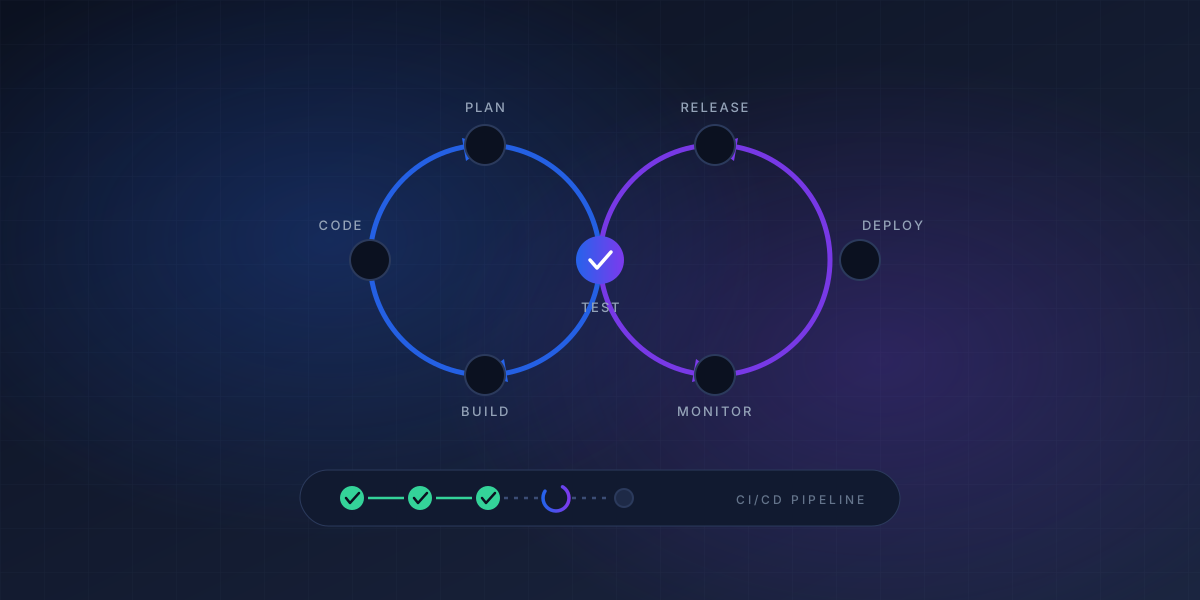
Data pipelines get the same treatment as application code: every change is versioned, tested, gated on data quality, promoted through matching environments, and observed in production.
- Automated testing: Validate data quality, schema changes, and transformation logic before deployment
- Environment parity: Promote changes through dev, staging, and production with confidence
- Faster iterations: Deploy data pipeline changes multiple times per day instead of weekly or monthly
At Performalytic, we help organizations implement CI/CD pipeline automation for their data infrastructure, enabling faster, more reliable releases. For the database side of this — migrations, schema comparison gates, and drift detection — see our guide to building a database CI/CD pipeline. And for the process around those changes — requests, approvals, risk tiers, and audits — see our guide to database change management.
3. Infrastructure as Code (IaC)
Manual infrastructure setup is error-prone and hard to reproduce. Infrastructure as Code tools like Terraform, Pulumi, and AWS CloudFormation allow data teams to define their infrastructure in declarative configuration files:
- Define data warehouses, storage buckets, compute clusters, and networking in code
- Spin up identical environments for development, testing, and production
- Track infrastructure changes in version control alongside pipeline code
- Automate scaling and disaster recovery
4. Automated Data Quality Testing
Data quality testing should be automated and integrated into the pipeline, not performed as a manual afterthought. Implement testing at multiple levels:
- Schema tests: Validate that columns exist, have correct data types, and meet nullability requirements
- Freshness tests: Ensure data arrives within expected time windows
- Distribution tests: Monitor for unexpected changes in data distributions
- Referential integrity: Validate relationships between tables
- Custom business rules: Enforce domain-specific data quality requirements
5. Monitoring & Observability
Data pipelines can fail silently. Without proper monitoring, data quality issues can propagate through downstream systems before anyone notices. Implement comprehensive observability:
- Track pipeline run status, duration, and failure rates
- Monitor data volume and schema evolution over time
- Set up alerts for data quality violations and pipeline failures
- Create dashboards showing end-to-end pipeline health
6. Containerization & Environment Consistency
Docker containers ensure that data pipelines run consistently across development, testing, and production environments. Containerization eliminates the "it works on my machine" problem and makes deployments more predictable. For larger workloads, Kubernetes provides orchestration for containerized data applications.
"The goal of DataOps is not just automation - it's delivering value from data faster, with higher quality, and lower risk."
7. Collaboration & Documentation
DevOps is as much about culture as it is about technology. Data teams should adopt collaborative practices that break down silos:
- Use data catalogs to document datasets, definitions, and lineage
- Hold regular stand-ups and retrospectives for data team workflows
- Embed data engineers within product teams when possible
- Create runbooks for common operational procedures
Getting Started with Data DevOps
Transforming your data operations doesn't happen overnight. Start with these practical steps:
- Audit your current state: Identify manual processes and pain points in your data workflows
- Pick one pipeline: Apply DevOps practices to a single critical pipeline as a pilot
- Automate incrementally: Start with version control, then add testing, then CI/CD
- Measure success: Track deployment frequency, lead time for changes, and time to recover
Our application development and system integration experts can help you design and implement a modern DevOps practice for your data infrastructure. Whether you're just starting your journey or looking to optimize existing processes, we bring deep expertise across the full technology stack.
See how 4DAlert automates data pipeline CI/CD with schema validation and quality testing built into your deployment workflows.