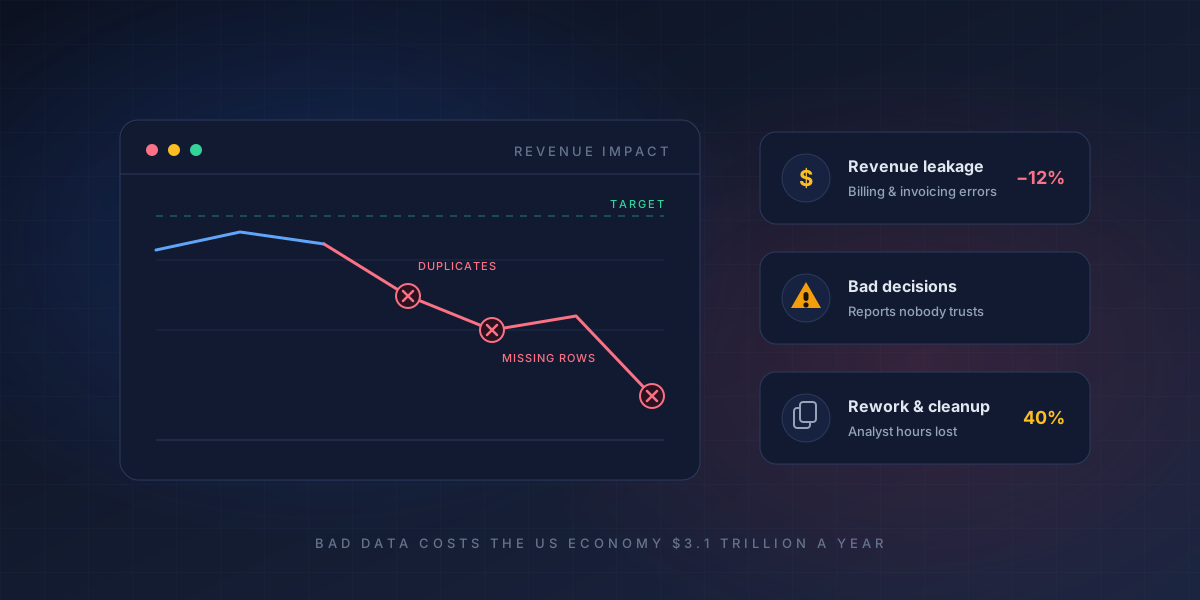
Here's a number that might surprise you: poor data quality costs the US economy an estimated $3.1 trillion per year, according to IBM. That's not a typo. Trillion. And that number has only grown as organizations become more reliant on data for decision-making.
But here's the thing - bad data doesn't usually announce itself with a big, dramatic failure. It creeps in quietly. A customer record gets duplicated. A revenue number gets calculated differently by two teams. A pipeline drops a few records that nobody notices. Each incident seems minor in isolation. But over time, they compound into a problem that undermines trust, wastes resources, and leads to bad decisions.
Let's break down what bad data actually costs your business - and why fixing it is one of the highest-ROI investments you can make.
1. Direct Financial Losses
Bad data directly impacts your revenue and costs in ways that are easy to quantify but often overlooked:
- Incorrect billing and invoicing: Duplicate customer records, wrong pricing data, or missing transactions lead to revenue leakage. Studies show that poor data quality causes 12% of revenue loss on average.
- Wasted marketing spend: If your customer data is inaccurate, you're sending mailers to wrong addresses, targeting people who don't exist, and missing the ones who actually want to hear from you.
- Compliance penalties: In regulated industries, inaccurate data can lead to GDPR, CCPA, or HIPAA violations - and the fines that come with them.
- Duplicate payments: Duplicate vendor records and invoices cost enterprises an estimated 1-2% of annual procurement spend.
2. The Hidden Tax on Your Team
Every hour your team spends fixing data issues is an hour not spent on strategic work. We call this the "data tax" - and it's bigger than most organizations realize:
- Data cleaning: Analysts and engineers spend 50-80% of their time on data preparation instead of analysis. That's not a data problem - it's a productivity crisis.
- Reconciliation work: When teams don't trust the numbers, they build their own shadow spreadsheets. Suddenly, "the truth" lives in five different places.
- Manual workarounds: Bad data forces people to build manual processes, validation steps, and checks that a good data pipeline would handle automatically.
We recently worked with a financial services firm where analysts were spending 15 hours per week reconciling data between systems. After implementing proper data integration and quality frameworks, that dropped to under 2 hours. That's 13 hours per analyst per week returned to high-value work.
3. Bad Decisions Based on Bad Data
This is the most dangerous cost of all, because it's invisible until it's too late. When leaders make decisions based on inaccurate, incomplete, or inconsistent data, the outcomes are predictable:
- Inventory mismanagement: Wrong demand forecasts lead to overstocking (tying up cash) or understocking (losing sales).
- Poor customer targeting: Inaccurate customer segmentation means you're investing in the wrong audiences.
- Misallocated resources: If your performance data is wrong, you're investing in the wrong teams, projects, and markets.
- Delayed response to market changes: If your data is stale, you're reacting to last month's reality instead of this week's.
A retail client once told us they'd been optimizing their product mix based on data that was three weeks out of date. By the time they realized it, they'd lost an entire quarter of market share to a competitor who was making decisions based on real-time data.
4. Eroded Trust in Analytics
Here's the subtlest - and most damaging - cost of bad data: when people get burned by wrong numbers once or twice, they stop trusting data altogether. They go back to gut instinct, ignore dashboards, and make decisions the old-fashioned way.
This is a cultural catastrophe. You've invested in tools, platforms, and talent to become data-driven, but if the underlying data quality isn't there, your investment is wasted. The antidote? Data quality frameworks, automated monitoring, and transparent data governance that gives people confidence in the numbers they're seeing.
5. The AI and Machine Learning Problem
As organizations invest more in AI and machine learning, data quality becomes even more critical. Machine learning models are only as good as the data they're trained on. Bad data doesn't just produce bad insights - it produces confidently wrong predictions.
- Models trained on biased or incomplete data produce biased or incomplete outputs
- Fresh, accurate training data degrades model performance over time if not maintained
- Data quality issues in production data can cause AI systems to fail silently
If you're investing in AI and machine learning, data quality isn't optional - it's foundational.
"You can't build a data-driven organization on bad data. Quality isn't a nice-to-have - it's the foundation everything else rests on."
A Framework for Measuring the Cost
Want to quantify what bad data is costing your organization? Here are the key metrics to track:
Five metrics that turn "bad data is expensive" into a number you can track, report and improve quarter over quarter.
- Data quality score: Measure completeness, accuracy, consistency, and timeliness of your key datasets
- Time-to-insight: How long does it take from data collection to actionable insight? If it's days or weeks, you have a data speed problem.
- Manual intervention rate: What percentage of your data processes require human intervention? Every manual step is a potential failure point.
- Decision cycle time: How quickly can your organization make data-informed decisions? Slow cycles often trace back to data quality issues.
- Data-related incidents: Track how often data issues cause business disruptions, rework, or customer complaints.
Practical Steps to Improve Data Quality
Fixing data quality doesn't require a massive, multi-year program. Here's a practical approach:
- Assess your current state - Run a data quality audit on your most critical datasets. You might be surprised by what you find.
- Prioritize by business impact - Which data quality issues have the biggest impact on revenue, cost, or risk? Fix those first.
- Implement automated monitoring - Don't wait for business users to report issues. Catch them proactively with data quality tests and alerts.
- Establish clear ownership - Every dataset needs an owner responsible for its quality. Without ownership, quality improvements don't stick.
- Build quality into the pipeline - Shift-left data quality by validating data at the point of ingestion, not after it's already downstream.
The ROI of Getting Data Right
Organizations that invest in data quality consistently see:
- 20-30% improvement in analyst productivity (less time cleaning, more time analyzing)
- 15-25% reduction in revenue leakage from billing and invoicing errors
- Faster decision cycles - from weeks to hours when data is reliable
- Higher adoption of analytics tools when people trust the data
- Lower compliance risk with auditable, high-quality data trails
At Performalytic, we help enterprises build data quality into the foundation of their analytics infrastructure. From data integration to AI-ready data pipelines, we ensure the data your organization relies on is accurate, complete, and timely. Schedule a free consultation to learn how we can help you turn bad data into a competitive advantage.
See how 4DAlert monitors data quality in real time and catches bad data before it reaches your reports and decisions.