TL;DR - Key Takeaways
- AI agents differ from copilots by autonomously perceiving, reasoning, acting, and retaining memory across multi-step tasks
- Enterprise adoption is accelerating in data engineering, customer support, code generation, and analytics workflows
- Architecture matters: single agents, orchestrated multi-agent systems, and human-in-the-loop patterns each serve different needs
- Safety and governance are non-negotiable - hallucination, cost control, and auditability must be designed in from day one
- Build vs buy depends on use case specificity, strategic importance, and available internal AI expertise
The enterprise AI landscape is undergoing a fundamental shift. For the past two years, organizations have deployed copilots - helpful AI assistants embedded in IDEs, CRMs, and productivity tools. These copilots respond to prompts, suggest completions, and augment human workflows. They're useful, but they're fundamentally reactive.
Now a new paradigm is emerging: AI agents. Unlike copilots that wait for instructions, agents perceive their environment, reason through complex multi-step tasks, take autonomous actions across systems, and learn from outcomes. They don't just assist - they execute entire workflows end-to-end.
This guide is a comprehensive exploration of AI agents in the enterprise. We'll define what agents actually are (and aren't), break down how they work architecturally, examine real-world use cases, and provide practical guidance on implementation, governance, and the build-vs-buy decision.
What Are AI Agents (vs Copilots, vs Traditional AI)
The term "AI agent" is used loosely across the industry. Let's establish precise definitions.
Traditional AI / ML Models
Traditional AI systems are narrow and task-specific. A fraud detection model scores transactions. A recommendation engine suggests products. These systems operate within fixed input-output boundaries - they receive data, process it, and return a result. They don't maintain state across interactions, they don't take actions in external systems, and they don't adapt their behavior based on context.
AI Copilots
Copilots represent the next evolution. They're powered by large language models (LLMs) and integrated into existing tools. GitHub Copilot suggests code. Microsoft 365 Copilot drafts emails and summarizes meetings. Salesforce Einstein copilot answers questions about CRM data. Copilots are interactive, context-aware, and conversational - but they're still reactive. They respond to user prompts within a single session and don't autonomously take actions across systems without explicit approval.
AI Agents
AI agents are fundamentally different. An agent is an autonomous entity that:
- Perceives its environment through APIs, databases, files, sensors, or user inputs
- Reasons about goals, constraints, and available tools using an LLM as its reasoning engine
- Acts on the environment by calling APIs, writing files, sending messages, or triggering workflows
- Remembers context across interactions through persistent memory systems
- Iterates autonomously toward a goal, adapting its approach based on intermediate results
| Capability | Traditional AI | AI Copilot | AI Agent |
|---|---|---|---|
| Autonomy | None - executes fixed logic | Responds to user prompts | Pursues goals independently |
| Multi-step Execution | No | Limited (single response) | Yes - chains actions across systems |
| Tool Use | Fixed integrations | Context-specific suggestions | Dynamic tool selection and invocation |
| Memory | None | Session-scoped | Persistent across interactions |
| Error Recovery | Fails or returns error | Asks user for clarification | Self-corrects and retries |
| Goal Orientation | Task completion only | Assists with user's task | Owns end-to-end objective |
How AI Agents Work: The Core Loop
Every AI agent, regardless of its specific implementation, follows a core loop that repeats until the goal is achieved or a stopping condition is met.
Every AI agent runs the same core loop — perceive the environment, reason to a plan, act through tools, and write the result back to memory — repeating until the goal is met or a stop condition fires.
1. Perception
The agent gathers information about its environment. This can include reading from databases, querying APIs, parsing documents, monitoring system logs, or receiving instructions from users. Perception is the input layer - it gives the agent the context it needs to reason effectively. Enterprise agents typically connect to multiple data sources simultaneously: a CRM system, a data warehouse, a ticketing platform, and communication channels.
2. Reasoning
The agent uses an LLM (such as GPT-4, Claude, or Gemini) as its reasoning engine. It analyzes the perceived information, decomposes the goal into sub-tasks, identifies the right tools for each sub-task, and formulates a plan. Modern reasoning approaches include chain-of-thought prompting, ReAct (Reasoning + Acting) patterns, and tree-of-thought exploration. The quality of the reasoning step directly determines the agent's effectiveness.
3. Action
The agent executes its plan by interacting with external systems. This might mean calling a REST API to update a database record, writing SQL to query analytics data, sending a Slack notification, generating and running code, or triggering a CI/CD pipeline. Each action produces observable results that feed back into the perception step.
4. Memory
Memory distinguishes agents from simple prompt-response chains. Short-term memory tracks the current task context - what's been tried, what worked, what failed. Long-term memory persists knowledge across sessions: user preferences, past decisions, organizational policies, and learned patterns. Enterprise agents use vector databases, key-value stores, or structured databases for memory persistence.
The loop continues: the agent perceives the results of its actions, reasons about what happened, takes the next action, and so on. This iterative, goal-directed behavior is what makes agents fundamentally more powerful than copilots.
Types of AI Agents in the Enterprise
Not all agents are the same. Enterprise deployments typically involve one or more of these agent archetypes:
Conversational Agents
These agents interact with users through natural language interfaces but go beyond simple Q&A. They can retrieve data from multiple sources, perform analysis, and execute actions on behalf of the user. Think of a data analyst who asks: "What were our top 10 customers by revenue last quarter?" and the agent not only retrieves the data but generates a formatted report, emails it to stakeholders, and schedules a follow-up review.
Task-Oriented Agents
Focused on completing specific, well-defined tasks. A data engineering agent might monitor pipeline health, detect anomalies, identify root causes, and either fix issues automatically or create detailed incident reports. A code review agent might analyze pull requests, check against coding standards, run tests, and post review comments. These agents excel at structured workflows with clear success criteria.
Autonomous Agents
The most powerful and the most risky. Autonomous agents operate with minimal human oversight, pursuing broad goals across extended timeframes. An autonomous research agent might continuously monitor market trends, competitor activities, and regulatory changes - synthesizing findings into weekly briefings without any human prompting. These agents require robust guardrails and monitoring.
Multi-Agent Systems
Complex enterprise workflows often require multiple specialized agents collaborating. A data platform might deploy a ingestion agent, a transformation agent, a quality-check agent, and a deployment agent - each with distinct capabilities and responsibilities. An orchestrator agent coordinates the workflow, handles inter-agent communication, and manages error recovery across the system.
Enterprise Use Cases
AI agents are moving from experimental to production across several high-value enterprise domains:
Data Engineering Agents
Perhaps the most natural fit. Data engineering agents can monitor data pipelines, detect quality issues, automatically apply transformations, reconcile discrepancies between source and target systems, and generate documentation. They reduce the toil of maintaining complex data infrastructure and accelerate the development of new data products. In practice, a data engineering agent might detect that a critical pipeline has been failing silently for three hours, trace the root cause to a schema change in the source system, generate a fix, test it against a staging environment, and deploy it - all without human intervention.
Customer Support Agents
Beyond chatbots that surface FAQ articles, enterprise support agents can query the product database to check inventory status, access the billing system to process refunds, update the CRM with case details, and escalate complex issues to human agents with full context. They resolve 60-80% of tier-one inquiries end-to-end, freeing human agents to focus on complex, high-empathy interactions.
Code Generation and Engineering Agents
Engineering agents have evolved dramatically from simple code completion. They can understand an entire codebase, plan architectural changes, write code across multiple files, create tests, update documentation, and submit pull requests. Agents like Devin, GitHub Copilot Workspace, and custom enterprise solutions are demonstrating that software engineering tasks can be decomposed and executed autonomously with appropriate human review gates.
Analysis and Reporting Agents
Analysis agents connect to data warehouses, execute complex queries, apply statistical methods, generate visualizations, and produce narrative reports. They can answer ad-hoc business questions in natural language, proactively surface anomalies and trends, and maintain personalized dashboards that adapt to each stakeholder's priorities. This transforms analytics from a pull-based model (where humans request reports) to a push-based model (where insights find their audience).
Compliance and Governance Agents
In regulated industries, agents can continuously monitor data access patterns, detect policy violations, generate audit reports, and even recommend remediation steps. They can process regulatory changes, assess their impact on existing policies, and draft updated compliance procedures - accelerating the organization's ability to respond to evolving regulatory requirements.
Architecture Patterns
Deploying AI agents in production requires careful architectural decisions. Three patterns dominate enterprise implementations:
Single Agent Architecture
The simplest pattern. A single agent with access to multiple tools handles the entire workflow. This works well for focused use cases with clear boundaries - a customer support agent, a code review agent, or a report generation agent. The agent uses an LLM as its reasoning core, has access to a defined set of tools (APIs, databases, file systems), and maintains short-term and optionally long-term memory.
Advantages: Simple to build, debug, and monitor. Lower latency. Easier to ensure consistent behavior.
Limitations: Struggles with complex workflows that require different specializations. The context window of the LLM limits how much state the agent can maintain. Scaling to handle multiple concurrent tasks is difficult.
Agent Orchestration / Multi-Agent Architecture
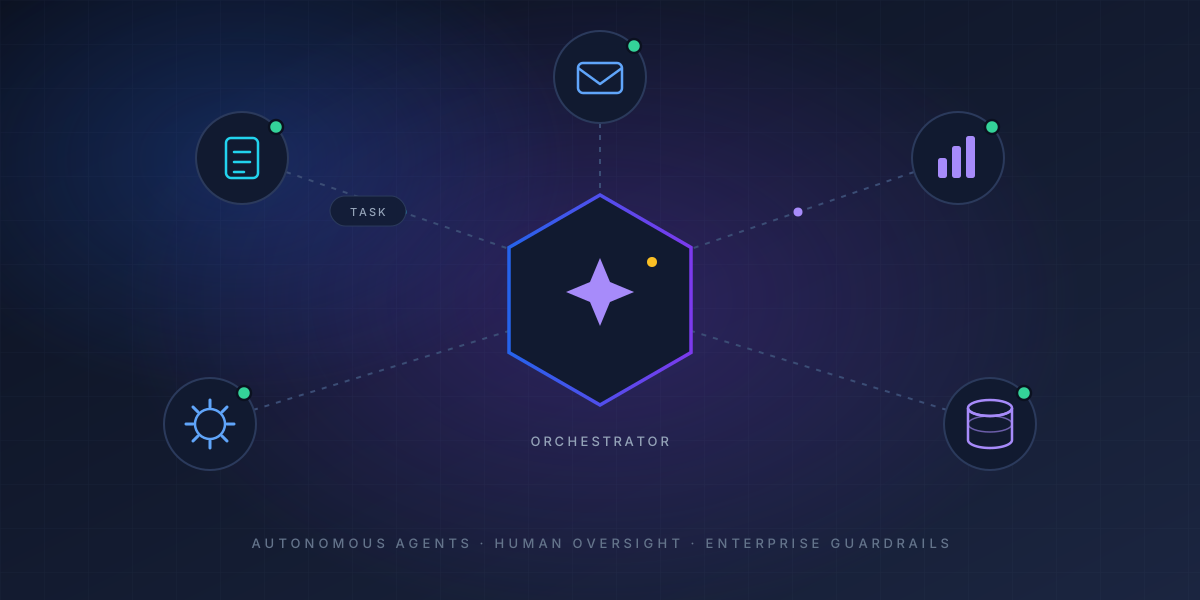
Multiple specialized agents are coordinated by an orchestrator. Each agent has a defined role, a specific set of tools, and clear inputs and outputs. The orchestrator manages the workflow - routing tasks, handling inter-agent communication, managing dependencies, and resolving conflicts.
This pattern mirrors how effective human teams work: a project manager coordinates specialists, each contributing their expertise to a shared outcome. In data engineering, you might have an ingestion agent, a transformation agent, a quality assurance agent, and a deployment agent orchestrated by a pipeline manager agent.
Advantages: Better separation of concerns. Each agent can be optimized for its specific role. Easier to scale individual components. More resilient - a failure in one agent doesn't necessarily crash the entire system.
Limitations: Significantly higher complexity in design, implementation, and debugging. Inter-agent communication introduces latency and potential for miscommunication. Requires robust state management across agents.
Human-in-the-Loop Architecture
The most practically important pattern for enterprise deployment. The agent operates autonomously but checkpoints critical decisions with human reviewers. This might involve asking for approval before executing high-impact actions, presenting proposed changes for review before deployment, or flagging uncertain outcomes for human judgment.
Human-in-the-loop isn't just a safety measure - it's a trust-building mechanism. As organizations gain confidence in agent behavior, the checkpoint frequency can decrease. The key design challenge is identifying where human judgment adds value versus where it creates unnecessary friction.
Architecture Decision Framework
🔧 Choose Single Agent When...
The workflow is focused, the tool set is bounded, and the complexity fits within a single LLM context window. Good for starting your agent journey.
⚙ Choose Multi-Agent When...
The workflow spans multiple domains, requires different specializations, or needs to scale independently. Expect higher implementation cost but greater long-term flexibility.
Implementation Considerations
Deploying AI agents in enterprise environments requires addressing challenges that don't exist in prototype demos:
Safety and Guardrails
Agents that can take autonomous actions pose real risks. A data engineering agent with write access to production databases can cause significant damage if it reasons incorrectly. Enterprises must implement: tool-level access controls (principle of least privilege), action confirmation workflows for high-impact operations, sandboxed environments for testing, output validation before execution, and circuit breakers that halt agent execution when anomalies are detected.
Cost Management
LLM inference is expensive, and agents consume tokens at a much higher rate than simple copilot interactions. A single agent task might involve 10-50 LLM calls as it reasons through multiple steps, each potentially consuming thousands of tokens. Enterprises need cost monitoring dashboards, token budget limits per task, model selection strategies (use smaller, cheaper models for routine reasoning and reserve expensive models for complex decisions), and caching strategies to avoid redundant inference.
Reliability and Testing
Agents are non-deterministic by nature - the same input can produce different reasoning paths and outcomes. This makes traditional testing approaches insufficient. Effective agent testing requires scenario-based evaluation (testing against a suite of realistic scenarios), regression testing (ensuring changes don't break existing behaviors), adversarial testing (probing for failure modes and edge cases), and continuous monitoring of real-world performance metrics.
Governance and Auditability
Enterprise agents must be auditable. Every decision, action, and reasoning step should be logged. Organizations need agent activity logs that capture what the agent did, why it did it (reasoning traces), what data it accessed, what actions it took, and what the outcomes were. This audit trail is essential for compliance, debugging, and building organizational trust in agent behavior.
Latency and Performance
Multi-step agent reasoning takes time. While a copilot response arrives in seconds, an agent task might take minutes or longer as it iterates through multiple reasoning-action cycles. Enterprise deployments must design for this reality - using asynchronous execution, progress notifications, and appropriate timeout policies. Users need visibility into agent progress, not just final results.
Building vs Buying AI Agents
This is one of the most consequential decisions enterprises face when adopting agent technology.
When to Build
- Proprietary workflows: When the agent needs deep integration with your specific systems, data, and business logic that no vendor can replicate
- Competitive advantage: When the agent's capabilities directly differentiate your product or service
- Sensitive data: When data privacy requirements prevent sending information to external AI services
- Custom reasoning: When your domain requires specialized reasoning patterns that general-purpose agents can't handle
- Team expertise: When you have strong ML engineering and AI capabilities in-house
When to Buy
- Standard workflows: When the use case is well-understood and vendor solutions are mature (customer support, code review, data entry)
- Speed to market: When the business value of deploying quickly outweighs the cost of vendor lock-in
- Limited AI expertise: When building and maintaining agent infrastructure would stretch your team beyond its capabilities
- Horizontal use cases: When the agent serves a general business function rather than a domain-specific workflow
- Rapid iteration: When you need to experiment with different agent approaches before committing to a specific architecture
The Hybrid Approach
Most successful enterprise deployments adopt a hybrid strategy. Buy agent platforms for standard workflows - CRM agents, IT support agents, basic data analysis agents. Build custom agents for domain-specific, strategically important workflows - proprietary data pipelines, industry-specific compliance automation, customer-facing intelligent features. Use a common agent orchestration layer to manage both.
In our experience, the enterprises that succeed with AI agents are the ones that start with a clear business problem, not a desire to use the latest AI technology. Agent technology is a means to an end - the end is measurable business outcomes.
The Future of AI Agents in the Enterprise
Several trends will shape the next phase of enterprise AI agents:
Agent-to-Agent Communication
Today's agents operate largely in isolation. The future is interconnected agents that collaborate across organizational boundaries. Imagine your procurement agent negotiating with a supplier's inventory agent to optimize ordering, or your data quality agent automatically coordinating with your analytics agent to flag and quarantine questionable data before it reaches dashboards.
Specialized Agent Marketplaces
Just as app marketpaces transformed software distribution, agent marketplaces will emerge where enterprises can discover, evaluate, and deploy pre-built agents for common use cases. This will dramatically lower the barrier to entry and accelerate adoption.
Regulatory Frameworks
As agents become more autonomous, regulatory frameworks will evolve to address liability, transparency, and accountability. Enterprises that proactively implement governance and auditability will be better positioned to comply with emerging regulations.
Domain-Specific Foundation Models
General-purpose LLMs will be complemented by domain-specific models trained on industry data. Healthcare agents will reason over medical knowledge. Financial agents will understand regulatory nuance. These specialized models will dramatically improve agent reliability in high-stakes domains.
The Copilot-to-Agent Continuum
The boundary between copilots and agents will blur. Copilots will gradually gain more autonomous capabilities, while agents will incorporate more human-in-the-loop interaction patterns. The distinction will become less about the technology and more about the degree of autonomy granted for specific tasks.
How We Help
At Performalytic, we help enterprises navigate the transition from AI experimentation to production-grade agent deployments. Our approach combines technical architecture expertise with business process understanding:
- Agent Readiness Assessment - Evaluate your current data infrastructure, AI capabilities, and organizational readiness for agent deployment
- Use Case Identification - Identify the highest-value agent opportunities based on business impact and technical feasibility
- Architecture Design - Design agent systems that integrate with your existing stack, follow governance best practices, and scale with your needs
- Build and Deploy - Implement agents with robust safety guardrails, cost monitoring, and observability from day one
- Optimize and Evolve - Continuously improve agent performance based on real-world outcomes and expanding capabilities
Whether you're exploring your first agent use case or scaling an existing deployment, we'll help you get it right. Schedule a free consultation and we'll discuss how AI agents can transform your enterprise workflows.
See how 4DAlert uses AI agents for automated data reconciliation, delivering exception-driven workflows across enterprise data systems.