TL;DR — Key Takeaways
- Agentic AI is defined by the loop - plan, act, observe, replan - not by the model answering one prompt well
- Six use cases work today: draft migrations, impact analysis, test generation, risk classification, failure triage, and drift explanation
- The failure modes are hallucinated structure, over-confident reasoning, and scope creep - all caught by verification, none caught by reading
- Guardrails are structural: read-only access, deterministic gates, declared scope, and named human approval for anything irreversible
- Measure acceptance rate and review time alongside change failure rate - speed without correctness is a regression
A developer opens a ticket: add a billing country field, populate it from the existing address data, and index it.
An agentic workflow takes that as a goal. It reads the current schema and confirms the table and column names. It checks lineage and finds three reports that select from the table. It drafts an expand migration, a batched backfill with a checkpoint, and a matching rollback. It builds a disposable database, applies all three, compares the result against the intended state, and runs the test suite. It returns a package: diff, risk tier, lock estimate, rollback, and the list of reports affected.
A person reads it and approves. The pipeline runs it.
That is agentic AI in database DevOps. Not a chatbot. A worker with tools.
1. What Is Agentic AI in Database DevOps?
Agentic AI refers to a model that pursues a stated goal through a loop of planning, acting on tools, observing the results, and replanning - rather than producing a single response to a single prompt. The distinction matters because database work is inherently multi-step and observational: you cannot plan a migration without first reading the schema, and you cannot verify it without comparing before and after.
An agentic database workflow therefore has four properties that a plain copilot does not:
- It chooses its own tool sequence. Given a goal, it decides to read the schema, then query lineage, then draft SQL, then execute against a sandbox - rather than being handed each step.
- It observes real state. Outputs are grounded in live reads of the actual database, the actual diff, and the actual test results, not in what the model believes the schema looks like.
- It iterates on failure. A test fails or a comparison shows a mismatch, and the agent revises rather than reporting the error back to a human.
- It stops at a declared boundary. The loop ends at approval, not at execution. What the agent produces is a package for review.
Agent, copilot, and automation are different things
An automation runs a fixed script and does exactly what was written. A copilot completes the next thing you were about to do. An agent decides what to do next based on what it observes. Database DevOps needs all three, in that order of increasing autonomy - and the guardrails scale with the autonomy.
2. How an Agentic Database Workflow Is Structured
The working architecture has six components. Every serious implementation looks roughly like this, whether it is assembled from a framework or bought as a product.
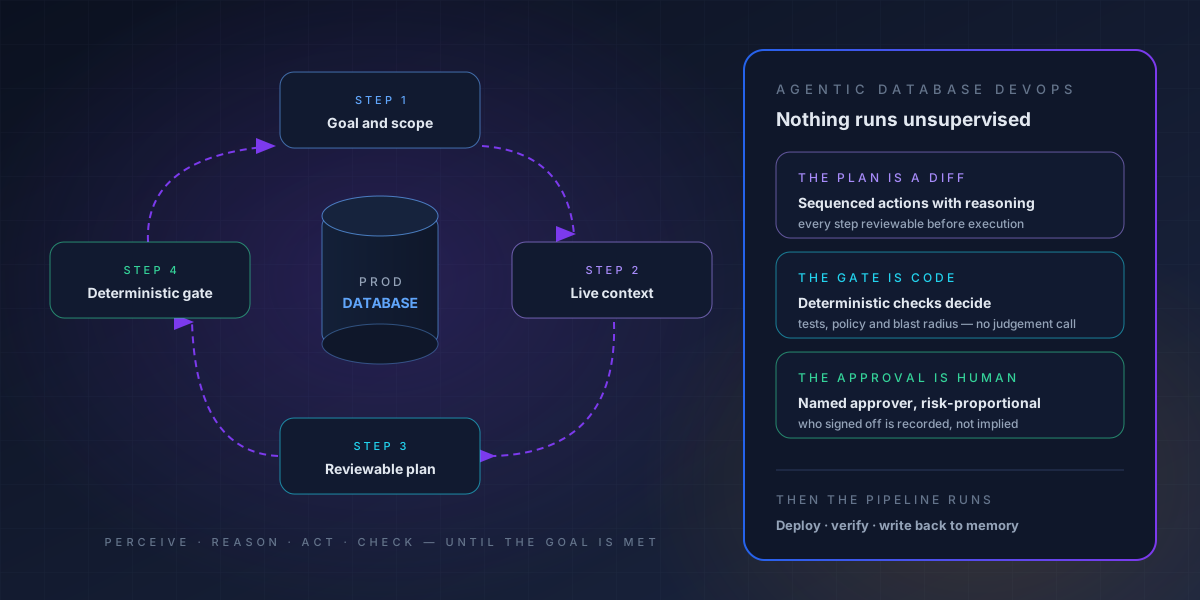
The six components of an agentic database workflow: scope and live context feed a reviewable plan, a deterministic gate decides, and a named human approves before anything executes.
- The goal and scope. A stated objective plus a declared boundary: which database, which objects, which change class. Scope is given to the agent, not inferred by it.
- The context layer. Live reads of schema, lineage, recent migration history, data volume, and query logs. This is what keeps the agent from inventing structure.
- The tool set. Schema inspection, diff, migration authoring, disposable database provisioning, test execution, comparison. Deliberately small.
- The plan. A structured, reviewable sequence of intended actions, produced before anything runs, with the reasoning attached to each step.
- The verification gate. Deterministic checks: the diff matches intent, tests pass, lock duration is within budget, rollback exists. This decides, not the model.
- The approval and execution step. A named human approves; the pipeline executes; the result is verified against the approved state and recorded.
Two design choices do most of the work in practice. First, the agent reads state itself rather than being given a transcript of it - grounding every claim in a fresh query removes most hallucination. Second, verification is code, not judgement - a schema comparison either matches or it does not, and that check does not care how confident the model was.
The agent proposes with reasoning attached. The pipeline verifies with deterministic checks. The person approves what is irreversible. Nobody is allowed to skip their step.
3. Six Concrete Use Cases That Work Today
These are not speculative. Each is running in production environments now, and each has a clear boundary where a human takes over.
Migration and rollback drafting
State the intent in plain language; receive a forward migration, a batched backfill, and a reverse migration in the team's conventions. The value is not the SQL - it is that the reverse gets written, because the agent produces it as part of a complete package rather than as an afterthought.
Impact analysis
Given a diff, the agent walks lineage and the query log to list every view, pipeline, model, and report that references the affected objects. This is the task humans skip when they are busy, and skipping it is how breaking changes reach production.
Test generation
From the schema and its constraints, the agent proposes test cases: referential integrity, allowed ranges, required fields, expected row counts after a backfill. Coverage improves because generating tests stops being a chore.
Risk classification
Each proposed change is assigned a tier with a rationale - this takes an exclusive lock, this narrows a type, this touches a regulated table. The classification is a recommendation that a reviewer confirms, and it makes routing to the right approval path automatic.
Failure triage at 2 a.m.
When a migration fails, the agent correlates the error with schema history and current object state and produces a short diagnosis. War rooms become five-minute reads. This is arguably the highest-value use case today, because it has no destructive failure mode.
Drift explanation
A drift alert arrives as a raw diff. The agent explains what changed, which consumers are affected, and what the likely cause is - turning an alert into a decision.
4. Where Agents Fail: Failure Modes to Design Against
Three failure modes account for most of the risk, and each has a specific countermeasure.
| Failure mode | What it looks like | Countermeasure |
|---|---|---|
| Hallucinated structure | References a column that does not exist, assumes a default the engine does not use, invents a key name | Force live schema reads before any claim; reject output that cannot be traced to a query |
| Over-confident reasoning | A plausible migration that is subtly wrong - wrong null handling, wrong batch key, an unsafe lock | Verify with schema comparison and tests at production volume; never review by reading alone |
| Scope creep | Performs reasonable changes nobody asked for, because the goal was described loosely | Declare an explicit object scope; fail any diff outside it before human review |
| Stale context | Plans against a schema snapshot taken an hour ago, after someone else changed it | Re-read state immediately before execution and re-verify after |
| Unbounded tool use | Retries a destructive command repeatedly after partial failure | Read-only credentials, capped retries, and destructive operations gated behind a human |
The important observation is that none of these are caught by reading the output. A hallucinated column and a real one look identical in prose. This is precisely why the verification step must be a deterministic comparison rather than a careful human eye - the eye is the least reliable component in the loop.
Verdict
If your review process for agent output is "someone reads it carefully", you do not have a review process. If it is "the diff must match the intent and the tests must pass", you do.
5. The Guardrails That Make It Safe
Guardrails work when they are structural rather than advisory. Five are non-negotiable.
- Read-only credentials for the agent. The agent inspects and proposes. It never holds a write path to a live database. Execution belongs to the pipeline, which holds the credential, after approval.
- Deterministic gates that cannot be argued with. The schema comparison must match the intent, tests must pass, lock duration must be within budget, and a rollback must exist. The model does not get to grade its own homework.
- Declared scope with automatic rejection. Any difference outside the approved object scope fails before it reaches a reviewer, which neutralises scope creep without relying on the reviewer to notice.
- Human approval for irreversible operations. Dropping data, narrowing a type, changing a primary key - these require a named person, and the approval is recorded with the change.
- Complete audit. Prompt or goal, plan, diff, verification results, approver, execution time, and post-deploy state are retained together. Without this you cannot answer what an agent did last quarter, and you will be asked.
One addition teams often miss: rate limits and blast-radius caps. An agent should not be able to propose changes across more than a declared number of objects or more than one environment in a single run. Limits cost nothing when the agent is behaving and are the only thing that constrains it when it is not.
6. Human-in-the-Loop: What People Still Decide
Being precise about the boundary is what makes an agentic workflow acceptable to an engineering organisation.
The agent decides: what to read, in what order, how to express the change, which tests to write, how to segment a backfill, and how to explain a result.
The gate decides: whether the diff matches the intent, whether tests pass, whether locks are within budget, whether the rollback exists, and whether scope was respected. These are deterministic and automatic.
The person decides: whether this change should happen at all, whether an irreversible operation is acceptable, whether the risk tier is right, and whether the change ships in this window. None of these can be delegated to a model, because all four are accountability rather than computation.
The practical test for a boundary is simple. If a decision can be wrong in a way that destroys data or violates a regulation, a person signs it. If a decision can be checked by comparing two structures, code signs it. Almost everything a model does belongs in the first category only as advice - which means the model proposes, and the signature stays human.
7. Evaluating Candidates and Measuring Results
If you are buying or building an agentic workflow, evaluate it on evidence rather than demonstrations.
- Does it read live state? Ask to see the queries it issues. An agent that answers from context alone will eventually invent a column.
- Is verification built in or bolted on? If schema comparison and test execution are part of the loop rather than a manual step afterwards, the design is sound.
- Can it show scope violations? Demonstrate it by declaring a narrow scope and asking for a broad change. A good implementation refuses.
- Is every action attributable? Plan, diff, verification, approver, and execution should be reconstructable from the record.
- What happens on failure? Watch it handle a failing test. Correct behaviour is revising and re-verifying, not reporting success anyway.
Then measure it, with paired metrics so speed never hides quality:
| Leading indicator | Lagging indicator | What the pair tells you |
|---|---|---|
| Acceptance rate without edits | Change failure rate | Whether accepted output is actually good |
| Median review time | Mean time to restore | Whether reviews got faster by getting shallower |
| Rejections per week, with reason | Hotfixes outside the pipeline | Whether the agent is teaching good habits or workarounds |
| Impact analysis coverage | Drift events per month | Whether blast radius is being caught before deploy |
Watch the lagging column closely for the first quarter. If review time falls while change failure rate rises, reviewers are skimming agent output - the exact regression that makes an agent more dangerous than a slower human process.
8. Rollout: From Copilot to Controlled Autonomy
Do not start with autonomy. Start with explanation, and earn it.
- Month one - read-only assistance. The agent explains diffs, summarises drift, triages failures, and drafts impact analysis. Nothing it produces is applied. You learn how often it is wrong without any exposure.
- Month two - drafting with mandatory verification. The agent produces migrations and rollbacks. Every one is verified by comparison and tests and approved by a person before it runs. You start tracking acceptance rate and review time.
- Month three - auto-approval for verified Tier 1 changes. Additive changes that pass the gate and stay inside a declared scope ship without a human in the loop, with the full record retained. Higher tiers keep the approval step.
- Ongoing - widen carefully. Expand scope only as the lagging metrics hold. Every widening is a decision with evidence behind it.
The reason for the sequence is not caution for its own sake. It is that you cannot tune approval thresholds until you know the agent's error rate on your own schema, and you cannot know that until it has been producing output for a while with a person checking it.
9. How 4DAlert and Ask4D Fit the Loop
4DAlert's position in this architecture is the deterministic layer - the part that verifies and records rather than reasons.
- Baseline and comparison. Before the agent's change runs, the intended schema is compared against the live baseline. After it runs, production is compared against the approved state. A mismatch fails, regardless of how confident the model was.
- Drift detection. A change applied outside the pipeline produces the same comparison result and the same alert, with timestamp and owner.
- Dependency mapping. Each difference is linked to the downstream models and reports it affects, which is the input the agent uses for impact analysis - grounded in real lineage rather than inference.
- The audit record. Goal, plan, diff, verification, approver, execution, and post-deploy state are retained together.
Ask4D, the generative assistant in the platform, is the conversational surface on top: it converts a plain-language request into a structured change plan with objects, migration, risk, and rollback; explains existing differences and drift in plain language; and answers questions about why a change was made six months ago. The division of labour is deliberate - Ask4D proposes and explains, 4DAlert verifies and records, and the pipeline executes only what a person approved.
That separation is the design principle worth taking away whatever you build or buy: keep the reasoning and the enforcement in different components, so that neither can override the other.
Frequently Asked Questions
What is agentic AI in database DevOps?
Agentic AI in database DevOps is the use of an autonomous model to carry out a multi-step database task from a stated goal rather than a single prompt. Given an instruction such as add a column and backfill it, the agent plans the steps, reads the schema and lineage, drafts the migration and its rollback, runs it against a disposable database, checks the result with a schema comparison, and presents the whole package for approval. The defining feature is that the model chooses its own sequence of tool calls instead of returning one answer.
Can AI deploy database changes to production safely?
Only if the deploy stays with the pipeline and approval stays with a person. The safe architecture is an agent with read access to schema, lineage, and test results that proposes a migration with its risk classification and rollback attached; a deterministic gate that verifies the diff and runs the tests; and a named human who approves anything irreversible. Granting an agent write credentials to a production database is not automation, it is a delegation of accountability with no rollback.
What are the main risks of using AI for database changes?
Three stand out. Hallucinated structure: the model describes a table or column that does not exist, or assumes a default that this database does not use. Over-confident reasoning: a plausible migration that is subtly wrong in a way only production data exposes. And scope creep: an agent given a broad goal performs changes nobody asked for. Each is mitigated by grounding the agent in live schema reads, verifying output with schema comparison and tests rather than reading it, and constraining tasks to a declared scope.
Which database DevOps tasks are safe to automate with AI today?
Drafting migrations and rollbacks, generating impact analysis from a diff and lineage, writing test cases, classifying change risk, explaining a failed deployment, summarising schema drift for review, and preparing change advisory board material. These are all tasks where the output is reviewed before it acts. The tasks that should stay human are approving irreversible changes, deciding whether data loss is acceptable, and anything touching regulated data.
How do you measure whether an agentic workflow is working?
Track leading and lagging indicators together. Leading: percentage of agent-proposed changes accepted without edits, median review time, number of agent suggestions rejected and why. Lagging: change failure rate, mean time to restore after a failed migration, number of hotfixes applied outside the pipeline, and drift events per month. If review time falls but change failure rate rises, the agent is producing confident output that humans are waving through - which is worse than no agent at all.
What is Ask4D and how does it relate to 4DAlert?
Ask4D is the generative AI assistant in the 4DAlert platform. It converts a plain-language request into a structured change plan - the objects affected, the proposed migration, the risk assessment, and the rollback - and it explains existing schema differences and drift in plain language. 4DAlert supplies the deterministic layer around it: the baseline, the field-level comparison, the verification after deployment, and the audit record.
Conclusion
Agentic AI in database DevOps is not about handing a model a database. It is about removing the tedious middle of the process - reading schema, walking lineage, drafting the reverse migration, writing the tests, explaining the diff - while keeping the two ends firmly human and deterministic: the decision to make the change, and the verification that it did what was intended.
The teams getting this right share a structure. The agent reads live state and proposes with reasoning. A deterministic gate verifies the diff and the tests and enforces the scope. A named person approves anything irreversible. Everything is recorded.
Start with explanation, measure acceptance rate against change failure rate, and widen autonomy only when the numbers justify it. Done that way, the agent does not replace the process - it makes the process fast enough that people stop working around it.