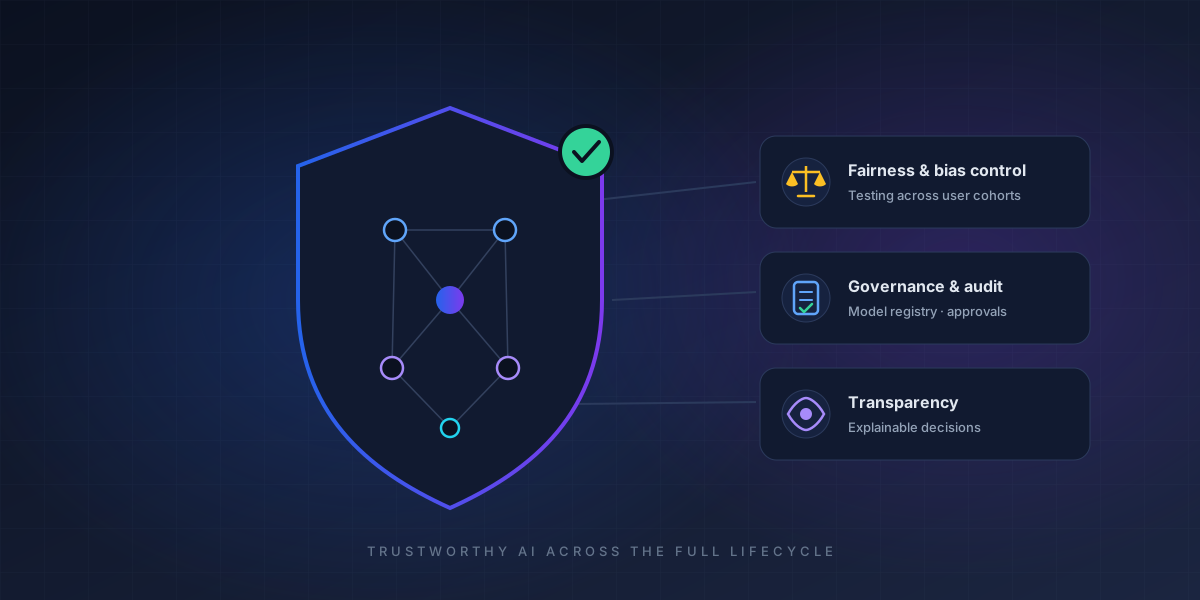
TL;DR - Key Takeaways
- Regulation is here: The EU AI Act is fully enforceable in 2026, with fines up to 35M EUR or 7% of global turnover for non-compliance
- Governance first: Establish an AI review board, clear ownership, and documented policies before deploying production AI systems
- Bias is a process problem: Mitigate bias across the entire lifecycle - data collection, model training, deployment, and monitoring - not just at one stage
- Explainability is non-negotiable: High-risk AI systems require human-interpretable explanations for every consequential decision
- Continuous monitoring: Responsible AI is not a one-time audit - it requires ongoing measurement, drift detection, and iterative improvement
Artificial intelligence is no longer an experimental technology tucked away in research labs. In 2026, AI systems make hiring decisions, approve credit applications, diagnose medical conditions, and allocate public resources. With that power comes an urgent responsibility: ensuring these systems operate fairly, transparently, and within legal boundaries.
A responsible AI framework is the structural answer to that responsibility. It's not a checkbox exercise or a PR exercise - it's the operational backbone that determines whether your AI systems build trust with customers, employees, and regulators, or expose your organization to legal liability, reputational damage, and real-world harm.
This guide provides a comprehensive, practical blueprint for building a responsible AI framework from the ground up. Whether you're a CTO evaluating governance structures, a data scientist implementing bias controls, or a compliance officer navigating the EU AI Act, this is the reference you need.
Why Responsible AI Matters Now
The regulatory landscape for AI has shifted dramatically. What was voluntary guidance in 2024 is now legally enforceable in 2026. Organizations that treat responsible AI as optional are exposing themselves to significant risk.
The EU AI Act: The Global Standard
The European Union's AI Act entered full force on August 1, 2025, with enforcement obligations phased through 2026. It is the world's first comprehensive AI regulation and is already setting the global standard - similar to how GDPR influenced privacy laws worldwide.
Key provisions in effect for 2026:
- Risk classification: All AI systems must be categorized into four risk tiers (unacceptable, high, limited, minimal)
- High-risk requirements: Systems used in employment, education, credit scoring, law enforcement, and critical infrastructure face mandatory compliance obligations
- Transparency obligations: Chatbots, deepfakes, and emotion recognition systems must disclose AI involvement
- GPAI rules: General-purpose AI models must provide technical documentation and comply with copyright law
- Enforcement: National authorities can impose fines up to 35 million euros or 7% of global annual turnover
NIST AI Risk Management Framework
The U.S. National Institute of Standards and Technology (NIST) AI RMF 1.0 provides a voluntary but increasingly influential framework for managing AI risks. It is organized around four core functions:
- Govern: Establish policies, processes, and procedures for AI risk management
- Map: Identify and document AI risks and their potential impacts
- Measure: Assess, analyze, and track AI risks using quantitative and qualitative methods
- Manage: Respond to, monitor, and recover from identified risks
Many U.S. federal procurement requirements now reference NIST AI RMF compliance, making it effectively mandatory for government contractors and increasingly expected by enterprise buyers.
The Business Case Beyond Compliance
Regulation is the floor, not the ceiling. Organizations with mature responsible AI programs see tangible business benefits:
- Customer trust: 78% of consumers say they would stop using a product or service if they discovered it used AI in ways they considered unfair or unethical
- Talent retention: AI engineers and data scientists increasingly choose employers based on ethical AI commitments
- Investor confidence: ESG frameworks now include AI governance as a material risk factor
- Reduced incidents: Proactive bias testing catches issues before they become public scandals
Key Components of a Responsible AI Framework
A comprehensive responsible AI framework is built on five foundational pillars. Each pillar addresses a distinct category of risk and requires specific technical controls, governance processes, and documentation.
A responsible AI framework rests on five pillars — each addresses a different category of risk and needs its own controls, governance and documentation.
1. Fairness
Fairness ensures that AI systems do not produce discriminatory outcomes based on protected characteristics such as race, gender, age, disability, or other legally protected attributes. This requires both statistical testing and contextual judgment - because fairness is not a single mathematical definition but a set of competing principles that must be balanced for each use case.
Key practices include defining fairness metrics appropriate to the context, testing models against protected subgroups, documenting tradeoffs between different fairness criteria, and establishing ongoing monitoring for fairness drift after deployment.
2. Transparency
Transparency means that stakeholders - including affected individuals, regulators, and internal teams - can understand how an AI system works, what data it was trained on, what limitations it has, and why it makes specific predictions or decisions. Transparency is the prerequisite for accountability; you cannot hold a system accountable if you cannot see how it operates.
This encompasses model documentation (model cards, data sheets for datasets), explainable AI techniques that produce human-interpretable decision rationales, clear communication with end users about when they are interacting with AI, and open reporting of system performance and limitations.
3. Accountability
Accountability defines who is responsible for the outcomes of AI systems at every stage - from data collection and model development to deployment and ongoing monitoring. Without clear accountability structures, responsible AI principles remain aspirational rather than operational.
An effective accountability framework assigns named owners for each AI system, establishes escalation paths for identified risks, requires sign-offs before high-risk systems go live, and creates consequences for non-compliance with established policies.
4. Privacy
AI systems often process vast amounts of personal data, creating privacy risks that extend beyond traditional data protection concerns. Model memorization, inference attacks, and re-identification risks require specific technical and procedural safeguards.
Privacy in a responsible AI framework includes data minimization and purpose limitation for training data, differential privacy techniques to prevent model memorization, access controls on training data and model artifacts, compliance with GDPR, CCPA, and sector-specific privacy regulations, and regular privacy impact assessments for AI systems processing personal data.
5. Safety
AI safety ensures that systems operate reliably within their intended parameters and do not cause harm through errors, misuse, or unexpected behavior. This is particularly critical for systems deployed in high-stakes domains such as healthcare, finance, transportation, and critical infrastructure.
Safety controls include adversarial testing and red teaming before deployment, robustness testing against distribution shift and edge cases, human-in-the-loop requirements for high-consequence decisions, fail-safe mechanisms that default to safe behavior, and incident response procedures for AI-related failures.
AI Governance Structure
Principles without structure are suggestions. A responsible AI framework requires formal governance that embeds ethical AI practices into organizational decision-making.
Roles and Responsibilities
Effective AI governance requires clear ownership at multiple levels:
- Chief AI Officer (CAIO): Executive sponsor responsible for overall AI strategy, risk appetite, and cross-functional alignment. Reports to the CEO or board-level risk committee.
- AI Ethics Board: Cross-functional committee (legal, engineering, product, domain experts, and external advisors) that reviews high-risk AI use cases, sets policy, and adjudicates conflicts between fairness principles.
- AI System Owners: Named individuals accountable for each production AI system's compliance with the responsible AI framework throughout its lifecycle.
- Model Validators: Independent technical reviewers who assess models against fairness, accuracy, and robustness standards before deployment approval.
- Data Stewards: Responsible for data quality, representativeness, and compliance with data governance policies in AI training datasets.
Policy Framework
The AI governance policy stack should include:
- AI Acceptable Use Policy: Defines permitted and prohibited AI use cases within the organization
- AI Risk Classification Policy: Establishes the criteria and process for categorizing AI systems by risk level
- AI Development Standards: Technical requirements for data collection, model development, testing, and deployment
- AI Monitoring and Incident Response: Procedures for ongoing monitoring, drift detection, incident reporting, and remediation
- AI Vendor Assessment Policy: Requirements for evaluating third-party AI tools and services against responsible AI standards
Review Board Process
Every AI system should pass through a structured review process before production deployment:
- Stage 1 - Proposal: System owner submits use case description, risk classification, data sources, and intended decision context
- Stage 2 - Impact Assessment: Ethics board evaluates potential harms, affected populations, and regulatory requirements
- Stage 3 - Technical Review: Model validators assess fairness metrics, explainability, robustness, and documentation
- Stage 4 - Approval or Remediation: Board approves deployment, requests modifications, or rejects the use case
- Stage 5 - Post-Deployment Monitoring: Ongoing monitoring plan is activated with defined triggers for re-review
Bias Detection and Mitigation
Bias in AI systems is not a technical glitch - it is a reflection of historical inequities encoded in data and amplified by algorithms. Mitigating bias requires understanding its sources, testing for its presence, and implementing controls at every stage of the AI lifecycle.
Types of AI Bias
Bias can enter an AI system at multiple points:
- Historical bias: Training data reflects past discriminatory practices (e.g., hiring data from a company that historically favored one demographic)
- Representation bias: Certain groups are underrepresented or overrepresented in training data relative to their real-world proportion
- Measurement bias: Features used as proxies for protected attributes create indirect discrimination (e.g., zip code as a proxy for race)
- Aggregation bias: Combining data from different populations without accounting for meaningful differences produces inaccurate models for subgroups
- Evaluation bias: Testing the model on benchmarks that do not represent the deployment population
- Deployment bias: The model is used in a context different from its intended design, producing unexpected outcomes
Testing Methods
Bias testing should be applied at three stages: pre-training (data), during training (model), and post-deployment (monitoring).
Pre-training data testing involves analyzing dataset composition across protected attributes, identifying missing data and label quality issues for specific subgroups, and measuring feature correlations with protected characteristics.
Model testing during development uses fairness metrics to evaluate predictions across demographic subgroups. Key metrics include demographic parity (equal positive prediction rates across groups), equalized odds (equal true positive and false positive rates), predictive parity (equal positive predictive values), and individual fairness (similar individuals receive similar predictions).
Post-deployment monitoring tracks fairness metrics in production data over time to detect drift, compares outcomes across demographic groups for real decisions, and establishes alert thresholds that trigger investigation when disparities exceed acceptable levels.
Remediation Strategies
When bias is detected, organizations can apply interventions at three levels:
- Data-level: Re-sampling underrepresented groups, collecting additional data, engineering features to reduce proxy discrimination, or removing or transforming biased features
- Model-level: Applying fairness-aware training algorithms, adding regularization terms that penalize discriminatory outcomes, using adversarial debiasing, or training separate models for different subgroups with appropriate safeguards
- Decision-level: Implementing human-in-the-loop review for flagged decisions, applying calibration adjustments to model outputs, setting thresholds that balance accuracy and fairness, or restricting model use to lower-risk decision contexts
No single debiasing technique eliminates all forms of bias. In practice, organizations must choose which fairness criteria to prioritize based on the specific use case, affected populations, and regulatory requirements - and document those tradeoffs explicitly.
Explainability and Transparency
Explainability is both a technical capability and a regulatory requirement. High-risk AI systems under the EU AI Act must produce explanations that are meaningful to the individuals affected by AI decisions.
Explainable AI (XAI) Techniques
The field of explainable AI offers multiple approaches, each with strengths and tradeoffs:
- SHAP (SHapley Additive exPlanations): Game-theoretic approach that assigns each feature a contribution value for individual predictions. Provides both local (per-prediction) and global (model-level) explanations.
- LIME (Local Interpretable Model-agnostic Explanations): Creates interpretable local approximations of complex models. Useful for explaining individual predictions but can be unstable across similar inputs.
- Counterfactual explanations: Answers "what would need to change for a different outcome?" Highly intuitive for end users and regulators, but computationally expensive for complex models.
- Attention mechanisms: In neural networks, attention weights show which input elements the model focused on. Widely used in NLP but attention weights alone do not always faithfully represent model reasoning.
- Intrinsic interpretability: Using inherently interpretable models (decision trees, linear models, rule-based systems) when possible. Best for high-stakes decisions where explanation fidelity is critical.
Model Cards and Documentation
Technical documentation makes AI systems legible to both internal teams and external auditors. The model card format, introduced by Google Research, provides a standardized template:
- Model details: Version, type, training date, owner, and contact information
- Intended use: Primary use cases, intended users, and out-of-scope applications
- Training data: Data sources, collection methodology, known limitations, and demographic representation
- Evaluation results: Performance metrics disaggregated across demographic subgroups
- Ethical considerations: Known biases, potential harms, and mitigation measures applied
- Recommendations: Deployment guidance, monitoring requirements, and update schedule
Stakeholder-Specific Transparency
Different audiences need different levels and types of explanation:
- Affected individuals: Plain-language explanations of how a decision was made and what factors contributed to it, plus clear appeal mechanisms
- Regulators: Technical documentation, fairness audit reports, risk assessments, and evidence of compliance with applicable regulations
- Internal teams: Full technical documentation including training data characteristics, model architecture, evaluation methodology, and known limitations
- Executive leadership: High-level summaries of AI system purposes, risk levels, performance metrics, and compliance status
Compliance Requirements
Compliance with AI regulations is not optional, and the regulatory landscape is expanding rapidly. Organizations must understand which regulations apply to their AI systems and implement controls to meet those requirements.
EU AI Act Risk Tiers
| Risk Level | Examples | Requirements |
|---|---|---|
| Unacceptable | Social scoring, real-time biometric surveillance in public spaces, subliminal manipulation | Prohibited - cannot be placed on the EU market |
| High Risk | Employment decisions, credit scoring, law enforcement, critical infrastructure, education access | Full compliance: risk management, data governance, documentation, human oversight, conformity assessment |
| Limited Risk | Chatbots, deepfakes, emotion recognition, content generation | Transparency: must disclose AI involvement to users |
| Minimal Risk | Spam filters, recommendation engines, AI-enabled video games | No specific requirements (voluntary codes of conduct encouraged) |
NIST AI RMF Alignment
The NIST AI RMF is voluntary but increasingly referenced in U.S. federal procurement and by industry standards bodies. Organizations selling AI solutions to government agencies or large enterprises should align with its four core functions:
- Govern: Establish and maintain policies, processes, procedures, and practices across the organization for managing AI risk
- Map: Contextualize AI system risks within the specific deployment environment and identify impacts on individuals and communities
- Measure: Apply quantitative and qualitative methods to analyze, assess, and track AI risks and related impacts
- Manage: Allocate resources to manage identified risks, prioritize response actions, and establish recovery capabilities
Industry-Specific Regulations
Beyond horizontal AI regulations, many industries have sector-specific requirements that apply to AI systems:
- Healthcare: FDA oversight of AI/ML-based medical devices, HIPAA requirements for AI systems processing health data, and clinical validation standards
- Financial services: Fair lending laws (ECOA, FCRA), model risk management guidance (SR 11-7), and SEC requirements for algorithmic trading
- Employment: EEOC guidance on AI in hiring, NYC Local Law 144 requiring bias audits for automated employment decision tools, and Illinois AI Video Interview Act
- Automotive: NHTSA guidelines for autonomous vehicles, ISO 26262 functional safety standards, and UNECE regulations for automated driving
Building Your Responsible AI Program
Implementing a responsible AI framework is a multi-month journey. Here is a practical, phased approach that organizations can adapt to their size and maturity.
Phase 1: Foundation (Months 1-2)
Establish the organizational infrastructure for responsible AI:
- Secure executive sponsorship and budget allocation
- Appoint a Chief AI Officer or senior AI governance lead
- Form a cross-functional AI Ethics Board with decision-making authority
- Draft and ratify an AI Acceptable Use Policy
- Conduct an inventory of all existing AI systems and their risk levels
Phase 2: Assessment (Months 2-4)
Evaluate your current state against the framework requirements:
- Complete risk classification for all inventoried AI systems
- Perform gap analysis against EU AI Act and NIST AI RMF requirements
- Audit existing models for fairness, explainability, and documentation gaps
- Assess data governance practices for training data quality and representativeness
- Map regulatory obligations to specific AI systems and use cases
Phase 3: Implementation (Months 4-8)
Build the technical and procedural controls:
- Develop and deploy fairness testing pipelines integrated into ML workflows
- Implement model card documentation standards for all production models
- Establish explainability tooling (SHAP, LIME, or counterfactual generation)
- Create automated monitoring dashboards for fairness metrics and model drift
- Build the AI system review board process with stage-gate approvals
- Implement data governance controls for training data lineage and quality
Phase 4: Operationalization (Months 8-12)
Embed responsible AI into business-as-usual processes:
- Train all AI practitioners on responsible AI policies and tools
- Integrate responsible AI checkpoints into existing SDLC and MLOps workflows
- Establish incident response procedures for AI-related issues
- Create external-facing AI transparency reports for high-risk systems
- Implement vendor assessment procedures for third-party AI tools
Phase 5: Maturity (Ongoing)
Continuously improve and adapt the program:
- Conduct regular internal audits and external assessments
- Update policies and controls as regulations evolve
- Participate in industry working groups and standards development
- Invest in research on emerging fairness and explainability techniques
- Share lessons learned and best practices across the organization
Measuring Success
A responsible AI framework without measurement is just a document. Effective programs track quantitative metrics and qualitative assessments to demonstrate progress and identify areas for improvement.
Key Performance Indicators
Track these KPIs to measure the health of your responsible AI program:
- Fairness compliance rate: Percentage of production AI systems that pass fairness testing against defined thresholds
- Documentation completeness: Percentage of production models with up-to-date model cards and risk assessments
- Review cycle time: Average time from AI system proposal to production deployment approval
- Incident rate: Number of AI-related fairness, bias, or safety incidents per quarter
- Mean time to remediate: Average time from incident detection to resolution
- Training completion: Percentage of AI practitioners who have completed responsible AI training
- Regulatory readiness score: Compliance coverage against applicable regulations (EU AI Act, NIST, industry-specific)
Audit Cadence
Establish a regular audit rhythm:
- Monthly: Automated fairness metric monitoring and drift alerts
- Quarterly: Ethics board review of all high-risk AI systems, incident review, and policy updates
- Semi-annually: Internal audit of documentation completeness and process adherence
- Annually: Comprehensive program assessment including external audit, policy refresh, and strategic planning
Continuous Monitoring Architecture
Automated monitoring is essential for catching issues before they become incidents:
- Data drift detection: Monitor input feature distributions for shifts that may affect model fairness and accuracy
- Prediction drift detection: Track output distribution changes that may indicate emerging bias
- Fairness metric tracking: Continuously compute and alert on fairness metrics across protected subgroups
- Performance degradation alerts: Detect accuracy drops that may correlate with fairness issues
- Canary deployment testing: Test model updates on small populations before full rollout to catch fairness regressions
The Bottom Line: Responsible AI is a Competitive Advantage
⚠️ Without a Framework
Regulatory fines, public bias incidents, loss of customer trust, talent attrition, and inability to sell AI solutions to regulated industries or government agencies.
✓ With a Framework
Regulatory compliance, demonstrable fairness, faster deployment approvals, stronger customer relationships, competitive differentiation, and access to regulated markets.
How We Help
At Performalytic, we help organizations design, implement, and operationalize responsible AI frameworks that meet regulatory requirements and build stakeholder trust. Our approach is practical, not theoretical - we work with your teams to build controls that fit your technology stack and business context.
Our responsible AI services include:
- AI Risk Assessment: Comprehensive evaluation of your AI systems against EU AI Act, NIST AI RMF, and industry-specific requirements
- Governance Design: Building AI ethics boards, review processes, policy frameworks, and accountability structures
- Bias Testing and Remediation: Implementing fairness testing pipelines, diagnosing bias sources, and applying targeted mitigation strategies
- Explainability Implementation: Deploying XAI tooling, creating model documentation standards, and building stakeholder-specific explanation interfaces
- Monitoring and Compliance: Setting up continuous monitoring architectures, automated compliance reporting, and audit-ready documentation
- Training and Enablement: Equipping your teams with the knowledge and tools to sustain responsible AI practices independently
Whether you're building your first responsible AI program or maturing an existing one, we'll meet you where you are and help you get to where you need to be. Schedule a free consultation and we'll assess your current state and outline a practical roadmap forward.