TL;DR - Key Takeaways
- RAG is the standard for enterprise AI - it grounds LLM responses in your proprietary data without fine-tuning
- Chunking strategy matters most - poor chunking causes 80%+ of retrieval quality problems in production
- Advanced RAG beats naive RAG - hybrid search, re-ranking, and query transformation significantly improve accuracy
- Evaluate with RAGAS - faithfulness, answer relevance, and context precision are the metrics that matter
- RAG vs fine-tuning isn't either/or - most enterprises use RAG for knowledge retrieval and fine-tuning for task-specific behavior
Enterprise teams are racing to build AI systems that can answer questions, summarize documents, and generate insights from their proprietary data. The challenge: large language models don't know anything about your internal knowledge base. Retrieval Augmented Generation solves this by combining the power of LLMs with precise document retrieval, creating AI systems that are both intelligent and grounded in facts.
This guide provides a comprehensive, vendor-agnostic deep dive into enterprise RAG architecture. Whether you're building your first prototype or scaling an existing system, you'll find actionable guidance on every design decision you'll face. For a broader view of how AI agents fit into enterprise architecture, see our guide on AI agents in the enterprise.
What is RAG and Why It Matters for Enterprises
How RAG Works
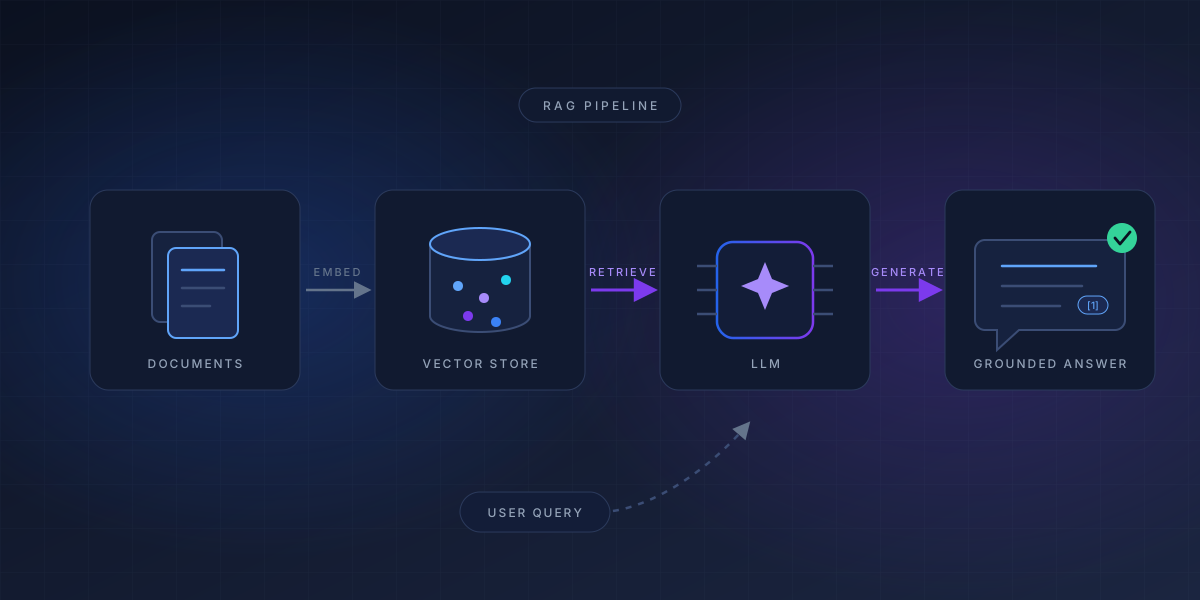
RAG operates on a straightforward principle: before asking an LLM to answer a question, first retrieve the most relevant documents from your knowledge base, then provide those documents as context to the model. This three-step process - index, retrieve, generate - produces answers that are accurate, traceable, and grounded in your actual data.
The process breaks down as follows:
- Indexing: Documents are split into chunks, converted to vector embeddings, and stored in a vector database along with their original text
- Retrieval: When a user asks a question, it's converted to an embedding and used to find the most semantically similar document chunks
- Generation: The retrieved chunks are combined with the user's question and sent to an LLM, which generates a response using the provided context
Why Enterprises Choose RAG Over Alternatives
Enterprises adopt RAG for several compelling reasons. Freshness - unlike fine-tuning, RAG automatically reflects the latest data without retraining. Every time you update your document index, the system immediately has access to new information. Traceability - every answer can be traced back to specific source documents, which is essential for compliance, auditing, and building user trust. Cost efficiency - RAG eliminates the expensive and time-consuming process of fine-tuning models on your entire knowledge base. Flexibility - the same RAG system can work across departments, document types, and use cases with configuration changes rather than retraining.
"RAG is not just a technique - it's the foundational architecture pattern for enterprise AI in 2026. Every organization with proprietary data will need a RAG strategy." - Gartner AI Research
RAG Architecture Components
A production RAG system consists of four interconnected components. Understanding each component's role and options is critical for making the right design decisions.
Vector Databases
The vector database is the backbone of your RAG system. It stores document embeddings and performs similarity searches to find relevant chunks. Your choice of vector database impacts latency, scalability, filtering capabilities, and cost.
Leading options in 2026:
- Pinecone: Fully managed, excellent performance, serverless pricing. Best for teams that want zero operational overhead.
- Weaviate: Open source with hybrid search (vector + keyword), strong filtering. Best for complex query patterns.
- Qdrant: Open source, high performance, Rust-based. Best for cost-conscious teams running on-premise.
- Milvus/Zilliz: Open source with managed option, massive scale support. Best for enterprise-scale deployments.
- pgvector: PostgreSQL extension, simple if you already use Postgres. Best for small to medium workloads.
- Chroma: Lightweight, developer-friendly. Best for prototyping and small deployments.
Embedding Models
Embedding models convert text into numerical vectors that capture semantic meaning. The quality of your embeddings directly determines retrieval accuracy.
Top embedding models for enterprise RAG:
- OpenAI text-embedding-3-large: 3072 dimensions, excellent multilingual support, best overall quality
- Cohere embed-v4: Multilingual, supports search and clustering, strong enterprise features
- Voyage AI voyage-3: Optimized for code and technical documents, competitive quality
- BGE-M3 (BAAI): Open source, multilingual, supports dense and sparse retrieval simultaneously
- GTE-Qwen2 (Alibaba): Open source, strong multilingual performance, competitive with closed models
- Snowflake Arctic Embed: Open source, optimized for long documents, strong on retrieval benchmarks
Retrieval Strategies
Retrieval strategy determines how your system finds and ranks relevant documents. This is where naive and advanced RAG systems diverge most significantly.
- Dense retrieval: Pure semantic search using embedding similarity. Fast but can miss keyword-specific matches.
- Sparse retrieval: Traditional keyword search (BM25). Excellent for exact term matches but lacks semantic understanding.
- Hybrid search: Combines dense and sparse retrieval, then merges results. The industry standard for production systems.
- Re-ranking: A cross-encoder model that re-scores retrieved chunks for precision. Adds latency but significantly improves relevance.
- Multi-query retrieval: Generates multiple query variations and merges results, improving recall for ambiguous questions.
Generation Layer
The generation layer takes retrieved chunks and the user query, then produces a coherent response. Key considerations include prompt engineering, context window management, and hallucination mitigation.
Critical generation considerations:
- Prompt design: Instruct the model to answer only from provided context and cite sources
- Context window management: Balance chunk count against model context limits and relevance
- Source attribution: Include document metadata in prompts so the model can reference sources
- Fallback behavior: Define what happens when retrieved context is insufficient to answer
Key Design Decisions
Every enterprise RAG implementation requires navigating several critical design choices. Here are the decisions that matter most and how to approach them.
Chunking Strategies
Chunking is arguably the most important and most underestimated design decision in RAG. How you split your documents determines what information is available for retrieval.
| Strategy | How It Works | Best For |
|---|---|---|
| Fixed-size chunking | Splits text every N tokens/characters | Quick prototyping, uniform documents |
| Recursive splitting | Follows document structure (paragraphs, sections) | Most production systems |
| Semantic chunking | Splits when embedding similarity drops | Narrative documents, variable density |
| Document-aware chunking | Uses document structure (headers, tables, lists) | Technical docs, reports, structured content |
| Agentic chunking | LLM-based splitting considering topic coherence | High-value, complex documents |
Recommended approach: Start with recursive splitting with 512-1024 token chunks and 50-100 token overlap. Measure retrieval quality, then experiment with semantic or document-aware chunking for underperforming document types.
Embedding Model Selection
Choose your embedding model based on three factors: your document language(s), domain specificity, and latency requirements. For most enterprise use cases, a commercial model (OpenAI or Cohere) delivers the best quality-to-effort ratio. For sensitive data or cost optimization, open-source models like BGE-M3 or GTE-Qwen2 are excellent alternatives.
Always benchmark your top 2-3 candidates on your actual documents. Retrieval quality varies significantly by domain and document type.
Vector DB Selection
Your vector database choice depends on scale, filtering needs, and operational preference:
- Under 1M vectors: pgvector or Chroma for simplicity
- 1M - 100M vectors: Qdrant or Weaviate for performance and features
- 100M+ vectors: Pinecone or Milvus/Zilliz for enterprise scale
- Need metadata filtering: Weaviate or Qdrant for advanced filtering
- Zero ops overhead: Pinecone or Zilliz Cloud for fully managed
Retrieval Patterns
The retrieval pattern you choose directly impacts answer quality. Most production systems use a combination of these approaches:
- Hybrid search with RRF: Combines vector and keyword search using Reciprocal Rank Fusion. This is the baseline for any production system.
- Parent-document retrieval: Retrieves small chunks for matching but returns the full parent chunk for context. Solves the "lost context" problem.
- Hypothetical document embeddings (HyDE): Generates a hypothetical answer, embeds it, and uses that for retrieval. Effective for complex, multi-part questions.
- Step-back prompting: Generates a more general question first, retrieves broader context, then narrows down. Useful for questions requiring background knowledge.
Implementation Patterns
RAG implementations follow three evolving patterns, each building on the previous one. Understanding these patterns helps you choose the right level of complexity for your use case.
Naive RAG
Naive RAG is the simplest implementation: embed documents, perform vector search, inject top-k results into the prompt, and generate. While straightforward to build, naive RAG has significant limitations in production:
- Retrieval quality depends entirely on embedding similarity
- No query understanding or reformulation
- Fixed chunk sizes regardless of content
- No post-retrieval processing or validation
- Limited handling of complex, multi-hop questions
When to use: Prototyping, simple Q&A over uniform documents, proof-of-concept demos. Expect 60-70% accuracy on real-world enterprise queries.
Advanced RAG
Advanced RAG addresses naive RAG's limitations with pre-retrieval and post-retrieval optimization. This is where most production enterprise systems operate.
Pre-retrieval optimizations:
- Query transformation: Rewrite, expand, or decompose user queries for better retrieval
- Query routing: Classify the query type and route to the appropriate retrieval strategy
- Hypothetical document generation: Use LLM to generate ideal answers for better embedding matching
Post-retrieval optimizations:
- Re-ranking: Cross-encoder models re-score retrieved chunks for precision
- Context compression: Extract only relevant portions from retrieved chunks
- Fusion and deduplication: Merge results from multiple retrieval strategies
When to use: Production deployments, customer-facing applications, high-stakes decision support. Expect 80-90% accuracy with proper tuning. For more on AI-driven business intelligence, see AI in Business Intelligence.
Modular RAG
Modular RAG treats each component as a pluggable module, enabling agentic workflows where the system decides how to retrieve, validate, and synthesize information. This is the cutting edge of enterprise RAG in 2026.
Key modular capabilities:
- Tool-use patterns: The system decides whether to search the web, query a database, or use RAG based on the question
- Self-reflection: The system evaluates its own answers and retrieves additional context if confidence is low
- Multi-step reasoning: Complex questions are decomposed into sub-queries, each with its own retrieval and synthesis
- Feedback loops: User feedback improves retrieval quality over time
When to use: Complex enterprise workflows, multi-domain knowledge bases, scenarios requiring adaptive behavior. Expect 90%+ accuracy but higher implementation complexity. For governance considerations, see our Responsible AI Framework guide.
Which Pattern Should You Choose?
🚀 Start with Naive RAG if...
You're building your first RAG system, have a small knowledge base, or need to validate the concept before investing in a full implementation.
⚡ Move to Advanced RAG if...
You're deploying to production, handling diverse query types, or naive RAG accuracy isn't meeting your quality bar.
Evaluation and Quality Metrics
You can't improve what you can't measure. Enterprise RAG systems require systematic evaluation across multiple dimensions.
RAGAS Framework
RAGAS (Retrieval Augmented Generation Assessment) is the industry-standard evaluation framework for RAG systems. It measures four critical dimensions:
- Faithfulness: Does the generated answer stay true to the retrieved context? Measures hallucination.
- Answer Relevance: Does the answer actually address the question asked?
- Context Precision: Are the retrieved chunks actually relevant to the question?
- Context Recall: Did the system retrieve all the information needed to answer the question?
Implement RAGAS in your CI/CD pipeline to catch quality regressions before they reach users. Aim for faithfulness above 0.9, context precision above 0.7, and answer relevance above 0.8.
Beyond RAGAS: Additional Metrics
RAGAS covers the core quality dimensions, but enterprise systems need additional metrics:
- Retrieval latency: Time from query to retrieved chunks (target: under 200ms)
- End-to-end latency: Time from query to final answer (target: under 2 seconds)
- Citation accuracy: Percentage of citations that correctly reference the source information
- Knowledge coverage: Percentage of your knowledge base that is successfully retrievable
- User satisfaction: Thumbs up/down or rating on answer quality
Building an Evaluation Pipeline
Create a benchmark dataset with at least 100-200 representative questions and their expected answers. Run this dataset through your RAG pipeline regularly. Track metrics over time to identify regressions. Use LLM-as-judge evaluations for scaling, but validate with human reviews monthly.
Common Pitfalls and How to Avoid Them
After implementing RAG systems across dozens of enterprises, these are the mistakes we see most frequently:
1. Poor Chunking Strategy
The problem: Splitting documents at arbitrary boundaries breaks context and creates chunks that are incomplete or overlapping in confusing ways.
The fix: Use recursive splitting with structural awareness. Keep chunks between 512-1024 tokens. Add 50-100 token overlap. Test chunk quality by verifying that each chunk can stand alone as a meaningful unit of information.
2. Ignoring Metadata
The problem: Storing only the text and embedding without metadata makes filtering, attribution, and debugging nearly impossible.
The fix: Store document title, section heading, source URL, date, and any other relevant metadata alongside each chunk. Use metadata filtering to scope searches to relevant document collections.
3. Over-Retrieval or Under-Retrieval
The problem: Retrieving too many chunks dilutes the signal; too few misses critical information. The optimal k varies by use case.
The fix: Start with k=5-10, then experiment. Implement a re-ranker to handle initial over-retrieval while maintaining recall. Use dynamic k based on query complexity.
4. No Hallucination Guardrails
The problem: LLMs generate confident-sounding answers that aren't supported by the retrieved context.
The fix: Add explicit instructions to your prompt: "Answer only based on the provided context. If the context doesn't contain enough information, say so." Implement faithfulness scoring with RAGAS and set a threshold.
5. Skipping Evaluation
The problem: Teams build RAG systems and deploy them without systematic quality measurement, then wonder why users complain about accuracy.
The fix: Build evaluation into your development process from day one. Create a test dataset, measure RAGAS metrics, and set up automated quality gates in your CI/CD pipeline.
6. Neglecting Data Quality
The problem: RAG systems amplify data quality issues. Outdated documents, duplicate content, and poorly formatted data all degrade retrieval quality.
The fix: Invest in data preprocessing pipelines. Deduplicate content, extract text cleanly from PDFs and documents, and implement freshness tracking to flag outdated content.
RAG vs Fine-Tuning: Decision Framework
The RAG vs fine-tuning question is one of the most common in enterprise AI. The answer isn't either/or - it's about matching the right approach to the right problem.
| Factor | RAG | Fine-Tuning |
|---|---|---|
| Data freshness | Real-time - updates immediately | Requires retraining |
| Source citations | Built-in traceability | Requires additional engineering |
| Cost | Lower - no training required | Higher - compute + data preparation |
| Domain-specific language | Limited to retrieval context | Learns domain vocabulary and style |
| Complex reasoning | Limited by context quality | Can learn reasoning patterns |
| Setup time | Days to weeks | Weeks to months |
| Knowledge base size | Scales to millions of documents | Limited by training data size |
| Output style/tone | Prompt-controlled | Can be trained to match exact style |
Decision Framework
Choose RAG when:
- Your knowledge base changes frequently
- You need to cite sources for every answer
- You're working with a large, diverse knowledge base
- You need fast iteration and deployment
- Regulatory compliance requires auditability
Choose fine-tuning when:
- You need the model to learn a specific writing style or format
- Tasks require domain-specific reasoning that can't be captured in context
- You need consistent output structure across all responses
- The knowledge base is small and stable
Choose both when:
- You need domain-specific language understanding AND knowledge retrieval
- The system requires specialized output formatting based on retrieved information
- You're building a complex AI application with multiple capabilities
In practice, 70% of enterprise AI use cases are best served by RAG alone, 20% benefit from fine-tuning, and 10% require both approaches working together.
Enterprise Considerations
Building a production RAG system for the enterprise requires addressing requirements beyond technical architecture. Our Advanced Analytics & AI team specializes in these enterprise-grade implementations.
Security and Access Control
Enterprise RAG systems must enforce document-level access control. Different users should only retrieve and see documents they're authorized to access. Implement this by:
- Metadata-based filtering: Tag documents with access permissions and filter at query time
- Index partitioning: Create separate indices for different security levels
- Hybrid approach: Combine index partitioning with metadata filtering for complex access patterns
- Audit logging: Track every query, retrieval, and generation for compliance
Scalability
Enterprise RAG systems must handle concurrent users, growing document collections, and peak load periods:
- Horizontal scaling: Use vector databases that support sharding and replication
- Caching: Cache frequent query results and embedding computations
- Asynchronous processing: Decouple ingestion from serving for independent scaling
- Load testing: Benchmark with realistic concurrent user loads before deployment
Cost Management
RAG costs span three areas: embedding generation, vector storage, and LLM inference. Manage each deliberately:
- Embedding batching: Batch embedding requests to reduce API calls
- Smart retrieval: Use cheaper retrieval for initial search, expensive re-ranking only when needed
- Model tiering: Use smaller models for simple queries, larger models for complex ones
- Token optimization: Compress context and remove irrelevant chunks before sending to LLM
Data Governance
Enterprise data governance requirements for RAG include:
- Data lineage: Track where each piece of information originated and how it was processed
- Content freshness: Monitor document age and flag outdated content
- Quality monitoring: Continuously evaluate retrieval and answer quality
- Privacy compliance: Ensure PII is properly handled in both indexing and retrieval
MLOps for RAG
Treat your RAG system as an ML product with proper operations:
- Version control: Track changes to embedding models, chunking strategies, and prompts
- A/B testing: Test changes against your benchmark dataset before deployment
- Monitoring: Track latency, error rates, and quality metrics in production
- Rollback capability: Maintain ability to revert to previous configurations
How We Help
At Performalytic, we help enterprises design, build, and optimize RAG systems that deliver measurable business value. Our approach covers the full lifecycle:
- Assessment: Evaluate your data landscape, use cases, and requirements to determine the right RAG architecture
- Architecture design: Select the optimal combination of vector database, embedding model, and retrieval patterns for your needs
- Implementation: Build production-grade RAG pipelines with proper chunking, indexing, retrieval, and generation
- Evaluation: Establish quality baselines with RAGAS and build continuous evaluation into your CI/CD
- Optimization: Iteratively improve retrieval quality, reduce costs, and enhance user experience
- Governance: Implement security, access control, monitoring, and compliance requirements
Whether you're building a customer support chatbot, an internal knowledge assistant, or a complex decision-support system, we'll help you get it right. Schedule a free consultation and we'll assess your readiness and design a RAG architecture that fits your enterprise.
See how 4DAlert integrates with enterprise RAG pipelines to ensure data quality and consistency across your AI-powered knowledge systems.