TL;DR — Key Takeaways
- Database change management is the request, review, test, approve, deploy, and audit loop applied to every schema change
- Databases need their own process because schema changes are hard to reverse, slow to apply, and shared across consumers
- Tier changes by risk - additive changes should be auto-approved, breaking changes should need named owners
- The roles that matter are requester, reviewer, schema owner, release manager, and CAB for high-risk work
- Tooling is what keeps the process fast: versioned migrations, automated testing, schema comparison, and an automatic audit trail
Someone needs to add a column. It is a two-line change. It should take five minutes.
In most organizations it takes nine days, because the route to production runs through a ticket, an email thread, a review meeting, a change window, and a person who is on vacation. In a smaller number of organizations it takes four minutes - because someone connected to production and ran the statement directly. The first organization is slow and safe. The second is fast and accumulating risk that nobody is tracking.
Database change management is the discipline of being fast and safe at the same time.
1. What Is Database Change Management?
Database change management is the process by which an organization requests, reviews, approves, tests, deploys, and audits every change to a database structure. It covers DDL statements, migrations, stored procedures, indexes, constraints, partition schemes, and the data backfills that accompany them. Its output is not just a changed schema - it is a record of who changed what, when, why, and what happened next.
It is a close cousin of change management in IT service management, but it is not the same thing. Generic IT change management asks "is this change safe to make?". Database change management also has to answer "is this change safe for this schema, for these consumers, in this state, with this data?"
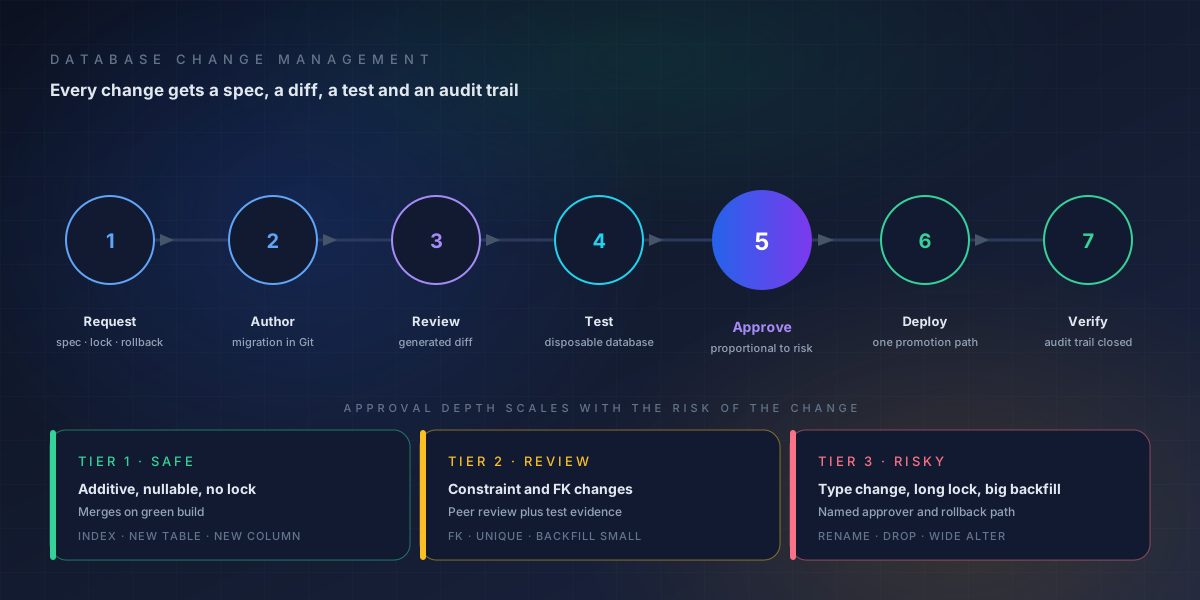
The process has six stages:
- Request. The change is described in business terms - what is needed and why - with a proposed technical approach attached.
- Design and author. The change is written as a versioned migration script in source control, including the rollback.
- Review. A second engineer reads the script, the generated diff, and the impact analysis.
- Test. The migration runs against a realistic copy of production, is verified by comparison and by tests, and performance is checked.
- Approve and deploy. Approval depth is set by risk tier; deployment happens through an automated pipeline in an approved window.
- Audit and verify. The post-deploy comparison confirms production matches what was approved, and the whole sequence is recorded.
The principle underneath
Every schema change should be attributable, reviewable, reproducible, and reversible in principle. If a change cannot be described after the fact by someone who was not in the room, the process has a hole.
2. Why Database Changes Need Their Own Process
Teams already review code. Why not simply review the SQL as part of the normal pull request? Because database changes have four properties that application code does not.
- Irreversibility. A bad deployment can be undone by redeploying the previous build. Dropping a column cannot be undone - the data is gone. Adding a
NOT NULLconstraint on a column with existing nulls fails or rewrites the table. Many schema operations are one-way. - Duration and locking. Adding an index on a large table, changing a column type, or rebuilding a clustered index can hold locks for minutes. On a hot table that means stalled application traffic, not just a slow migration.
- Shared ownership. One schema usually serves several applications, several microservices, and a warehouse feed. A change that is harmless for one consumer breaks another. The blast radius is not visible from the change itself.
- Environment divergence. Development, staging, and production rarely match. A migration that ran cleanly in staging may behave differently in production because of data volume, existing objects, or a hotfix that only ever ran there.
Those four properties are what justify process. Not bureaucracy for its own sake - a process that responds to genuine risk, and that deliberately removes ceremony from the changes that do not carry it.
The purpose of change management is not to slow change down. It is to make the safe path the fast path, so nobody is tempted around it.
3. The Database Change Management Lifecycle
A mature lifecycle looks similar whether the team uses a lightweight pull-request flow or a formal CAB. What changes is the depth applied at each step.
The database change management lifecycle: every change is specified, versioned, reviewed as a diff, tested against a realistic database, approved in proportion to risk, deployed through one path, then verified and audited.
Request and specification
The request states the business need, the objects affected, the expected lock duration, whether data must be backfilled, and how the change will be reversed. Poor requests produce good surprises later; a request that already asks "what breaks if this fails halfway" filters out most risky designs before anyone writes SQL.
Authoring in version control
The change is written as an ordered, immutable migration file, never as an interactive script. Two rules do most of the work here:
- Every migration is forward and backward. Each file has a paired rollback, even if the rollback is "restore from backup and replay". Making reversal explicit at authoring time changes what people are willing to write.
- Nothing is edited after it has run anywhere. Once a migration has executed in any environment, the file is frozen. Corrections are new migrations, so the history stays truthful.
Peer review with a generated diff
Reviewing raw DDL is slow and error-prone. Reviewing the resulting diff between the current schema and the schema after the migration is fast: the reviewer sees exactly which columns, types, and constraints change. Automated impact analysis adds which downstream pipelines, models, and reports reference the affected objects.
Test against a realistic database
Testing a migration means three things: it applies cleanly from the current baseline, it applies cleanly from an older baseline (for environments that lag), and the resulting schema matches what was intended. Realistic data volume matters - a migration that takes two seconds on ten thousand rows may take twenty minutes on two hundred million.
Approval proportional to risk
See the risk tiers below. The essential design decision is that low-risk changes are approved by policy rather than by a person, so the human attention available is spent on the changes that can actually hurt.
Deploy through one path
Deployment runs through the same pipeline in every environment, promoting the same artifact. Manual execution against production is removed rather than discouraged, because a rule that depends on people remembering is not a control.
Post-deploy verification and audit
Immediately after deployment, the production schema is compared against the approved state. A mismatch fails the release. Every step - request, approvals, test results, diff, deploy time, verification - is written to an immutable record.
4. Roles and Responsibilities
Most database change failures are ownership failures. The five roles below can be held by one person on a small team; what matters is that each exists and is named.
| Role | Owns | Decides | Typical failure when absent |
|---|---|---|---|
| Requester | The business need, the acceptance criteria | Whether the change is still needed | Changes shipped without a stated reason |
| Author | The migration script and its rollback | How the change is expressed | Irreversible or slow operations written casually |
| Reviewer | The diff, the impact analysis | Whether the change is safe | Approvals rubber-stamped without reading |
| Schema owner | The structure and its contract | Whether the change fits the model | Accidental drift toward inconsistent naming and duplication |
| Release manager | The window, the pipeline, the rollback | When it ships and whether to halt | Changes deployed during a conflicting release |
| Change advisory board | High-risk and regulated changes | Whether the risk is acceptable | Breaking changes reaching production unnoticed |
The schema owner role deserves particular emphasis. Without a named owner for a structure, nobody is accountable for its consistency, and every team that touches it optimizes locally. Naming one person - or one small group - is the cheapest governance intervention available.
5. Types of Database Changes and Their Risk Levels
Not all changes deserve the same ceremony. A workable risk model uses three tiers.
| Tier | Examples | Approval | Testing | Window |
|---|---|---|---|---|
| Tier 1 — Low | Add nullable column, add index on non-critical table, add a view | Auto-approved by policy after CI passes | Unit tests plus schema comparison | Any time |
| Tier 2 — Medium | Backfill, change column type to a wider type, add constraint with existing data | Schema owner plus one reviewer | Full test suite on a production-scale copy, lock duration measured | Scheduled window |
| Tier 3 — High | Drop or rename column, table split, partition change, anything on a regulated table | Schema owner, reviewer, and CAB | Full tests plus rehearsal of the rollback, restore timing verified | Approved window with on-call present |
Two details make tiers work in practice. First, the tier must be declared by the migration, not negotiated in a meeting - the tooling can then route it automatically. Second, the classification should be conservative: it is far better to over-classify a change and be pleasantly surprised than to under-classify one and discover the consequences in production.
Verdict
If every change goes to the same approval path, your process is either too slow for the ninety percent or too loose for the ten percent. Tiering is not optional; it is the mechanism that makes a formal process survivable.
6. Environments, Approvals, and the Change Advisory Board
The environment model is the skeleton of change management. A reliable default:
- Development - disposable, auto-built from migrations, no approvals.
- Integration - shared, refreshed from development, schemas validated against baseline nightly.
- Staging - production-shaped schema and a masked copy of production data, where every Tier 2 and Tier 3 change is rehearsed.
- Production - changed only by the pipeline, only with a recorded approval, only in a window.
The change advisory board is the piece most teams get wrong. Used well, the CAB reviews a small number of high-risk changes, checks conflicts with other planned releases, confirms rollback readiness, and approves a window - a fifteen-minute meeting. Used poorly, the CAB reviews everything, becomes a weekly bottleneck, and teaches people to find workarounds.
The fix is to automate the decision for Tier 1, pre-approve a standing policy for well-understood Tier 2 patterns, and reserve the board for Tier 3. Most organizations find that reduces CAB volume by eighty percent while increasing the quality of the decisions it does make.
One governance detail worth borrowing from regulated industries: freeze windows. Declared periods - month-end close, peak season - during which only Tier 1 emergency changes are allowed, with a named approver. A freeze that is announced and short is fine; a freeze that is permanent is just a backlog.
7. Tooling: What a Database Change Management Platform Does
Process without tooling degrades within a quarter. The tooling exists to make the correct path the path of least resistance.
- Migration framework. Tracks which migrations have run, applies them in order, and refuses to run an already-applied file. Liquibase, Flyway, Alembic, and native ORM migrations all serve this role.
- Version control and CI. Every migration in Git, every change proposed through a pull request, every merge gated on lint, test, and diff.
- Schema comparison. Produces the diff used in review, verifies the deployed result, and detects drift introduced outside the pipeline.
- Test harness. Builds a disposable database, applies migrations from scratch and incrementally, runs data and contract tests, and measures lock duration.
- Policy engine. Classifies each change into a risk tier and routes it to the right approval path automatically.
- Deploy runner. Executes in a window, supports pause and rollback, and refuses to run outside the pipeline.
- Audit and evidence store. Retains diffs, approvals, timings, verification results, and downstream dependencies with a retention period that matches your compliance obligations.
Bought versus built is a genuine trade-off. A small team with a mature CI system can assemble most of this from a migration tool and a schema comparison step. Larger organizations, or those under audit, usually get more value from a platform that supplies the policy engine and the evidence store, because those are the parts that are tedious to build and expensive to get wrong.
For a concrete example of the pipeline itself, see our guide to database CI/CD, and for the mechanics of writing changes that are safe to apply, schema migration best practices.
8. Agentic AI and Database Change Management
Agentic AI is beginning to compress specific parts of this lifecycle, and it helps to be precise about which.
Where agents are genuinely useful today:
- Drafting migrations from a stated intent. "Add a billing_country column, backfill from the address table, and index it" becomes a forward migration plus a rollback, written in the team's conventions.
- Generating impact analysis. An agent can read the diff, the lineage graph, and the query log to list the pipelines and reports that reference the affected objects - a task humans routinely skip because it is tedious.
- Classifying risk. Agents can propose a tier with a rationale, which a reviewer then confirms or overrides.
- Preparing CAB material. Summarising change volume, conflicts, and pending approvals so the meeting starts with decisions rather than status.
- Explaining failures. When a migration fails at 2 a.m., an agent can correlate the error with recent schema history and the exact object state, turning a war room into a five-minute read.
Where humans stay in the loop: approving Tier 2 and Tier 3 changes, deciding whether an irreversible operation is acceptable, and signing off anything touching regulated data. The reliable pattern is an agent that produces a plan with its reasoning, its blast radius, and its rollback attached, plus a deterministic gate that decides whether the plan is allowed to run.
The constraint that does not bend
An agent should propose; the pipeline should execute; a person should approve anything irreversible. Giving an autonomous agent a write credential to production schema is not automation, it is delegation of accountability.
9. How 4DAlert Supports Database Change Management
Most change management processes fail at the same place: producing evidence. The decision was made correctly, but six weeks later nobody can reconstruct what the schema looked like, who approved the change, or which reports depend on it.
4DAlert supplies that layer:
- Baseline and snapshot comparison. The approved schema is the baseline; every environment is compared against it on a schedule, so a change that arrived outside the process is visible immediately.
- Readable diffs for review. Reviewers approve a field-level diff rather than a page of DDL, which makes the review step fast enough that people actually do it.
- Downstream dependency mapping. Each change is linked to the models, pipelines, and reports it affects, so risk tiering is based on blast radius rather than guesswork.
- Automatic audit trail. Every change, its author, its timing, its verification result, and its downstream impact are recorded as the work happens - not assembled afterwards from ticket comments.
- Drift enforcement. A hotfix applied directly to production produces the same evidence, and the same alert, as a change that went through the pipeline.
The practical effect is that the process stops depending on discipline. The evidence generates itself, the review has something concrete to look at, and the audit question becomes a query rather than an investigation.
Frequently Asked Questions
What is database change management in simple terms?
Database change management is the set of steps a team follows before a change to a database structure is allowed to reach production: the change is requested, written as a versioned script, reviewed by a peer, tested against a realistic copy of the data, approved according to its risk, deployed through an automated path, and recorded so the change can be explained later. The goal is that no schema change ever reaches production as an undocumented, untested, one-off action.
Why does a database change need a different process from code?
Application code can usually be rolled back in seconds by redeploying the previous build. A schema change often cannot: dropping a column destroys data irreversibly, and a long-running lock can stall production traffic while it runs. Database changes are also shared - one schema may serve several applications - so a change that is safe for one consumer can break another. That combination of irreversibility and shared ownership is what justifies a formal process.
Who should approve database changes?
Approval should be proportional to risk. A non-breaking additive change in a lower environment can be auto-approved by policy. A breaking change to a high-volume production table should require the schema owner plus a second reviewer, and a change affecting regulated data or availability should go through a change advisory board. The rule that works is that approval depth tracks blast radius, not that every change needs a committee.
What is a change advisory board in database change management?
A change advisory board, or CAB, is the group - typically the schema owner, an operations representative, and a business or compliance owner - that reviews high-risk changes before they are scheduled. Its job is to assess impact, conflicts, and rollback readiness, and to approve a change window. Modern practice is to keep the CAB only for genuinely high-risk changes and let policy auto-approve the routine ones, otherwise the board becomes the bottleneck it was meant to remove.
What should be in a database change audit trail?
For every change: what the change was as a readable diff, who requested it, who approved it, which version of the migration introduced it, when it was applied and by which pipeline run, which environments it reached, what tests and comparisons it passed, whether it was rolled back, and which downstream models and reports depend on it. If you cannot reconstruct that sequence after the fact, you do not have an audit trail, you have a changelog.
How does 4DAlert support database change management?
4DAlert supplies the evidence layer around the process. It snapshots schema state per environment, produces a field-level diff for every change, maps each change to its downstream consumers, and retains a dated history of who changed what. That gives the review step something concrete to approve, the deployment step something to verify against, and the audit step a record that was generated automatically rather than assembled by hand.
Conclusion
Database change management has a reputation for being the slow part of software delivery, and it earns that reputation whenever it is applied uniformly to every change. The version of it worth building is tiered: routine additive changes flow through automatically with CI as the gate, medium changes get a named reviewer, and only the genuinely dangerous ones reach a board.
Three decisions determine whether the process works. Put every migration in version control so there is one truthful history. Remove the ability to change production schema outside the pipeline, so the process does not depend on anyone remembering it. And generate the audit record automatically, because a process whose evidence must be assembled by hand will eventually produce none.
Get those right and the process gets faster over time, not slower. Each migration becomes precedent, each diff becomes a reusable check, and the approvals that remain are the ones that genuinely deserve a human decision.