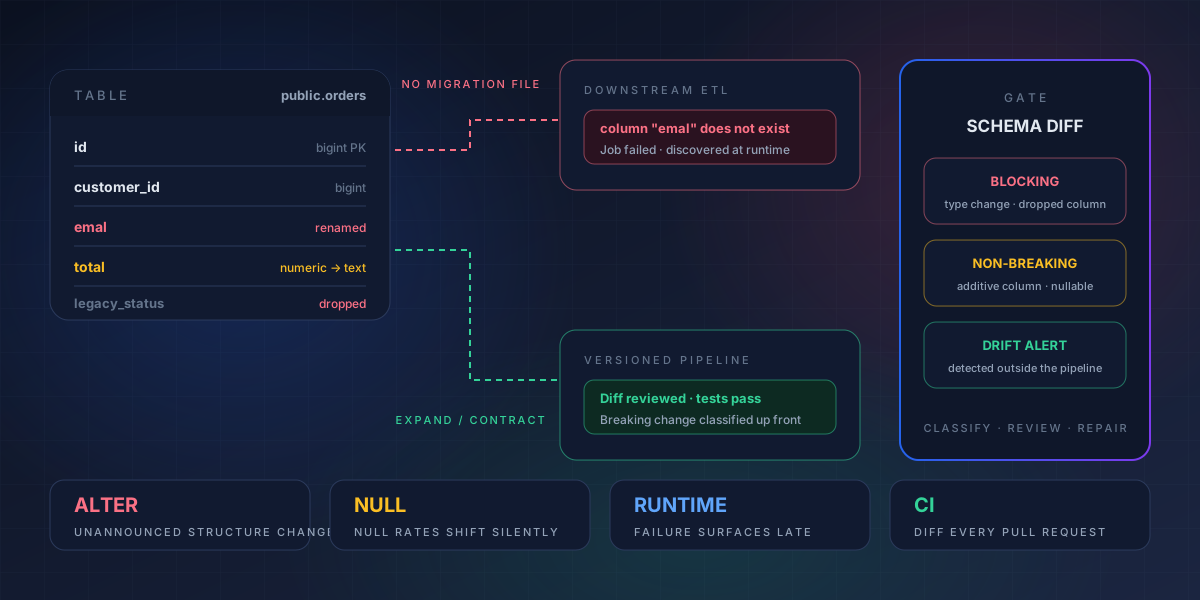
TL;DR — Key Takeaways
- Schema drift is an unannounced change to a data structure that downstream consumers were never told about - it is a communication failure, not a tooling failure
- Schema drift, schema evolution, and data drift are three different problems; evolution is planned, drift is not, and data drift changes values rather than structure
- The usual causes are hotfixes applied straight to production, vendor API changes, environment-specific migrations, and auto-migrating ORMs
- Detection means fingerprinting the schema at ingest and diffing it against a baseline and every other environment - continuously, not quarterly
- Prevention means a single versioned source of truth for schema, contract tests in CI, and a comparison gate that fails the build
Your nightly load finished green. The dashboard rendered. But revenue for the week is off by a factor of ten and nobody can say why.
Forty minutes later someone notices that the column the finance team has always called revenue_usd is now revenue. The upstream team renamed it during a refactor on Tuesday. They mentioned it in a Slack channel that the analytics team does not read. Nothing crashed, because nothing in the pipeline was written to fail - it was written to fill blanks.
That is schema drift. Not a malfunction. A missed message.
1. What Is Schema Drift?
Schema drift is any change to the structure of a data source - the shape of a table, the fields of a message, the columns of a file, the response of an API - that happens without the downstream consumers of that data being told. The writer and the reader disagree about the structure, and the disagreement goes unnoticed until someone questions a number.
Structure means more than column names. A schema change is any of the following:
- A column is renamed, added, or removed
- A data type changes, for example
varchar(50)tovarchar(120),inttobigint,stringtodate - Nullability changes - a nullable field becomes
NOT NULL, or the reverse - Precision and scale change, for example
decimal(10,2)todecimal(18,4) - A flat field becomes nested, or a nested object is flattened
- A field moves between tables, or one table is split into several
- Primary keys, partitions, or clustering keys change
- Default values, encodings, or character sets change
The defining property of drift is not the change itself. It is that the change is unknown to the reader. If the same change were announced, versioned, and handled deliberately, it would be schema evolution - a normal, healthy part of building software.
The one-line definition
Schema drift is a change in structure without a change in contract. The data moved and nobody sent the forwarding address.
2. Schema Drift vs. Schema Evolution vs. Data Drift
These three terms get used interchangeably in casual conversation, and conflating them is expensive - because the fix for each one is completely different.
Conflating these four is expensive, because the fix for each is different: if the columns changed it is schema; if only the contents changed it is data; if someone wrote it down first it is evolution.
| Term | What changes | Planned? | Typical signal | The fix |
|---|---|---|---|---|
| Schema drift | Structure | No | Nulls where values used to be, a failed parse, a blank column | Detect it, diff it, notify the owner, repair the mapping |
| Schema evolution | Structure | Yes | A migration, a versioned message, a deprecation notice | Version the schema, keep readers backward-compatible |
| Data drift | Values | No | Distribution shift, a new category, a null-rate spike | Monitor quality, retrain models, widen validation rules |
| Code drift | Logic | Usually no | Two environments running the same job with different results | Version and deploy through one pipeline |
A practical test: if the columns changed, it is schema. If the columns are the same but the contents changed, it is data. If someone wrote the change down first, it is evolution. If they did not, it is drift.
Machine learning teams feel data drift most acutely, because a model trained on last quarter's distribution quietly degrades. Data engineering teams feel schema drift most acutely, because it fails at 2 a.m. in the middle of a load. Most real incidents are both: a schema change that also shifts the values flowing through it.
3. What Causes Schema Drift
Schema drift is almost never malicious and rarely even careless. It is the predictable output of a system where many people can change shared data and no single gate checks the change before it lands.
- Hotfixes applied directly in production. A downstream job breaks, a developer connects to the production database, runs an
ALTER TABLE, and moves on. The change never enters version control, so no other environment ever learns about it. - Upstream vendor and SaaS API changes. Your billing provider adds a field, renames a key, or changes a type from string to number on their release cadence, not yours. Most vendors give no schema version - they just ship it.
- Environment-specific migrations. A migration is applied to development and staging but blocked, skipped, or rolled back in production. The environments are now structurally different, and the difference is invisible until data moves between them.
- ORM and framework auto-migration. Several application frameworks create or alter tables on application start. One redeploy with a changed model definition can modify a production schema with no human decision at all.
- Merges, renames, and branch divergence. Two teams refactor the same entity on two branches. Both merge. The resulting table carries structure that neither branch intended.
- Ownership split across microservices. When three services write into one shared table or topic, three release schedules drive one schema, and there is no one person who can say what the shape should be.
- Partner and third-party feeds. A trading partner changes a file layout, a file name pattern, or a delimiter without telling you, because to them it is an internal detail.
Every one of these causes has the same root: the schema is treated as an implementation detail of the writer instead of a contract with the reader.
That reframing is the whole discipline. The moment you treat schema as a shared, versioned contract with named owners, most of the causes above stop being possible.
4. How Schema Drift Breaks Pipelines and Dashboards
Drift is dangerous specifically because it tends to fail silently. An explicit error is a gift - it wakes someone up. Drift more often produces plausible-looking wrong answers.
The five failure patterns show up again and again:
- The blank column. A renamed field maps to nothing, the load fills nulls, and every aggregate for that column quietly becomes zero. Row counts stay correct, so nothing trips.
- The truncated value. A numeric type is narrowed, or a field is written into a shorter target column, and values are cut off. Totals drift slowly rather than breaking.
- The dropped record. A parser reads a fixed list of keys and a new key is added upstream. The new data is discarded on ingest and never appears in the warehouse.
- The broken join. A key changes type or case, from
order_idstring toorderIdinteger. The join returns fewer rows than it should, and revenue attribution silently under-counts. - The half-split table. One table becomes two, only one half is wired into the pipeline, and the other half simply stops arriving.
The organizational damage is worse than the technical damage. Each of these incidents costs a morning of archaeology, erodes trust in the dashboard, and trains people to export to CSV and reconcile by hand - which is exactly the behaviour data teams are trying to eliminate.
Verdict
A pipeline that reports success while dropping rows is worse than one that fails loudly. If your only signal is job status, you are not monitoring your pipeline - you are monitoring whether it crashed.
5. How to Detect Schema Drift
Detection has one core mechanism and several places to run it.
The core mechanism is a schema fingerprint. At the moment data lands - the API response, the Kafka message, the file header, the table catalog - capture a canonical representation of the structure: field names, types, nesting, nullability, precision, key and partition definitions. Store it. Then compare it, on every ingest, against two things: the stored baseline you declared as correct, and the schema currently present in the other environments you load into.
Where to run the comparison:
- On ingest. Compare the incoming payload schema against the expected schema before it enters the pipeline. This catches vendor and upstream changes first, at the cheapest possible point.
- In the schema registry. Streaming platforms validate each message against a registered, versioned schema and reject incompatible writers. This is the most mature form of drift control in the ecosystem.
- Across environments. Diff production against staging against development on a schedule. This catches migrations that were applied in one place and not another.
- In CI. Apply the migration to a disposable database in the pipeline and diff the resulting schema against a committed snapshot. This catches drift before it is ever deployed.
- Against the warehouse. Compare the source system schema against the modelling layer, so you know a change upstream has not yet been reflected downstream.
A useful detection alert is not "schema changed". It is "column revenue was renamed to revenue_usd in orders, which feeds three models and eleven dashboards, owner: Finance Analytics". The diff plus the blast radius is what makes an alert actionable rather than noise.
6. Schema Drift Detection Methods Compared
| Method | What it checks | Catches | Misses | Effort |
|---|---|---|---|---|
| Manual review | Nothing automated; someone reads a release note | Announced changes | Every unannounced change | Low, but unreliable |
| Catalog sync job | Source schema vs. warehouse schema, nightly | Column add/drop/rename, type change | Intraday changes, nested field changes | Low |
| Schema registry | Every message against a versioned contract | Producer-side incompatibility, encoding changes | Changes outside the registry's scope | Medium |
| Contract tests in CI | Migrated database vs. committed snapshot | Anything deployed through the pipeline | Changes made directly in production | Medium |
| Continuous comparison | All environments and sources, on a schedule | Everything above, including hotfixes and vendor changes | Nothing structural, if sources are covered | Medium-high |
| Row-level profiling | Null rates, distributions, patterns in values | Data drift and semantic change | Renames where data stays valid | High |
Mature teams combine four of these: registry for streaming, contract tests in CI, a nightly cross-environment diff, and value profiling for the fields that drive decisions. The combination matters because no single method covers both structural and semantic change.
7. How to Prevent Schema Drift
Detection tells you that drift happened. Prevention makes it much less likely. Five practices carry most of the benefit.
- Make the schema a versioned artifact. Store migrations, models, and generated schema snapshots in Git. The repository is the single source of truth, and every environment is built from it rather than modified in place.
- Block direct production changes. Remove ad-hoc
ALTERandDDLrights from human accounts in production. If the only way to change a schema is through the pipeline, hotfix drift stops existing. - Adopt a data contract. A written, machine-checkable agreement between producer and consumer covering field names, types, nullability, units, and change policy. Pair it with an explicit version and a deprecation window.
- Gate merges on a schema diff. In CI, build a fresh database, apply the migration, and diff the result against the committed snapshot. A breaking diff fails the build and forces a deliberate decision.
- Prefer additive, backward-compatible changes. Add a new column and backfill rather than renaming. Deprecate rather than delete. This lets old and new consumers coexist during the transition, which is what turns drift into evolution.
Backwards-compatible sequencing is the single highest-leverage habit. A rename becomes safe when it is staged as: add new field, dual-write, backfill, switch readers, remove old field - each step reversible and none of them breaking.
8. Agentic AI and Schema Drift
Agentic AI changes schema drift management in two specific ways, and it is worth being precise about which is real and which is hype.
Detection and triage are now conversational. Instead of reading a raw diff, a team can ask what changed and get an explanation: which fields changed, in which direction, when, and which downstream models, tests, and reports reference them. The agent reads the diff, the lineage graph, and the recent commit history together, and produces a summary a data owner can act on in a minute rather than an hour.
Impact analysis becomes continuous rather than manual. Before a change ships, an agent can simulate its effect - walk the lineage, identify every consumer whose expectation would break, and flag the specific tests that would start failing. That turns "we will find out in production" into "we know on the pull request".
Where agents genuinely help with repair:
- Drafting the compatibility shim - the coalesce, the cast, the default value that lets both versions of a field load
- Proposing the migration in both directions, forward and rollback
- Updating the contract and the tests to match, so the guardrail does not rot
- Writing the notification to the affected downstream owners
Where they must stay supervised: anything that changes production data. An agent should propose and explain; a human should approve and execute. The pattern that works is an agent proposing a fix with its reasoning and blast radius attached, and a deterministic gate deciding whether it is allowed to run - not an agent with a write credential and a good mood.
Why this matters for AI itself
Agentic systems are heavy consumers of structured data. An agent reading a table with a silently renamed column does not throw an error - it produces a confident, wrong answer. For AI workloads, schema drift is not just an operational problem, it is a correctness problem.
9. How 4DAlert Detects and Resolves Schema Drift
4DAlert treats schema drift as a monitoring problem with an ownership problem attached, because an alert without an owner is just a new form of noise.
- Continuous snapshots. 4DAlert captures the structure of every connected source on a schedule and retains the history, so you can answer "when did this change" without archaeology.
- Readable diffs. Drift alerts arrive as a field-level comparison - added, removed, retyped, re-precisioned - rather than a raw DDL dump. The change is obvious at a glance.
- Blast radius. Each change is mapped to the downstream models, pipelines, and reports that consume it, so the alert tells you what actually breaks, not just what changed.
- Baseline enforcement. The declared schema is the baseline. Anything that diverges from it is flagged whether it came from a migration, a hotfix, or a vendor release.
- Audit trail. Every drift event, who or what caused it, and what was done about it is recorded, which turns recurring drift into a pattern you can fix at the source.
The result is that the column rename from the start of this article shows up as an alert within minutes, addressed to the team that owns the field, with a link to the two reports that will otherwise be wrong tomorrow morning.
Frequently Asked Questions
What is schema drift in simple terms?
Schema drift is when the structure of a data source changes without the people or systems reading that data being told. A column gets renamed, a field changes from string to number, a nested object gains a new key, or a table is split in two - and the downstream pipeline, report, or API still expects the old shape. Nothing usually fails loudly; instead the load silently drops records, blanks a column, or reports a wrong total.
What is the difference between schema drift and schema evolution?
Schema drift is unplanned and uncommunicated: the change happens, nobody declares it, and consumers find out when something breaks. Schema evolution is planned and backward-compatible: the change is announced, versioned, and handled deliberately so old and new readers both work. Data drift is a different problem entirely - the structure stays the same but the values change, for example a new country code appearing in a field.
What causes schema drift?
The common causes are ad-hoc ALTER TABLE statements run directly against production, upstream vendors or SaaS APIs changing payloads without notice, migrations that are deployed in one environment but never in another, merges and renames from developer branches, ORMs that auto-migrate on application start, and microservices that each own a piece of a shared schema.
How do you detect schema drift in a data pipeline?
Capture a fingerprint of the schema at the point data lands - column names, data types, nullability, precision, and nested structure - and compare it against a stored baseline and against the schema in every other environment. Detection works by schema diffing on every ingest, schema registry validation on streaming topics, contract tests in CI, and continuous comparison between production and development.
Can schema drift cause data loss?
Yes, and often quietly. A renamed column can cause an entire field to land as null. A widened numeric type can be truncated on write. A new nested field can be dropped by a parser that only reads a fixed key list. A table split in two can leave half the rows behind. In each case the job reports success, which is what makes drift more dangerous than an outright failure.
How does 4DAlert help with schema drift?
4DAlert snapshots the schema of every source it monitors, compares those snapshots against a baseline and against each other on a schedule, and raises a drift alert with a readable, field-level diff as soon as a change appears. It maps each changed field to the downstream models and reports that depend on it, so the team knows the blast radius before the first broken dashboard.
Conclusion
Schema drift is not a bug in your tooling. It is the gap between a change made by one team and the people who depend on that change. Every incident of it follows the same shape: a structure changed, nobody told anyone, and the system kept running as if nothing had happened.
Closing the gap takes three moves. Put the schema under version control so there is one source of truth. Put a comparison in the path of every change, in CI and in production, so divergence is caught at the cheapest possible moment. And give every schema an owner, so that when a diff does appear, it arrives with a name attached rather than an open question.
Do those three things and drift does not disappear - upstream vendors will keep shipping changes - but it stops being a 2 a.m. discovery. It becomes a normal, handled event: a diff, an owner, and a decision.