A pipeline runs overnight. Ten million records leave the source system. The job finishes, the log shows "success," and everyone moves on with their morning.
Then, a week later, someone in finance or operations notices the numbers don't add up. A closer look shows the target system only received 9.8 million records. Nobody caught it because nobody was looking — the pipeline didn't fail, it just quietly dropped data.
If you've worked in data engineering for more than a year, you've probably lived through some version of this story. Maybe it was a failed join that silently deduplicated rows. Maybe it was a timeout that truncated a batch. Maybe it was a schema change nobody flagged. The pipeline didn't crash, so nobody was alerted. The damage was discovered downstream, usually by a business user, usually at the worst possible time.
This is the core problem that data reconciliation exists to solve, and it's also why manual reconciliation — spreadsheets, ad hoc SQL, someone eyeballing row counts — no longer scales. Data volumes have grown, pipelines have multiplied, and the number of systems talking to each other has exploded. Automated data reconciliation isn't a nice-to-have anymore. It's becoming the baseline expectation for any team that wants to trust its data.
TL;DR — Key Takeaways
- Manual reconciliation — spreadsheets, ad hoc SQL — no longer scales against today's data volumes and pipeline counts
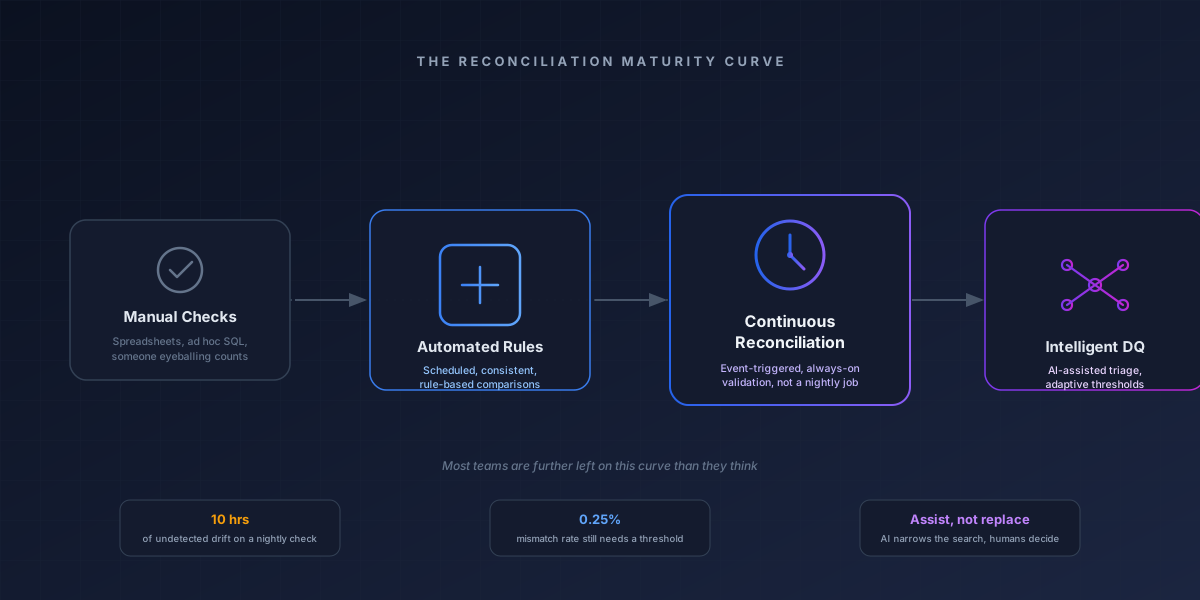
- The shift follows a fairly predictable path: manual checks → automated rules → continuous reconciliation → intelligent data quality
- AI can already flag unusual mismatches and help triage exceptions — but autonomous root-cause diagnosis and auto-remediation aren't reliable yet
- Adaptive thresholds and cross-platform reconciliation are the realistic near-term direction, not a distant future
- Platforms like 4DAlert are built around this shift — centralizing rules, thresholds, exceptions, and history in one connected system
This article looks at where reconciliation is heading — what's changing, what's realistic, and what data teams should actually be preparing for.
What Is Data Reconciliation?
At its core, data reconciliation is the process of comparing data between two or more systems — usually a source and a target — to confirm that what left one place actually arrived correctly at the other.
That comparison can happen at a few different levels:
- Record counts — Did the same number of rows make it from source to target?
- Field-level comparison — Do individual column values match, or has something been transformed, truncated, or corrupted along the way?
- Missing records — Are there rows present in the source that never showed up in the target?
- Duplicate records — Did the pipeline introduce duplicates that weren't in the original data?
- Partial mismatches — Do some fields match while others don't, suggesting a transformation bug rather than a complete failure?
- Threshold-based reconciliation — Instead of demanding a perfect match, is the discrepancy within an acceptable tolerance (say, under 0.1% of records)?
None of this is new conceptually. What's changed is the scale at which it needs to happen and the number of places it needs to happen simultaneously.
Why Traditional Data Reconciliation Is No Longer Enough
Most data teams didn't set out to build fragile reconciliation processes. They grew into them. A quick SQL script here, a spreadsheet macro there, and eventually reconciliation became a patchwork of manual steps that only one or two people fully understand.
That approach breaks down for a few reasons.
Data volumes keep growing
Comparing a few thousand rows by hand is tedious but doable. Comparing tens of millions of rows across multiple tables, every day, is not something a person should be doing manually — and realistically, nobody actually does it thoroughly. They sample, spot-check, and hope.
Systems have multiplied. It's rare now for an organization to have just one source and one target. A typical enterprise might be pushing data from SQL Server into Snowflake, syncing part of it to Postgres for an application layer, and landing raw files in a data lake for analytics. Each hop is a place where something can go wrong.
Pipelines run constantly. Nightly batch jobs used to be the norm. Now it's common to see near-real-time or micro-batch pipelines running every few minutes. Manual reconciliation was already struggling to keep up with daily jobs — it has no chance against continuous ones.
Exceptions get lost. Even when a manual check does catch a mismatch, tracking what happened to it afterward is its own problem. Was it investigated? Resolved? Ignored? Without a centralized system, that context lives in someone's inbox or, worse, in their memory.
The result is what you'd expect: reconciliation becomes reactive. Issues get found after they've already caused downstream damage, not before.
The Shift Toward Automated Data Reconciliation
The natural response to this has been a gradual shift in how organizations approach reconciliation, and it tends to follow a fairly predictable path:
The predictable maturity path: manual checks give way to scripted rules, then to always-on continuous reconciliation, and finally to intelligent, self-tuning data quality.
Manual checks → Automated rules → Continuous reconciliation → Intelligent data quality
Most teams start with manual checks, move to scripted or rule-based automation once the pain becomes acute enough, and only later start thinking about reconciliation as a continuous, always-on process rather than a periodic task.
What automation actually takes off a team's plate is fairly concrete:
- Scheduling comparisons across systems without someone kicking off a job manually
- Executing the same rules consistently, every time, without human error creeping in
- Running source-to-target comparisons at scale
- Detecting exceptions and categorizing them automatically
- Evaluating results against defined thresholds
- Generating alerts when something falls outside acceptable limits
- Keeping a historical record of every run, not just the most recent one
- Producing reports and dashboards that don't require someone to compile them by hand
None of this requires exotic technology. It requires discipline, good rule design, and a system built to run reconciliation as a first-class part of the data pipeline rather than an afterthought bolted on at the end.
What Will the Future of Data Reconciliation Look Like?
This is where it gets more interesting — and more speculative. Some of what follows is already happening in mature data organizations. Some of it is still emerging. Worth being honest about which is which.
Continuous Reconciliation
Scheduled checks — run reconciliation once a night, once an hour — are a reasonable starting point, but they leave gaps. If a pipeline breaks at 2 PM and your check doesn't run until midnight, that's ten hours of bad data flowing downstream unnoticed.
The direction things are heading is toward reconciliation that runs continuously or triggers on events — a new batch landing, a schema change, a pipeline completing — rather than on a fixed clock. This shrinks the window between "something broke" and "someone knows about it."
AI-Assisted Reconciliation
This is probably the most hyped area, so it's worth being precise about what's realistic today versus what's still aspirational.
Right now, AI can reasonably help with things like: flagging mismatches that look statistically unusual compared to historical patterns, suggesting reconciliation rules based on schema and data profiling, and helping classify exceptions into categories (timing issue, transformation bug, genuine data loss) so humans can triage faster.
What AI is not reliably doing yet
Despite what some vendors imply, AI is not autonomously diagnosing root causes with full confidence or fixing pipelines without human review. Treat any claim to the contrary with some skepticism. The realistic near-term role for AI in reconciliation is as an assistant that narrows down where a human should look, not a replacement for that human judgment.
Intelligent Thresholds
Static thresholds — "alert if mismatch exceeds 1%" — are simple but blunt. A 1% threshold might be far too strict for a volatile, high-change dataset and far too loose for a stable, critical one.
The next step is thresholds that adapt based on historical patterns for that specific dataset — tightening or loosening automatically as normal variance becomes better understood. This reduces both false positives and the more dangerous false negatives.
Automated Root-Cause Analysis
Knowing that 12,500 records mismatched is useful. Knowing why is what actually saves time. Emerging reconciliation systems are starting to connect mismatches back to pipeline runs, schema changes, transformation logic, or upstream failures — so a mismatch doesn't just generate an alert, it generates a lead.
Data Observability Integration
Reconciliation is increasingly being treated as one piece of a broader data observability practice, alongside freshness monitoring, completeness checks, schema change detection, anomaly detection, and lineage tracking. Reconciliation tells you whether two datasets match. Observability tells you the full context of why they might not.
Cross-Platform Reconciliation
Modern data estates rarely live in one place. A reconciliation strategy that only works for a single database is already outdated. The realistic expectation going forward is reconciliation that works consistently across PostgreSQL, SQL Server, Oracle, Snowflake, cloud data warehouses, APIs, and data lakes — without requiring a completely different toolset for each. This is exactly the challenge we cover in cross-cloud data reconciliation.
Self-Service Data Quality
Right now, writing a new reconciliation rule often still means someone with SQL skills getting involved. That's a bottleneck. The direction things are moving is toward letting business and technical users configure reconciliation rules — thresholds, field mappings, comparison logic — through a defined interface, without hand-writing SQL for every single validation.
A Practical Example
Consider a fairly typical enterprise scenario:
- Source: SQL Server (order management system)
- Target: Snowflake (analytics warehouse)
- Records processed: 5,000,000
- Result: 12,500 records do not match
Here's how an automated reconciliation process would typically handle this, step by step:
- Execute the scheduled (or triggered) validation between source and target.
- Compare total record counts between both systems.
- Identify which specific records are mismatched, missing, or duplicated.
- Apply the defined threshold (say, 0.5% tolerance) to determine whether this is within acceptable range.
- Categorize the 12,500 exceptions — missing records, field-level mismatches, duplicates.
- Generate an alert to the relevant team, since 12,500 out of 5 million (0.25%) may be within tolerance, but the category breakdown still matters.
- Track the exceptions until they're resolved or explicitly accepted.
- Store the run in historical records for trend analysis over time.
| Step | Manual Process | Automated Process |
|---|---|---|
| Comparison | Manual SQL queries, run inconsistently | Scheduled or event-triggered, run consistently |
| Detection | Discovered days or weeks later | Detected within the reconciliation window |
| Categorization | Ad hoc, often skipped | Structured, consistent exception categories |
| Thresholds | Rarely defined formally | Explicit, configurable per dataset |
| Historical tracking | Scattered across spreadsheets | Centralized and queryable |
| Ownership | Unclear, depends on who noticed | Routed to defined owners automatically |
Key Benefits of Automated Data Reconciliation
Done well, automated reconciliation offers some clear, grounded advantages:
- Faster validation across large datasets than manual review could ever achieve
- Reduced manual effort, freeing engineers from repetitive comparison work
- Earlier issue detection, closer to when the problem actually occurred
- Better data trust across the organization, since checks are consistent rather than occasional
- Scalability — the same rules apply whether you're validating thousands or millions of rows
- Consistent rule application, removing the variability of manual checks
- Auditability, since every run is logged and traceable
- Centralized visibility instead of scattered, siloed checks
- Reduced operational risk from bad data reaching downstream reports or decisions
Challenges Organizations Should Consider
It would be dishonest to present this as a frictionless upgrade. Automation introduces its own set of challenges.
- Legacy systems often lack clean APIs or consistent schemas, making automated comparison harder to set up initially.
- Different data types across platforms — date formats, numeric precision, encoding — can cause false mismatches that have nothing to do with actual data loss.
- Large data volumes still require careful performance tuning; a poorly designed comparison job can be as slow as the manual process it replaced.
- False positives from overly strict thresholds erode trust in the system faster than actual data issues do.
- Poorly designed rules produce noise, not signal. Automation amplifies whatever logic you give it — good or bad.
- Security and credentials management across multiple source and target systems adds real operational overhead.
- Governance questions — who owns a rule, who approves threshold changes — need clear answers before automation scales across teams.
- Integration complexity grows with every additional system added to the reconciliation scope.
Automation does not eliminate the need for thoughtful reconciliation design. It just makes good design pay off at scale — and makes poor design fail faster and louder.
How to Prepare for the Future
A few practical steps for teams that want to move in this direction without overcomplicating things early on:
- Standardize reconciliation rules across teams instead of letting each pipeline invent its own approach.
- Move critical checks from manual SQL scripts into automated, scheduled workflows.
- Define meaningful thresholds per dataset rather than applying one blanket rule everywhere.
- Centralize exceptions into a single place teams can actually monitor.
- Track reconciliation history so patterns become visible over time, not just individual incidents.
- Integrate reconciliation with broader data observability practices where possible.
- Introduce AI carefully, where it demonstrably saves time — not because it's expected.
- Treat reconciliation as part of the pipeline itself, not a separate afterthought bolted on at the end.
Where 4DAlert Fits In
Platforms like 4DAlert are built around this general direction — pulling reconciliation rules, multiple data sources, threshold-based validation, exception management, alerting, and historical visibility into one connected system rather than a collection of disconnected scripts.
In practice, that means reconciliation across systems like SQL Server, PostgreSQL, Oracle, Snowflake, and others can run on a defined schedule, apply consistent thresholds, and surface exceptions in one place instead of requiring someone to manually stitch results together from five different tools. It's one example of what automated reconciliation looks like when it's treated as infrastructure rather than a side project — not the only way to get there, but a reasonable illustration of the pattern. For a closer look at this in practice, see our guide to automated data reconciliation with 4DAlert.
Conclusion
The future of data reconciliation isn't really about comparing two datasets faster, though speed helps. It's about continuously understanding whether data can be trusted, catching problems closer to where they start, and giving teams the chance to act before a data issue turns into a business problem.
Manual reconciliation got organizations this far, but it's running out of road. The teams that will handle the next stage of data complexity well are the ones treating reconciliation as an ongoing, automated, observable part of their data infrastructure — not a task someone remembers to run when they have time.
See how 4DAlert is building the future of automated reconciliation with continuous validation, AI-assisted triage, and adaptive thresholds.