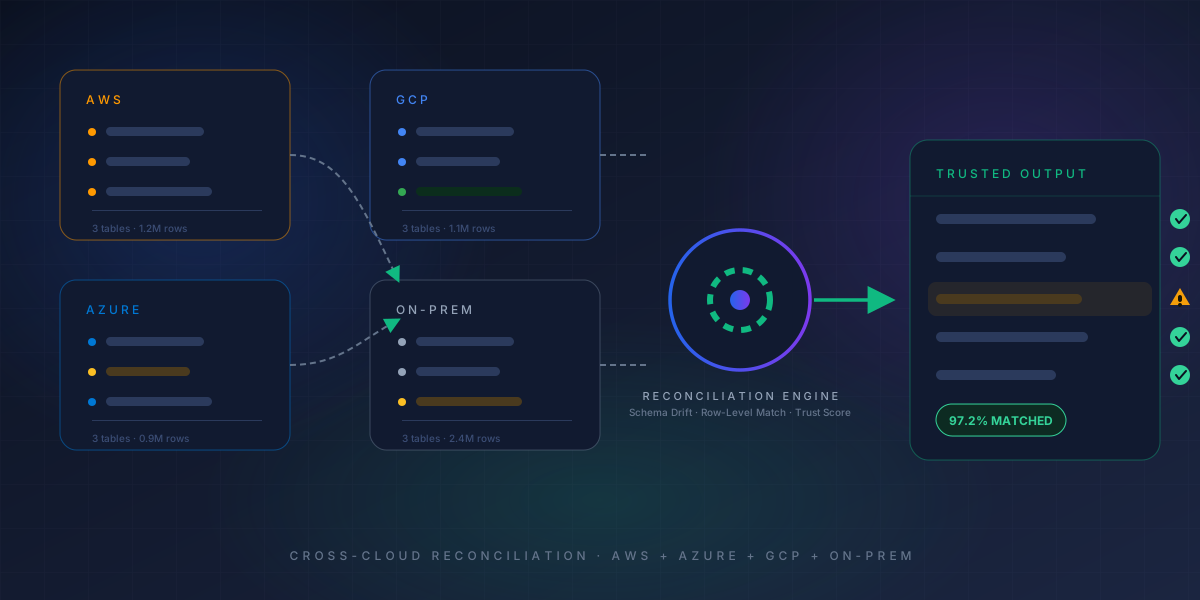
Here's the reality of modern enterprise data: 87% of organizations now run workloads in two or more public clouds. The average enterprise uses 3.4 cloud providers plus on-premises systems. Each environment stores overlapping datasets in different formats, with different schemas, under different consistency models.
The result is a reconciliation nightmare. The same customer might have one record in AWS Redshift, another in Azure Synapse, and a third in GCP BigQuery — with different field names, different update times, and different levels of completeness. When a report asks for the "total customers," which number is correct?
This isn't a data quality problem you can solve with better ETL. It's a fundamental architectural challenge of operating data across heterogeneous cloud platforms. Here's how to approach it.
Table of Contents
Why Cross-Cloud Reconciliation Is So Hard
Reconciling data within a single cloud is straightforward — you're operating within one ecosystem, one set of tools, one consistency model. Cross-cloud reconciliation introduces challenges at every layer:
- Different storage formats: AWS favors Parquet, Azure leans toward Delta Lake, GCP uses Avro, and on-prem systems may use CSV or proprietary formats. Each format has different metadata, partitioning schemes, and compression characteristics.
- Different schema evolution models: Schema-on-read (BigQuery) behaves differently than schema-on-write (Redshift, Synapse). A column added in one cloud may not propagate to others, creating silent drift.
- Different consistency guarantees: Strong consistency in one cloud, eventual consistency in another, read-after-write in a third. The timing of when data "arrives" varies across environments.
- Different update cadences: Real-time streams in one cloud, hourly batches in another, daily snapshots in a third. Reconciling requires aligning temporal boundaries that may not match.
- No shared catalog: Each cloud has its own catalog (AWS Glue, Azure Purview, GCP Data Catalog). There's no cross-cloud metadata standard for schema comparison.
Cross-Cloud Reconciliation Patterns
There are three primary patterns for reconciling data across cloud platforms, each with different tradeoffs:
Three cross-cloud reconciliation patterns, each with a different trade-off between simplicity, resilience and operational overhead.
Hub-and-Spoke Reconciliation
Select one environment as the reconciliation hub — typically your primary analytics platform or a neutral lakehouse layer. All other environments periodically publish their data profiles to the hub, which performs record-level matching, schema comparison, and drift detection. This pattern is straightforward to implement but creates a single point of truth and potential bottleneck.
Best for: Organizations with a clear primary analytics platform and a need for a single source of truth.
Peer-to-Peer Reconciliation
Each environment maintains its own reconciliation agent that compares data with every other environment. When drift is detected, alerts are raised in all affected environments simultaneously. This pattern is resilient (no single point of failure) but creates combinatorial complexity — n environments require n(n-1)/2 pairwise comparisons.
Best for: Organizations with evenly distributed workloads across clouds and high availability requirements.
Federated Catalog Reconciliation
A shared metadata catalog (OpenMetadata, DataHub, or Amundsen) serves as the canonical reference for schemas, data profiles, and quality metrics across all environments. Reconciliation agents in each cloud compare their local state against the federated catalog rather than against other clouds directly. This pattern reduces complexity from O(n²) to O(n) and provides a unified governance layer.
Best for: Organizations with mature data governance and a need for cross-cloud schema and quality management at scale.
For a deeper look at how reconciliation fits into your overall data quality strategy, see our guides on automated data reconciliation and AI-native data quality.
Schema Drift Detection Across Clouds
Schema drift is the silent killer of cross-cloud data pipelines. A column gets added to the source table in AWS. The downstream Azure pipeline doesn't know about it. Three weeks later, someone notices that the Azure copy is missing 15% of the columns.
Effective cross-cloud schema drift detection requires:
- Automated schema comparison: Continuously compare schemas across environments, detecting additions, deletions, type changes, and nullability changes. Tools like Apache Avro's schema resolution or Delta Lake's schema enforcement help, but they operate within rather than across clouds.
- Tolerant vs. strict modes: Not all drift is bad. Some schema changes are intentional evolutions that should propagate. Implement per-entity policies: "strict" for critical tables where drift always requires investigation, "tolerant" for staging or transient datasets.
- Schema lineage tracking: When drift is detected, trace it back to the source. Was it an intentional schema evolution in a source system? A DDL change that wasn't propagated? A bug in the ingestion pipeline?
- Cross-cloud schema registry: Maintain a centralized schema registry (like Confluent Schema Registry but operating across clouds) that all environments register against and compare to.
"Schema drift between clouds is rarely a technical failure — it's a communication failure. The systems are fine; the coordination between them isn't."
Data Drift Monitoring
Beyond schema differences, cross-cloud environments suffer from data drift — where the same logical dataset has different content across clouds. Data drift manifests in several ways:
- Record count drift: Different numbers of records for the same logical entity across clouds. Caused by timing differences, duplicate filtering inconsistencies, or partition boundary misalignment.
- Value distribution drift: The same metric computed differently across clouds (e.g., SUM(revenue) differs because one environment includes tax and another doesn't).
- Temporal drift: Data that exists in one environment but hasn't arrived in another yet. The "latest" record may be 1 minute old in AWS and 45 minutes old in GCP.
- Null pattern drift: Different null handling across clouds — one environment represents missing values as NULL, another as empty string, another as 0.
Data drift monitoring requires statistical comparison of data profiles across environments: row counts, column-level aggregates, distribution shapes, and null percentages. When these profiles diverge beyond configured thresholds, an alert is raised.
Reconciliation at the Lakehouse Layer
The lakehouse architecture — with open formats like Apache Iceberg, Delta Lake, and Apache Hudi — offers a promising foundation for cross-cloud reconciliation. By storing data in open formats that any cloud can read, the lakehouse provides a neutral ground for comparison.
Key capabilities for lakehouse reconciliation:
- Cross-cloud catalog integration: A lakehouse catalog (like Nessie or the Apache Iceberg REST catalog) can provide a unified metadata namespace across clouds. Tables have a single logical definition even when their physical data lives in multiple environments.
- Time-travel comparisons: Lakehouse formats support time travel, enabling point-in-time comparisons across clouds. You can reconcile "what did AWS have for orders at 2:00 PM" against "what did GCP have for orders at 2:00 PM" using consistent snapshots.
- Incremental reconciliation: Instead of full-table comparisons (which are expensive across clouds), lakehouse formats support incremental change data capture, enabling reconciliation of only the records that changed since the last check.
- Cross-cloud query federation: Engines like Trino, Presto, and Apache Spark can query across cloud environments from a single interface, making direct record-level comparisons possible without data movement.
Our team at Performalytic has deep experience building cross-cloud lakehouse architectures. See our enterprise solution development services for more on how we approach these challenges.
Handling Eventual Consistency
One of the most frustrating aspects of cross-cloud reconciliation is that the data is rarely perfectly in sync. Different clouds have different consistency models, and real-time synchronization across geographic regions is constrained by physics — data takes time to propagate.
Here's how to handle it:
- Define acceptable drift windows: Not every inconsistency needs immediate resolution. Define SLAs for data consistency per entity and data class. "Orders" might have a 5-minute drift window. "Customer profiles" might have 1 hour. "Historical aggregates" might have 24 hours.
- Use version-based reconciliation: Instead of comparing raw values, compare version markers. Each record carries a version timestamp or sequence number. Reconciliation compares versions, not values — if two environments have the same version for a record, no further check is needed.
- Implement reconciliation priority levels: Critical inconsistencies (e.g., financial totals don't match) trigger immediate investigation. Non-critical inconsistencies (e.g., minor count differences in staging tables) are queued for periodic review.
- Build idempotent reconciliation processes: Reconcile records should be replayable — running the same reconciliation twice should produce the same result, and re-running should not duplicate corrections.
"You can't eliminate eventual consistency. You can only decide how much inconsistency you can live with — and for how long."
A Practical Path Forward
Getting started with cross-cloud reconciliation doesn't require standing up a massive platform. Here's a practical approach:
- Map your cross-cloud data flows — Document every dataset that exists in more than one cloud. Include format, schema, update frequency, and consistency model. You'll likely find 10-20 datasets that are the highest priority for reconciliation.
- Start with a single critical entity — Pick one dataset where inconsistency causes the most pain (customer, order, product are good candidates). Implement record-level reconciliation for that dataset first.
- Establish baseline profiles — Capture data profiles (row counts, column stats, schema) from each environment for your critical entity. This gives you a baseline to measure drift against.
- Implement automated schema comparison — Use a federated catalog or custom scripts to compare schemas across clouds on a scheduled basis. Schema drift detection is lower effort than data-level reconciliation and catches many issues early.
- Add data-level reconciliation — Implement record-level comparison starting with high-value reconciled outputs. Use hash-based comparison (compare hash of sorted records) rather than row-by-row comparison for performance.
- Establish reconciliation governance — Define who owns each cross-cloud dataset, what the acceptable drift windows are, and what happens when reconciliation fails. Without governance, reconciliation becomes a technical exercise without business impact.
Frequently Asked Questions
What is cross-cloud data reconciliation?
Cross-cloud data reconciliation is the process of comparing and aligning datasets that exist across multiple cloud platforms (AWS, Azure, GCP) and on-premises systems. It ensures that the same logical data is consistent across environments despite differences in storage formats, schemas, update frequencies, and consistency models.
What causes schema drift across clouds?
Schema drift is caused by DDL changes in source systems that aren't propagated to all cloud environments. Common causes include: columns added to source tables without updating downstream pipelines, schema evolution policies that differ across environments, and type casting inconsistencies between cloud-native formats like Parquet, Avro, and Delta Lake.
Can a lakehouse solve cross-cloud reconciliation?
A lakehouse with open formats (Iceberg, Delta Lake, Hudi) doesn't eliminate the need for reconciliation, but it provides a better foundation. Open formats enable cross-cloud query federation, time-travel for point-in-time comparisons, and a unified catalog namespace. The lakehouse becomes the neutral ground where reconciliation comparisons happen without data movement.
How do you reconcile data with eventual consistency?
Accept that data won't always be perfectly in sync. Define acceptable drift windows per entity class, use version-based (rather than value-based) reconciliation, implement priority levels for different types of inconsistencies, and build idempotent reconciliation processes that can be re-run safely.
What tools support cross-cloud data reconciliation?
Tools like Trino/Presto for cross-cloud query federation, Apache Spark for distributed data profiling, OpenMetadata or DataHub for federated metadata management, and Nessie for lakehouse catalog versioning. Most reconciliation logic still requires custom implementation to handle the specific schemas, consistency models, and business rules of your environment.
How often should cross-cloud reconciliation run?
Frequency depends on data criticality and change velocity. Real-time financial data may need sub-minute reconciliation. customer profiles may need hourly. Historical aggregates may be daily. The key is monitoring drift over time and adjusting frequency based on observed drift patterns — not running all reconciliations at the same frequency.
At Performalytic, we help enterprises design and implement cross-cloud data reconciliation frameworks that ensure data consistency across AWS, Azure, GCP, and on-premises environments. From architecture design and schema drift detection to lakehouse integration and reconciliation governance — we build solutions that solve the hardest problems in multi-cloud data management. Schedule a consultation to learn how we can help you reconcile data across your cloud platforms.
Learn how 4DAlert automates cross-cloud reconciliation with schema drift detection and multi-platform data comparison.