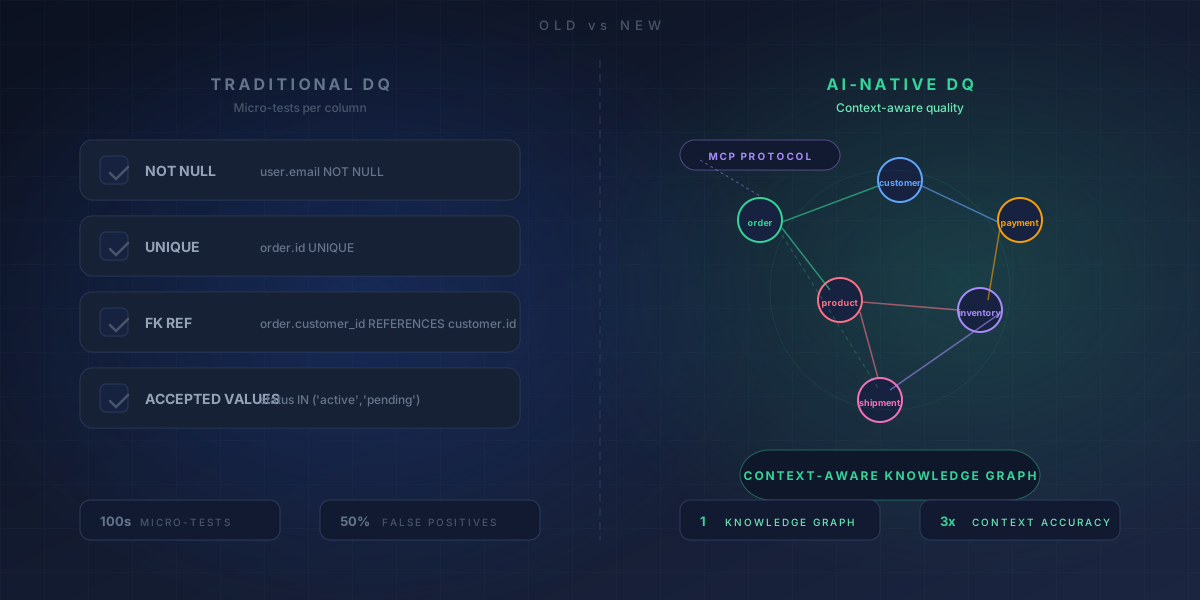
Here's a scenario that every data engineer knows intimately: you inherit a dbt project with 800+ data quality tests. Most are not_null. Dozens are unique. A handful check foreign key references. Every single one runs on every schedule. And every single one is blind to what the data actually means.
The NOT NULL test on user.phone_number fires because 30% of users didn't provide a phone number. Is that a data quality issue? In a B2B sales context, maybe. In a consumer app, probably not. The test doesn't know the difference. It just knows the column is null.
This is the fundamental limitation of traditional data quality: it operates at the column level, not the context level. And as data ecosystems grow more complex, this gap becomes critical. AI is finally offering a way out — not by adding more tests, but by understanding what the data is actually about.
Table of Contents
The Limits of Traditional Data Quality
Let's be clear: column-level tests are not useless. They're essential guardrails. A NOT NULL constraint on a primary key is non-negotiable. A UNIQUE test on an email address catches real problems. Foreign key checks prevent orphaned records that break joins. These tests are cheap, fast, and valuable.
Column-level tests are essential guardrails, but they cannot see business context or entity relationships — which is why teams report 40-60% of data quality test failures are false positives.
But they have fundamental blind spots:
- No business context: A null in a phone number field might be acceptable, concerning, or catastrophic depending on the business domain. The test can't tell the difference.
- No relationship awareness: Column-level tests don't understand that a missing address matters more for a shipped product than a digital download. They don't see the graph of relationships between entities.
- High false positive rates: Teams report that 40-60% of DQ test failures are false positives — valid data that happens to violate a rigid rule. Each false positive erodes trust in the quality monitoring system.
- Static thresholds: A test that checks "value > 0" can't adapt to seasonal patterns, promotions, or market changes. It's either pass or fail, with no nuance.
- Maintenance burden: As schemas evolve and new data sources connect, the test suite grows exponentially. Teams spend more time maintaining tests than acting on their results.
The result? Teams drown in test failures, most of which don't matter. They learn to ignore the alerts. And the data quality problems that actually do matter slip through because no test thought to check for them.
What Is Context-Aware Data Quality?
Context-aware DQ flips the model. Instead of asking "does this column satisfy this rule?", it asks "does this data make sense given what we know about the business?"
This is a fundamentally different approach. It requires:
- Entity knowledge: Understanding that a "customer" and an "order" are related entities with specific business meanings, not just tables with foreign keys.
- Relationship awareness: Knowing that if an order exists, there should be a customer, a payment, and a shipment — and that the quality of each affects the quality of the whole.
- Temporal understanding: Recognizing that data quality expectations change over time — a new data source may have lower initial quality that improves as integration matures.
- Semantic reasoning: Grasping that "revenue" computed one way might be perfectly valid in one context and wrong in another.
This is not something you can achieve with YAML-based test configurations. It requires a knowledge representation of your business — which is exactly what knowledge graphs provide.
"The shift from micro-tests to context-aware quality isn't about better rules. It's about replacing rules with understanding."
Knowledge Graphs: The Backbone of AI-Native DQ
A knowledge graph represents your business entities and their relationships as a connected network. Unlike a traditional data catalog that lists tables and columns, a knowledge graph captures business meaning: customers place orders, orders contain products, products belong to categories, categories are managed by teams.
This representation enables AI to reason about data quality in ways that column-level tests never could:
- Quality propagation: If the "customer" node has quality issues (e.g., missing email), the knowledge graph understands which downstream entities are affected — orders, shipments, support tickets — and can assess impact.
- Context-sensitive validation: Instead of "email NOT NULL", the graph enables "email is recommended for marketing customers but optional for guest checkout customers" — a nuanced rule that matches real business logic.
- Anomaly detection with relationships: An order without a matching payment is suspicious. An order with two payments is also suspicious. The graph sees both patterns; a column-level test sees neither.
- Root cause analysis: When a downstream report shows quality degradation, the knowledge graph can trace backward through entity relationships to identify the source, rather than requiring manual investigation of every upstream table.
- Cross-domain quality scoring: The graph computes a quality score not just per column, but per entity and relationship, giving a holistic view of data health that reflects actual business impact.
Platforms like Performalytic's AI infrastructure increasingly integrate knowledge graphs as the core of their data quality approach, moving beyond schema-level checks to entity-level understanding.
MCP: Connecting AI to Data Context
The Model Context Protocol (MCP) is an emerging standard that enables AI agents to connect to external context sources — and it's a game-changer for data quality.
MCP allows AI models to query knowledge graphs, data catalogs, lineage systems, and business glossaries directly, rather than relying on what's in their training data. For data quality, this means:
- Real-time context injection: When an AI agent evaluates a data quality issue, it pulls the current schema, lineage, and business definitions from the knowledge graph via MCP, ensuring its assessment reflects the actual data environment — not a generic training pattern.
- Tool integration: MCP enables AI to execute data quality checks, query data warehouses, and analyze results through standard tool calls. The AI doesn't just report potential issues — it investigates them.
- Collaborative quality workflows: An AI agent can detect an anomaly, query the knowledge graph for context, check the lineage for root cause, and route the issue to the right data owner — all orchestrated through MCP tool connections.
- Continuous learning: MCP allows AI to store quality assessments and outcomes back to the knowledge graph, building a history of data quality decisions that improves future evaluations.
MCP is still early, but its implications for data quality are profound. It transforms AI from a tool that generates SQL queries into a context-aware quality agent that understands your data domain, monitors quality holistically, and takes action when things go wrong.
When to Invest in DQ vs Let AI Figure It Out
One of the most common questions we hear is: "Should we keep building traditional data quality tests, or should we wait for AI to solve data quality for us?"
The answer is both — but in the right proportions.
Invest in traditional DQ when:
- You need absolute guarantees on critical fields (primary keys, PII, compliance-mandated fields)
- Your schema is stable and well-understood
- You have regulatory requirements that demand documented quality checks
- The cost of a false negative (missing a real quality issue) is very high
Let AI figure it out when:
- You have many data sources with varying quality profiles
- Your schemas evolve frequently
- You need to understand data quality across entity relationships, not just individual columns
- You're drowning in false positives from rigid test rules
- You need quality assessment for datasets without formal test definitions
The hybrid approach looks like this: column-level tests as the hard guardrails for your most critical data. AI-native DQ with knowledge graphs as the flexible, context-aware layer for everything else. The column tests catch the obvious problems. The knowledge graph catches the subtle ones — and helps you understand which column test failures actually matter.
This is where enterprise data architecture becomes critical. You need the infrastructure to support both approaches — reliable pipelines for traditional tests, and knowledge graph + MCP infrastructure for AI-native DQ.
A Practical Path Forward for Data Teams
Here's how to start moving from micro-tests to context-aware data quality, in practical, incremental steps:
- Audit your current DQ test suite - Run a false-positive analysis on your existing tests. Categorize every failure: "real issue," "false positive," or "nuisance." You'll likely find 40-60% fall into the latter two categories.
- Identify your entity graph - Map the 10-15 core business entities (customer, order, product, payment, etc.) and their relationships. This doesn't need to be a formal knowledge graph yet — even a whiteboard sketch surfaces insights.
- Layer in entity-level quality metrics - Start computing quality scores at the entity level, not just the column level. What percentage of customers have complete profiles? What percentage of orders have complete fulfillment chains?
- Introduce a knowledge graph - Use a lightweight knowledge graph tool (Neo4j, Amazon Neptune, or even a well-structured metadata store) to represent your entity graph and compute relationship-aware quality scores.
- Connect AI via MCP - Implement MCP to connect AI agents to your knowledge graph and data catalog. Start with a simple use case: an AI agent that investigates DQ test failures by querying the knowledge graph for context before alerting.
- Measure context-aware DQ effectiveness - Track metrics like false positive rate reduction, root cause identification time, and cross-entity quality correlation. These tell you whether your investment in AI-native DQ is paying off.
The transition from micro-tests to context-aware quality doesn't happen overnight. But the trajectory is clear: data quality is moving from column-level rules to entity-level understanding. The teams that invest in knowledge graphs and MCP today will have a significant advantage as AI-native DQ becomes the standard.
Frequently Asked Questions
What is AI-native data quality?
AI-native data quality replaces brittle column-specific micro-tests (not null, unique, FK) with context-aware quality powered by knowledge graphs and MCP. It understands business context, data relationships, and semantic meaning rather than just checking schema constraints.
What is a knowledge graph in data quality?
A knowledge graph maps entities like customers, orders, products, and payments as connected nodes with relationship edges. For data quality, it enables AI to understand that a null email on a marketing lead matters differently than a null email on a transaction — context that column-level tests can't capture.
What is MCP in data quality?
MCP (Model Context Protocol) is an emerging standard that connects AI agents to external tools and context sources, including data catalog metadata, lineage graphs, and knowledge graphs. It enables AI to make context-aware data quality decisions by pulling real-time context from your actual data environment — not just from training data.
Should I invest in traditional DQ tests or AI-native DQ?
Start with column-level tests for critical schemas and PII validation — these are cheap and high-value. Layer in AI-native DQ through knowledge graphs and MCP for complex domains where context matters. The best approach is a hybrid: traditional DQ for guardrails, AI-native DQ for understanding.
Does MCP replace traditional data quality tools?
No. MCP is a protocol that connects AI agents to existing tools and context. It enhances traditional data quality tooling by adding context awareness — it doesn't replace the underlying validation infrastructure. You still need reliable pipelines, schema validation, and monitoring. MCP makes these tools smarter by connecting them to business context.
How much false positive reduction can I expect with context-aware DQ?
Teams implementing knowledge-graph-based data quality typically see a 50-70% reduction in false positive alerts. This happens because the knowledge graph provides the context needed to distinguish between genuinely concerning data issues and acceptable variations that rigid column-level tests can't understand.
At Performalytic, we help enterprises navigate the transition from traditional data quality to AI-native, context-aware approaches. Our team combines deep expertise in data engineering, knowledge graphs, and AI infrastructure to build data quality systems that understand what your data actually means. Schedule a consultation to learn how we can help your team move beyond brittle micro-tests toward context-aware quality.
See how 4DAlert brings context-aware data quality to life with knowledge-graph-powered monitoring — explore the platform.