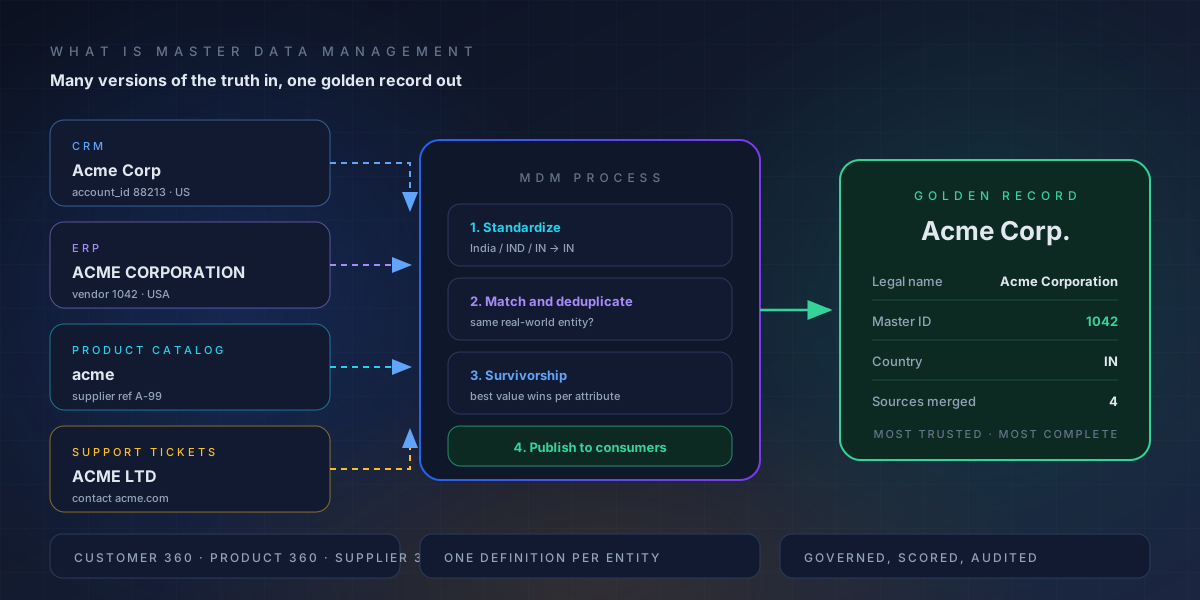
In today's data-driven business environment, organizations generate and manage enormous amounts of information every day. Customer details, product information, supplier records, employee data, financial information, and other critical data are often stored across multiple systems.
When the same information exists in different formats or contains errors and duplicates, it can become difficult for businesses to trust their data.
This is where Master Data Management (MDM) becomes important.
Table of Contents
- What Is Master Data Management?
- What Is Master Data?
- Why Is Master Data Management Important?
- How Does MDM Work?
- What Is a Golden Record?
- Key Components of MDM
- Benefits of Master Data Management
- MDM in Real-World Business
- MDM vs Data Governance
- MDM vs Data Management
- Common Challenges in MDM
- Best Practices for MDM Implementation
- Conclusion
What Is Master Data Management?
Master Data Management (MDM) is a set of processes, policies, technologies, and governance practices used to create, maintain, and manage an organization's most important business data.
The primary goal of MDM is to create a single, trusted, consistent, and accurate view of master data across different business systems.
In simple terms, MDM helps an organization answer:
"What is the correct version of our business data?"
For example, a company may have customer information stored in its CRM, ERP, billing system, and e-commerce platform. MDM helps ensure that customer information remains consistent across these systems.
What Is Master Data?
Master data refers to the core business information that is shared and used repeatedly across an organization.
Common examples include:
Customer Data
Customer master data may include:
- Customer name
- Customer ID
- Address
- Phone number
- Email address
- Customer type
- Location
Product Data
Product master data can include:
- Product name
- SKU
- Product description
- Category
- Brand
- Size and dimensions
- Product hierarchy
- Pricing information
Supplier Data
Supplier master data may contain:
- Supplier name
- Supplier ID
- Address
- Contact information
- Payment terms
- Supplier category
Employee Data
Organizations may also manage employee master data such as:
- Employee ID
- Employee name
- Department
- Job title
- Location
- Manager
Depending on the organization, master data can also include locations, assets, accounts, materials, and other important business entities.
Why Is Master Data Management Important?
Without effective data management, organizations can experience duplicate, incomplete, outdated, or inconsistent records.
For example, a customer could appear in different systems under slightly different names. One system might contain an old address while another has the current address.
This can result in:
- Incorrect reports
- Poor customer experiences
- Duplicate records
- Operational inefficiencies
- Compliance problems
- Incorrect business decisions
MDM helps organizations establish consistent rules for how important data is created, stored, updated, and shared.
How Does MDM Work?
A typical Master Data Management process includes several important stages.
A typical MDM process: collect from every system, standardise formats, cleanse, match and deduplicate, then publish the golden record back out to the applications that need it.
1. Data Collection
Master data is collected from different sources such as CRM systems, ERP platforms, databases, applications, spreadsheets, and external sources.
2. Data Standardization
Data from different systems may use different formats.
For example:
IndiaINDIN
MDM can establish a standard representation so that systems use consistent values.
3. Data Cleansing
Incorrect, incomplete, outdated, or invalid data is identified and corrected.
For example, duplicate customer records can be detected and reviewed.
4. Data Matching and Deduplication
MDM identifies records that may represent the same real-world entity.
For example:
ABC Technologies Pvt. Ltd.
and
ABC Technologies Private Limited
may refer to the same organization.
The MDM solution can match these records based on predefined rules and other data attributes.
5. Golden Record Creation
One of the key concepts in MDM is the Golden Record.
A golden record represents the most trusted and complete version of a business entity.
For example, information from several customer records may be combined to create one trusted customer profile.
6. Data Governance
Data governance establishes rules around data ownership, quality, security, access, and lifecycle management.
It defines questions such as:
- Who owns the data?
- Who can change it?
- What makes the data valid?
- How should duplicates be handled?
- How should changes be approved?
7. Data Distribution
Once master data has been standardized and approved, it can be shared with downstream systems and business applications.
This helps different departments work with consistent information.
What Is a Golden Record?
The Golden Record is a trusted representation of a business entity created by combining and validating information from multiple sources.
Consider this example:
| System | Customer Name | Phone | Address |
|---|---|---|---|
| CRM | ABC Ltd | 9876543210 | Bhubaneswar |
| ERP | ABC Limited | 9876543210 | Bhubaneshwar |
| Billing | ABC Ltd. | 9876543210 | Bhubaneswar |
MDM can recognize these records as belonging to the same customer and create a standardized master record.
The result is a more reliable view of the customer.
Key Components of MDM
An effective MDM strategy usually includes several components.
Data Governance
Defines policies, responsibilities, standards, and ownership for master data.
Data Quality
Ensures that data is accurate, complete, consistent, timely, and valid.
Data Integration
Connects master data across different applications and systems.
Data Modeling
Defines how important business entities and their relationships are structured.
Matching and Deduplication
Identifies duplicate or potentially duplicate records.
Data Stewardship
Assigns people or teams responsibility for maintaining data quality and resolving data issues.
Benefits of Master Data Management
Better Data Quality
MDM helps organizations reduce duplicates, errors, and inconsistencies.
Improved Decision-Making
Business leaders can make decisions using more reliable and consistent information.
Better Customer Experience
A unified customer view can help organizations understand customers more accurately and provide more personalized services.
Increased Operational Efficiency
Employees spend less time searching for, correcting, and reconciling inconsistent information.
Reduced Data Duplication
MDM helps identify duplicate records and establish a trusted master version.
Improved Compliance
Consistent data policies and governance can make it easier for organizations to meet regulatory and internal requirements.
MDM in Real-World Business
Consider a retail company operating hundreds of stores and an online marketplace.
The company may have product information in its ERP, website, warehouse system, mobile application, and sales platforms.
If product information is inconsistent, customers might see different product names, descriptions, prices, or categories.
With MDM, the organization can establish a trusted product master and distribute consistent product information to relevant systems.
This can improve product management, reporting, inventory processes, and customer experience.
MDM vs Data Governance
MDM and data governance are closely related, but they are not the same thing.
Data Governance defines the policies, standards, roles, and rules for managing data.
MDM applies processes and technology to manage and maintain important master data according to those rules.
A simple way to remember the difference is:
Data governance defines the rules; MDM helps put those rules into practice for master data.
MDM vs Data Management
Data management is a broader concept that covers the overall management of an organization's data.
It can include:
- Data integration
- Data quality
- Data security
- Data architecture
- Data governance
- Master data management
- Metadata management
MDM focuses specifically on critical shared business entities, such as customers, products, suppliers, employees, and locations.
Common Challenges in MDM
Implementing MDM is not only a technology project. Organizations may face several challenges, including:
- Poor existing data quality
- Duplicate records
- Different data standards between departments
- Lack of data ownership
- Complex legacy systems
- Resistance to process changes
- Difficult system integration
- Lack of clear governance
For this reason, successful MDM programs usually require cooperation between business teams, data teams, and IT teams.
Best Practices for MDM Implementation
Organizations planning an MDM initiative should consider the following practices:
Start With a Clear Business Problem
Instead of trying to manage every type of data immediately, begin with a specific business need, such as customer or product data.
Define Data Ownership
Clearly identify who is responsible for creating, approving, and maintaining master data.
Establish Data Standards
Define common formats, naming conventions, identifiers, and validation rules.
Focus on Data Quality
Regularly monitor data for duplicates, missing values, incorrect information, and inconsistencies.
Build Strong Governance
Create clear policies and workflows for managing changes to master data.
Integrate With Existing Systems
MDM should work with the organization's existing applications rather than becoming another isolated data system.
Conclusion
Master Data Management (MDM) is the practice of creating and maintaining a trusted, consistent, and accurate view of an organization's critical business data.
By combining data quality, governance, matching, standardization, integration, and stewardship, MDM helps organizations build reliable master records across their business systems.
Whether the focus is customer, product, supplier, employee, or location data, a strong MDM strategy can improve data quality, operational efficiency, reporting, customer experience, and decision-making.
Ultimately, the goal of MDM is simple:
Get the right data, make it trustworthy, and make it available to the right systems and people.
At Performalytic, we help enterprises design and implement modern MDM systems that create golden records your teams can trust. From data quality and governance to matching, standardization, and integration, we build master data foundations that power reliable reporting, operations, and AI initiatives. Schedule a consultation to learn how we can help your organization move from fragmented master data to a trusted, unified foundation. For a deeper look at how MDM has evolved for the AI era, see our guide on Master Data Management in the AI Era and the step-by-step AI-Based Master Data Management guide.
Explore how 4DAlert validates master data quality with automated reconciliation and golden record monitoring across your MDM systems. Browse the Master Data Management knowledge hub for definitions, guides, and FAQs.