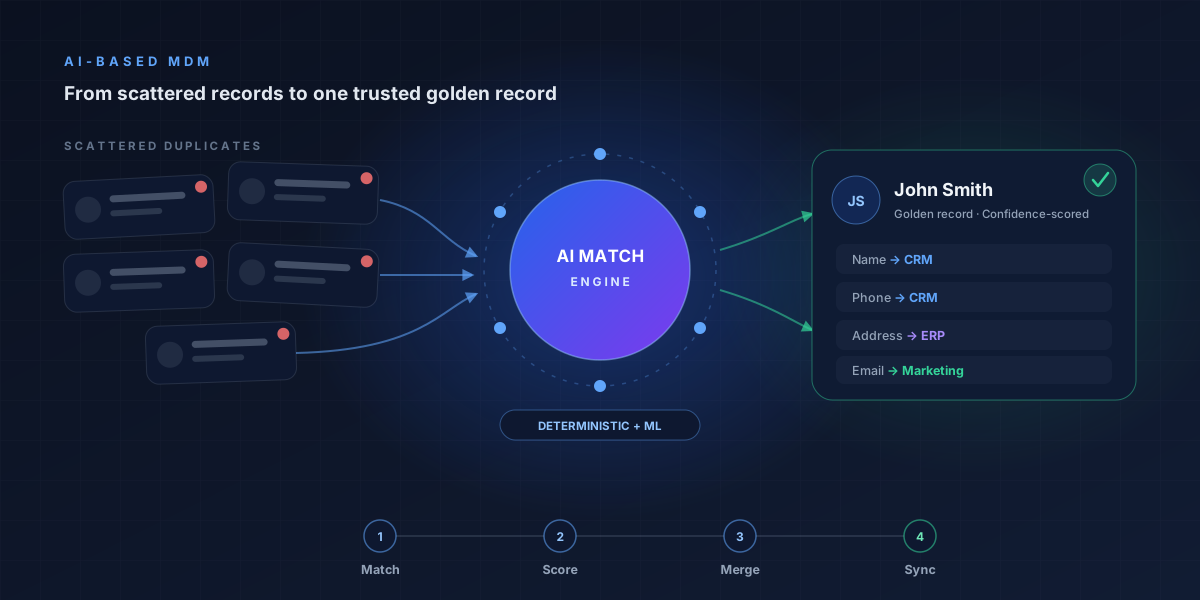
TL;DR - Key Takeaways
- AI-based MDM applies machine learning to the whole MDM lifecycle — standardization, matching, merging, survivorship, and stewardship — instead of hand-written rules alone
- The business driver is AI readiness — duplicate and conflicting master data is the fastest way to make models, dashboards, and agents wrong
- Legacy MDM suites take 6-12 months — AI-native platforms such as 4DAlert deliver entity resolution, reconciliation, and monitoring in weeks
- Start with one domain — usually Customer — prove value, then expand to product, supplier, and location
- Golden records must be verified continuously — reconciliation and anomaly detection keep the golden record honest after go-live
AI-based master data management (AI MDM) is the use of machine learning and language models to create and maintain a single, trusted version of core business entities — customers, products, suppliers, and locations — across all systems. Instead of relying only on hand-written matching rules and manual stewardship, AI-based MDM learns from your data to resolve duplicates, choose the best attribute values, and flag quality issues before they spread.
It matters now for a simple reason: your AI systems are only as good as the entities they recognize. A model that sees "J. Smith", "john.smith@email.com", and "SMITH JOHN" as three different customers will recommend, forecast, and segment incorrectly — no matter how sophisticated the model is. Master data is the layer that turns raw records into entities your analytics and AI can trust.
What Is AI-Based Master Data Management?
Master data management (MDM) is the discipline of creating and maintaining a single, trusted version of the most important business data across systems. AI-based MDM keeps that goal but changes how it is achieved: probabilistic and machine-learned matching replace brittle exact-match rules, adaptive survivorship replaces static "source always wins" logic, and AI copilots assist stewards instead of leaving them with a spreadsheet of exceptions.
The classic MDM pipeline stays the same — ingest, standardize, match, merge, publish — but AI upgrades every step:
- Standardization: Models normalize addresses, names, units, and free-text values that regex rules miss ("Ste." vs "Suite" vs "#")
- Matching: Probabilistic scoring and learned similarity decide whether two records are the same entity
- Merging and survivorship: Rules are ranked and refined by outcomes, choosing the best value per attribute rather than trusting one system blindly
- Publishing: Golden records are exposed to warehouses, BI tools, and AI/RAG pipelines through feeds and APIs
- Monitoring: Anomaly detection watches for new duplicates, drift, and broken feeds continuously
Answer in one sentence
AI-based MDM is master data management where machine learning does the heavy lifting of finding, merging, and maintaining golden records — and humans focus on the exceptions that actually need judgment.
Why Legacy MDM Falls Short in the AI Era
Traditional MDM platforms were designed for a world where the goal was clean reports. They assumed stable source systems, a handful of domains, and stewards who could review every merge. Three assumptions broke:
1. The data got messier
Enterprises now run CRM, ERP, marketing platforms, e-commerce, and event streams — each generating entities in its own format. Free-text notes, international addresses, and constantly changing SaaS schemas make deterministic rules permanently incomplete. Every new rule you write fixes one case and misses the next ten variants.
2. The consumers changed
Master data is no longer consumed only by reports. ML models, customer 360 applications, personalization engines, and retrieval-augmented generation (RAG) pipelines all depend on entity identity. Duplicate customers in a training set or a vector index produce duplicated, contradictory context — which is exactly how AI answers go wrong. For more on this connection, see enterprise RAG architecture.
3. The timeline is unacceptable
Legacy suite implementations regularly run 6-12 months for a single domain, with heavy services involvement. By the time the first golden record ships, the source landscape has changed. AI-native approaches compress this because profiling, match-rule suggestion, and monitoring are built in rather than custom-built afterward.
How AI Changes Each Stage of MDM
Standardization with learned formats
Traditional standardization uses lookup tables and regular expressions. AI adds pattern recognition: detecting that "Ltd.", "Limited", and "LTD" denote the same legal form, that a phone number's country code implies an address format, or that a free-text "company" field contains a real entity name. The practical effect is fewer false mismatches entering the match stage.
AI touches every stage: learned standardisation feeds three matching approaches — deterministic, probabilistic and machine-learned — before survivorship produces the golden record.
Matching: deterministic, probabilistic, and learned
Modern entity resolution blends three approaches:
- Deterministic: Exact matches on strong keys (customer ID, email, tax number). Fast and precise, but misses variants.
- Probabilistic: Fellegi-Sunter style scoring that weighs agreement and disagreement across fields, accounting for field reliability (a matching national ID is far more informative than a matching city).
- Machine-learned: Models trained on accepted and rejected match decisions learn similarity for messy fields — names, addresses, product descriptions — including transpositions, nicknames, and abbreviations that rules never cover.
AI also improves blocking: the step that narrows millions of record pairs to a reviewable candidate set. Learned blocking strategies cut comparison volume without dropping true matches — the difference between a nightly batch that finishes and one that doesn't. For a deeper treatment, see our guide to AI entity resolution.
Merging and survivorship
Survivorship decides which value wins for each attribute when records merge ("CRM phone, ERP address, billing system legal name"). AI-based MDM ranks sources by observed freshness and completeness per attribute rather than trusting a fixed hierarchy — and continuously re-evaluates that ranking as source quality changes.
Stewardship copilots
Exceptions will always exist: near-matches, conflicting registrations, genuinely ambiguous entities. AI changes the steward's job from researching each case to approving a recommended decision. The system surfaces candidate pairs with a confidence score, the evidence behind it, and a suggested action; the steward confirms or rejects — and that feedback retrains the matcher.
Anomaly detection for master data
Once golden records exist, the risk shifts to silent degradation: a broken feed, a source system starting to emit duplicates, a sudden null spike in a key attribute. ML-based anomaly detection learns normal behavior per entity domain and alerts on deviations — the same principle applied in our data quality framework, focused on master data.
Core Capabilities of AI-Based MDM
If you are evaluating platforms, these are the capabilities that separate AI-based MDM from MDM with an AI slide:
| Capability | What it does | Why it matters |
|---|---|---|
| Intelligent entity resolution | Probabilistic + ML matching with learned blocking | Catches fuzzy duplicates rules miss, at scale |
| Golden record automation | Auto merge with attribute-level survivorship | One trusted entity view without manual assembly |
| Confidence scoring | Every match decision carries a score and evidence | Stewards review only low-confidence cases |
| Cross-system reconciliation | Verifies golden records against sources continuously | Catches survivorship errors and broken feeds |
| Duplicate anomaly detection | Learns normal duplicate rates per domain, alerts on spikes | Stops new bad data at the source |
| Exception workflows | Routing, SLA tracking, audit trail, feedback loops | Stewardship becomes measurable, not tribal |
| Natural language interaction | Ask questions about entities and metadata in plain English | Business users verify records without SQL |
AI-Based MDM vs Traditional MDM
| Dimension | Traditional MDM | AI-Based MDM |
|---|---|---|
| Match logic | Hand-written deterministic rules | Probabilistic + ML, continuously tuned |
| Survivorship | Static source hierarchy | Adaptive, per-attribute quality ranking |
| Exception handling | Manual review of every flagged pair | Confidence-ranked review, AI suggestions |
| Deployment | 6-12 months, services-heavy | Weeks, platform-based, incremental |
| Ongoing quality | Periodic data cleanses | Continuous reconciliation and anomaly alerts |
| AI/RAG readiness | Bolted on after the fact | Golden records feed models by design |
| Cost profile | Large upfront license + implementation | Incremental, starts with one domain |
Traditional MDM still has legitimate strengths — deep multi-domain governance, mature write-back coexistence, and long-established vendor ecosystems. The question is not "MDM or no MDM," it is whether you need a 12-month suite project to get trustworthy entities, or whether an AI-native platform can deliver the same outcome faster. For a structured comparison, see 4DAlert vs legacy MDM platforms.
Architecture Patterns Still Matter
AI changes the mechanics of matching and stewardship, not the architectural decisions. The three canonical patterns still apply:
- Registry: Pointers and a match index, no physical golden record — good for quick wins and read-only reference data
- Consolidation: A central hub builds and stores golden records for analytics and AI — where most enterprises should start
- Coexistence: Golden records synchronize back to source systems for operational MDM — the most complex, most rewarding pattern
AI-based MDM works with all three: better matching improves every pattern, and continuous reconciliation is what keeps a consolidation or coexistence hub honest. The full trade-off analysis is in our guide to MDM implementation patterns.
Where AI-Based MDM Delivers Value
Customer 360
Resolve individuals and accounts across CRM, ERP, support, and marketing systems — including households and B2B contact-to-account relationships. The payoff is cleaner segmentation, no duplicate outreach, and reliable customer lifetime value. It is also the precondition for personalization AI that does not recommend a product the customer already returned.
Product 360
Unify product records across catalog, inventory, pricing, and e-commerce systems — variants, bundles, and regional SKUs included. Clean product entities make search, recommendation, and margin analysis trustworthy.
Supplier and vendor master
Duplicate vendor records are a direct financial-control risk (duplicate payments, split approvals). Entity resolution plus continuous duplicate detection is one of the fastest, most measurable MDM wins — and a common audit finding when absent.
Grounding AI and analytics
Golden records give your warehouse semantic layer, dashboards, and RAG pipelines a stable entity key. When an analyst asks "how many active customers do we have?" and an AI agent answers, both should be counting the same entities — see MDM in the AI Era for the wider argument.
How 4DAlert Delivers AI-Based MDM
4DAlert is Performalytic's AI-powered data management platform, and AI-based MDM is one of its core modules. It is built around a practical idea: master data fails not at go-live but in the months after — so the platform combines entity resolution with the reconciliation and monitoring needed to keep golden records true.
What the MDM module does
- Intelligent entity resolution: Deterministic, probabilistic, and ML-assisted matching across customer, product, vendor, and location domains — with confidence scores on every decision
- Automated match & merge: Golden record creation with attribute-level survivorship, tuned by steward feedback
- Cross-system reconciliation: Continuous verification that golden records still agree with their source systems — catching survivorship errors, stale feeds, and downstream drift
- Duplicate anomaly detection: Learns normal duplicate rates per domain and alerts when a source starts emitting new duplicates
- Exception workflows: Low-confidence matches route to the right steward with SLA tracking and a full audit trail
- Pre-built connectors: SAP and Salesforce connectors for the systems that usually own master data, plus 100+ platforms including Snowflake, BigQuery, Databricks, Oracle, PostgreSQL, and SQL Server
- Ask4D GenAI assistant: Ask about an entity, a match decision, or your data landscape in plain English — no SQL required
Why reconciliation is part of MDM, not a separate product
Most MDM tools stop at creating the golden record. 4DAlert reconciles that golden record against sources on an ongoing schedule, so a broken CRM feed or a survivorship regression surfaces as an exception in minutes — not as a wrong number in next quarter's board report. Reconciliation is the feedback loop that makes MDM continuous instead of project-shaped.
Because 4DAlert sits on top of your existing stack, teams typically profile their source systems in the first week and have entity resolution, reconciliation, and monitoring operational within a few weeks — no rip-and-replace, no 12-month implementation. It is SOC2 compliant and deployable inside your VPC on AWS, GCP, or Azure, so master data never leaves your security perimeter.
For the full module breakdown, visit the 4DAlert product page.
A Practical Implementation Roadmap
Organizations that succeed with AI-based MDM follow the same sequence. The common denominator: prove value on one domain before expanding.
- Profile before you build. Scan source systems for duplicate rates, missing attributes, and cross-system conflicts. The profiling report is both your business case and your baseline.
- Pick one high-impact domain. Customer is the usual first choice; vendor master if duplicate payments are an audit finding. One domain done well beats four domains half-done.
- Choose the architecture pattern. Consolidation is the right default for analytics and AI readiness — see the pattern guide if you are unsure.
- Configure resolution, not custom code. Load sources, accept AI-suggested match rules, set confidence thresholds, define survivorship per attribute. Stewards handle the exception queue from day one.
- Wire in verification. Turn on cross-system reconciliation and anomaly alerts before go-live — verification is what keeps the golden record trustworthy after the project team moves on.
- Expand domain by domain. Product, supplier, location — each reuses the same connectors, workflows, and monitoring patterns.
New to the fundamentals? Start with What Is Master Data Management? — and for the broader quality foundation, our data quality framework guide.
Common Pitfalls to Avoid
1. Buying a suite, then implementing rules
The mistake: Purchasing a legacy platform and rebuilding the same brittle deterministic logic you had before — paying legacy prices for traditional behavior.
The fix: Insist on probabilistic and ML-assisted matching with confidence scoring during evaluation. Ask for a demonstration on your messy sample data, not a sanitized vendor dataset.
2. Big-bang multi-domain launches
The mistake: Simultaneously onboarding customer, product, supplier, and location — with no domain proven. Exceptions pile up, stewards disengage, and the program stalls.
The fix: One domain, one measurable outcome (duplicate rate, reconciliation accuracy), then expand with a repeatable playbook.
3. No verification after go-live
The mistake: Treating golden record creation as the finish line. Feeds break, sources change, new duplicates appear — and without reconciliation, the golden record silently rots.
The fix: Continuous reconciliation and anomaly detection are part of the definition of done, not a phase two.
4. Ignoring the exception queue
The mistake: No routing, no SLAs, no audit trail for low-confidence matches. The queue becomes a backlog and stewards revert to spreadsheets.
The fix: Treat stewardship as an operational workflow with ownership, tracking, and feedback into the match model.
5. Skipping the AI readiness argument
The mistake: Framing MDM as a compliance project. It gets funded slowly and cut first.
The fix: Tie MDM to the AI initiatives already funded — clean entities improve model accuracy, RAG citations, and customer-facing automation. That is a budget conversation executives already understand.
Frequently Asked Questions
What is AI-based master data management?
AI-based master data management applies machine learning and language models to the core MDM processes — standardization, matching, merging, survivorship, and stewardship — so duplicate detection and golden record creation improve continuously instead of relying on hand-written rules. The result is higher match accuracy, fewer manual reviews, and master data that is ready for analytics and AI systems.
How is AI-based MDM different from traditional MDM?
Traditional MDM depends on deterministic rules and manual stewardship: exact-match logic, static survivorship, and long, services-heavy implementations. AI-based MDM uses probabilistic and machine-learned matching, adaptive survivorship, anomaly detection for new duplicates, and copilots that help stewards resolve exceptions — cutting implementation time and review effort while improving accuracy on messy, real-world data.
What are golden records and why do they matter for AI?
A golden record is the single, most accurate version of an entity — customer, product, supplier — assembled from duplicate records across systems using match rules and survivorship. AI models and analytics built on deduplicated master data produce more accurate predictions, cleaner segmentation, and reliable reporting. Models trained on fragmented entities reliably produce fragmented answers.
Which systems does 4DAlert connect to for MDM?
4DAlert connects to 100+ data platforms — including Snowflake, BigQuery, Redshift, Databricks, Oracle, PostgreSQL, SQL Server, SAP, and Salesforce — through pre-built connectors. It sits on top of your existing stack, so master data is resolved and reconciled where it already lives, without a rip-and-replace migration or moving data out of your environment.
How long does it take to get AI-based MDM running?
With a platform approach such as 4DAlert, teams typically profile source systems in the first week and have entity resolution, reconciliation, and quality monitoring operational within a few weeks. Legacy MDM suite implementations commonly run 6-12 months for a single domain. The recommended path is identical in both cases: start with one entity domain, prove the outcome, then expand.
At Performalytic, we help enterprises move from fragmented master data to a unified, AI-ready foundation — using 4DAlert to resolve entities, verify golden records, and monitor quality continuously. Schedule a consultation to profile your source systems and see what AI-based MDM would surface in your environment.