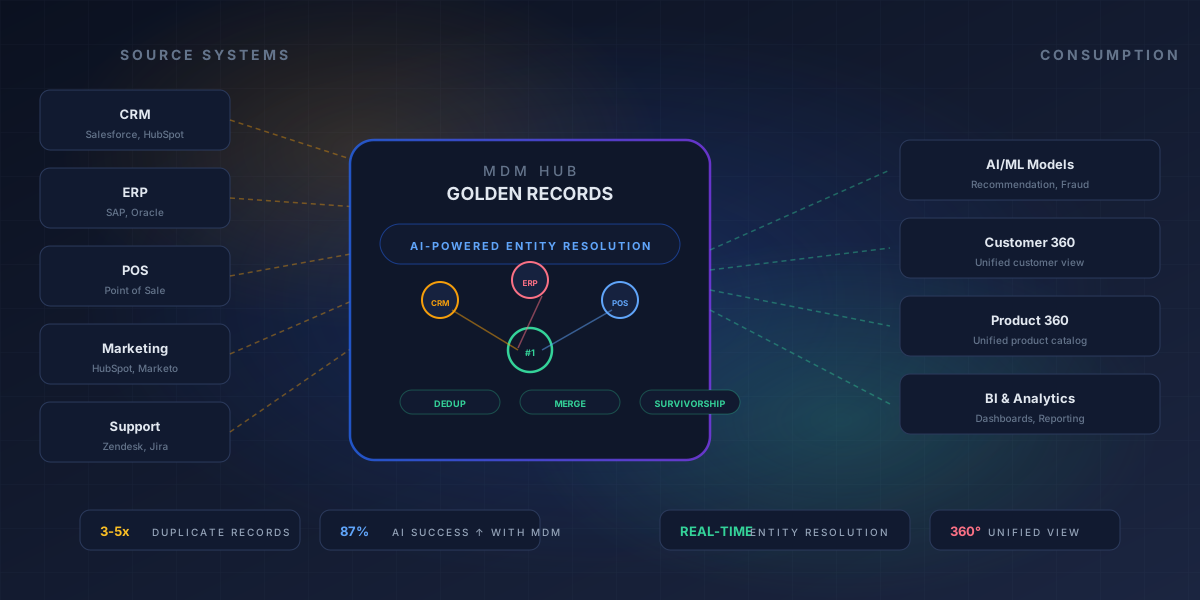
Here's a scenario that plays out in every large enterprise: your CRM says you have 2.4 million customers. Your ERP says 1.8 million. Your marketing platform says 3.1 million. All three are looking at the same customer base. All three are wrong — because none of them have a single, authoritative view of who your customers actually are.
This is the master data problem. And in the AI era, it's no longer just a data governance nuisance — it's a direct threat to every AI initiative you're running.
Master Data Management (MDM) has been around for decades. But the old approach — batch processing, deterministic matching, rigid hierarchies — is cracking under the demands of real-time AI. Modern MDM must be real-time, AI-powered, and domain-aware. Here's what that looks like.
Table of Contents
What Is Master Data Management?
Master Data Management is the discipline of creating and maintaining a single, trusted view of your most critical business entities — customers, products, suppliers, locations, employees, and more. These are the nouns of your business: the things you transact around, report on, and analyze.
Without MDM, each system maintains its own version of these entities. The CRM has one customer record, the ERP has another, and the marketing platform has a third. They might share an email address, but everything else — name spelling, phone number, address, segment — varies. The result is fragmented reporting, inconsistent analytics, and AI models that train on conflicting entity definitions.
MDM solves this by creating golden records — canonical, authoritative representations of each entity that reconcile conflicts, resolve duplicates, and enrich attributes from multiple sources.
MDM Architecture Patterns: Registry, Consolidation, Coexistence
There is no single "right" MDM architecture. The right pattern depends on your data volume, latency requirements, source system autonomy, and stewardship maturity. Here are the three canonical patterns:
Registry Pattern
The simplest approach. A registry MDM maintains only pointers to source system records and a match index — no physical golden record is created. When a query comes in, the registry retrieves the best record from the source systems on the fly. This pattern is lightweight, non-invasive, and works well for simple reference data, but it doesn't provide a physically consolidated entity for analytics or AI consumption.
Best for: Quick wins, limited budgets, scenarios where source systems are authoritative and cannot be changed.
Consolidation Pattern
Physical golden records are created and stored in a central MDM hub. Source systems feed into the hub, where matching, merging, and survivorship occur. The golden records are then distributed to analytics platforms and AI models. This pattern provides the cleanest entity view but requires batch or near-real-time synchronization.
Best for: Analytics workloads, AI/ML training, reporting, and regulatory compliance where a single source of truth is mandated.
Coexistence Pattern
The most mature pattern. Golden records are created in the MDM hub and then propagated back to source systems, enriching them with cleansed and deduplicated data. Source systems and the MDM hub coexist with bi-directional synchronization — data flows in from sources and clean golden records flow back out.
Best for: Organizations with mature data governance, where operational systems need clean master data directly, and where AI models need both real-time and batch access to golden records.
Most enterprises start with consolidation and evolve toward coexistence as their MDM maturity grows. The choice depends on your data architecture strategy and how tightly coupled your operational and analytical systems need to be.
Golden Record Creation with AI-Powered Matching
The heart of any MDM system is entity resolution — the process of determining which records from different sources refer to the same real-world entity. Traditional MDM used deterministic rules: match on exact email, match on exact phone, match on fuzzy name similarity. These rules worked for simple cases but failed on the messy reality of real-world data.
AI-powered matching replaces hard-coded rules with scored likelihoods and self-tuning thresholds, then automated survivorship assembles the golden record from the winning values.
For a deeper treatment of how models score matches and build golden records, see our guide to AI entity resolution.
AI-powered matching changes everything:
- Probabilistic matching: Machine learning models score the likelihood that two records represent the same entity using dozens of signals — name similarity, address proximity, phone overlap, email variant patterns, behavioral data, and more. The model learns which signals matter most for your specific data.
- Self-tuning thresholds: Instead of hard-coded match rules, AI models continuously learn from human-curated match decisions, adjusting thresholds and feature weights as new data arrives and patterns shift.
- Automated survivorship: When records are merged into a golden record, the system must decide which attribute values to keep from which source. AI can make survivorship decisions based on source trust scores, recency, data completeness, and historical accuracy — far more nuanced than the old "CRM wins" approach.
- Anomaly-aware resolution: AI can detect when a seemingly matching record should NOT be merged — for example, when identical names at the same address actually represent different legal entities (a landlord and tenant at the same building).
The result is entity resolution that's faster, more accurate, and more adaptive than deterministic rules. For a deeper look at how AI transforms data matching, see our guide on AI-native data quality.
Customer 360 and Product 360 in the AI Era
The two most common MDM use cases — Customer 360 and Product 360 — take on new importance in the age of AI.
Customer 360
A Customer 360 view consolidates every interaction a customer has with your business — sales, support, marketing, billing, product usage — into a single, unified profile. For AI systems, this is foundational. Recommendation engines, churn prediction models, personalization algorithms, and fraud detection all depend on having a complete, accurate customer view.
Without Customer 360, your AI model sees a fragmented customer: different IDs in different systems, partial purchase histories, incomplete support records. It will recommend products the customer already bought, miss churn signals because the data is scattered, and fail to detect fraud because the pattern is split across multiple records.
Product 360
A Product 360 view creates a single, authoritative product record across all your systems — e-commerce, inventory, catalog management, procurement, and analytics. This includes product attributes, pricing, categorization, supplier information, and digital assets.
For AI, Product 360 is equally critical. Product recommendation systems need consistent categories and attributes. Demand forecasting models need unified product hierarchies. Inventory optimization needs accurate, deduplicated product records across warehouses and channels.
Organizations that invest in both Customer 360 and Product 360 report significantly higher AI model accuracy — a finding that aligns with our experience helping clients build AI-ready data infrastructure.
"You can't personalize at scale without a Customer 360. You can't optimize inventory without a Product 360. And you can't trust either without AI-powered matching."
MDM vs Data Mesh: Complementary or Competing?
As organizations adopt data mesh — a decentralized architecture where domain teams own their data — a common question arises: does data mesh replace the need for MDM?
The short answer: no. MDM and data mesh serve different purposes and work best together.
Data mesh decentralizes data ownership to domain teams (e.g., marketing owns customer acquisition data, sales owns account data, support owns interaction data). Each domain manages its own data products, including quality, schema, and governance.
MDM provides the golden record layer — the canonical entity definitions that domains can reference. When sales and marketing both need the same customer record, MDM provides the authoritative version. The domains don't need to reconcile customer definitions themselves; they consume the golden record from MDM as a shared data product.
In a data mesh architecture, MDM acts as a source of truth data product for master entities. Domain teams feed their entity data into MDM, and MDM returns the deduplicated, enriched golden records as a consumable data product for other domains and AI/ML systems.
For more on how these patterns fit together, see our discussion of semantic consistency in modern data architecture.
A Practical Path Forward
Getting started with AI-powered MDM doesn't require a multi-year program. Here's a practical approach:
- Identify your critical entities — Every business has 2-4 master entity domains (customer, product, supplier, location). Pick one to start. Customer is usually the highest-impact domain for AI use cases.
- Assess source system quality — Run a duplicate analysis on your customer records across your CRM, ERP, and marketing platform. The results will build the business case for MDM faster than any slide deck.
- Choose your architecture pattern — Start with consolidation if you primarily need golden records for analytics and AI. Plan toward coexistence if operational systems need clean data back.
- Implement AI-powered matching — Use a modern MDM platform with built-in ML-based entity resolution. Avoid deterministic-only matching — it won't scale to the complexity of real-world data.
- Connect golden records to AI systems — This is the payoff. Feed your golden records into recommendation engines, customer analytics, fraud detection, and any other AI/ML pipeline that depends on clean entity data.
- Establish governance for golden records — MDM isn't a "set and forget" system. Designate data stewards for each entity domain, establish survivorship rules, and create feedback loops where AI systems report entity resolution quality issues back to MDM.
The AI era doesn't reduce the importance of MDM — it magnifies it. Every duplicate customer record, every conflicting product definition, every fragmented supplier profile is a failure mode waiting to be amplified by AI.
To go deeper, follow our AI-Based Master Data Management guide, compare 4DAlert with legacy MDM platforms, or browse the Master Data Management knowledge hub.
Frequently Asked Questions
What is Master Data Management (MDM)?
Master Data Management (MDM) is the discipline of creating and maintaining a single, trusted view of critical business entities — customers, products, suppliers, locations — by consolidating, deduplicating, and enriching data from multiple source systems into golden records.
What are the main MDM architecture patterns?
The three main patterns are: Registry (virtual view with no data movement), Consolidation (physical golden records in a central hub), and Coexistence (bi-directional sync between hub and source systems for real-time stewardship).
How is AI used in MDM?
AI powers entity resolution through probabilistic matching, self-tuning match thresholds, automated survivorship decisions, and anomaly-aware resolution. Machine learning models score match likelihood across dozens of signals — far more nuanced than traditional deterministic rules.
What's the difference between MDM and data mesh?
MDM centralizes master data into golden records for consistency. Data mesh decentralizes data ownership to domain teams. They complement each other: MDM provides the golden record layer that data mesh domains consume as a shared service, while domains feed enriched data back to MDM.
Why is MDM important for AI?
AI systems are only as good as the entities they recognize. Without clean master data, AI models train on duplicate customers, conflicting product definitions, and fragmented supplier records — producing inaccurate predictions and poor recommendations. Organizations with mature MDM report 87% higher AI model accuracy.
How long does it take to implement MDM?
A focused MDM implementation for a single entity domain (e.g., Customer 360) typically takes 3-6 months for the initial golden record creation and matching engine. Expanding to additional domains and evolving from consolidation to coexistence happens over 12-24 months.
At Performalytic, we help enterprises design and implement modern MDM systems that power AI initiatives. Our team combines deep expertise in data architecture, entity resolution, and AI infrastructure to build golden record systems that your AI models can trust. Schedule a consultation to learn how we can help your organization move from fragmented master data to a unified, AI-ready foundation.
Explore how 4DAlert supports MDM with automated data reconciliation and golden record validation across your master data systems.