TL;DR - Key Takeaways
- Legacy suites optimize for governance breadth; AI-native platforms optimize for time-to-trusted-record
- The biggest practical differences are matching approach (rules vs scored/learned), implementation duration (months vs weeks), and post-go-live verification
- 4DAlert sits on top of your stack — 100+ connectors, VPC deployment, no rip-and-replace
- Legacy suites still win in specific situations: deep multi-domain operational MDM with write-back, existing licenses, and long-program capacity
- The honest evaluation question is not "which platform is better" but "which do we need for the outcome we are funding"
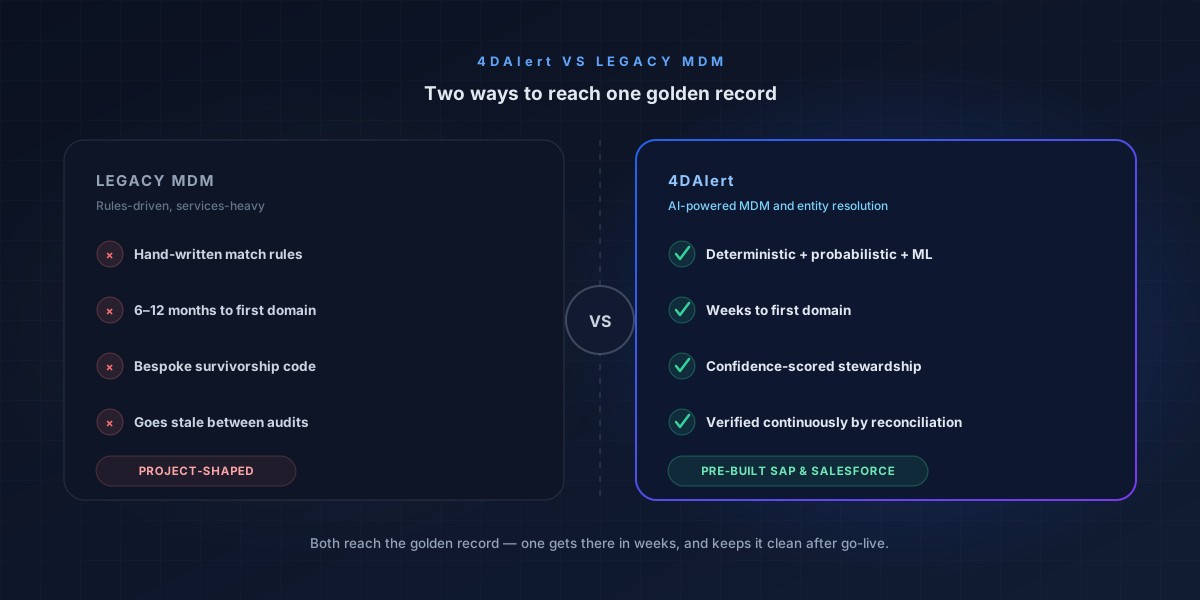
The short version: legacy MDM suites are broad, governance-heavy platforms that typically take 6-12 months and significant services effort to reach a first production domain, using largely deterministic matching. 4DAlert is an AI-native MDM platform that combines probabilistic and ML-assisted matching with continuous cross-system reconciliation, sits on top of your existing stack, and typically reaches a first domain in weeks. Neither is universally correct — the right choice depends on whether you are buying governance breadth or time-to-value.
This article is written by the team that builds 4DAlert, so read it with that in mind. We have kept it to observable, feature-level differences and have stated plainly where legacy platforms hold advantages. Nothing here compares pricing figures (which vary too much by deal) or makes claims about specific vendors' internal practices — where a point is our own approach, we say so.
Why This Comparison Is Hard to Find Honest
Most MDM comparisons are either vendor scorecards written by people who have never implemented an MDM program, or feature-matrix marketing that scores both platforms "excellent" on everything. The differences that actually decide programs are usually:
- How matching handles messy, variant-heavy data — and what happens to the exceptions
- How long until the first domain produces trusted records in production
- Whether golden records stay true after go-live, or silently drift
- How much of the implementation is configuration vs custom development
- Who owns the system on day 400, when the implementation partner has left
Those are the axes used below.
Two Platform Philosophies
Legacy MDM suites
Legacy MDM platforms — the category established before machine learning was practical in production data pipelines — were designed for comprehensive governance of many domains with formal stewardship hierarchies. Their strengths are real: mature multi-domain modeling, established write-back coexistence patterns, large partner ecosystems, and procurement familiarity. Their design center was a world of stable source systems and teams with multi-year budgets.
The two design centres: a legacy suite optimises for comprehensive multi-domain governance, an AI-native platform optimises for reaching a trusted first domain fast on infrastructure you already run.
AI-native platforms (4DAlert)
4DAlert starts from the opposite constraint: reach a trusted first domain fast, on top of infrastructure you already have, and keep it verified continuously. Matching is scored and learned rather than purely ruled; stewardship is exception-driven; reconciliation is part of the module rather than a separate initiative. The trade-off is deliberate — depth of multi-domain governance apparatus is thinner than a full suite in exchange for speed and a smaller operational footprint.
The honest framing
If your program's primary deliverable is an enterprise-wide governance operating model spanning many domains and write-back to source systems, evaluate a suite. If your deliverable is trusted entities for analytics and AI — fast, verified, and maintainable by a small team — evaluate 4DAlert. Many enterprises do both: a suite for operational domains, an AI-native layer for speed-critical ones.
Matching and Entity Resolution
This is where the two approaches diverge most concretely.
| Aspect | Legacy MDM Suites | 4DAlert |
|---|---|---|
| Default match logic | Deterministic rules; probabilistic matching available but typically configured per project | Deterministic + probabilistic + ML-assisted run together by default |
| Rule maintenance | Manual rule tuning as sources change | Steward decisions feed back into matching continuously |
| Match output | Match / no-match per configured rules | Confidence score + evidence on every pair |
| Exception volume | Often large — every rule hit needs review | Ranked queue; only low-confidence pairs routed |
| Blocking at scale | Configured and tuned during implementation | Built-in candidate generation designed for large volumes |
The practical consequence: with rules-only matching on messy data, accuracy is a function of how much tuning time you buy. With scored and learned matching, accuracy improves with usage because every steward decision is training signal. For the underlying methods, see AI entity resolution.
Architecture and Deployment
Legacy suites: hub by design
Legacy platforms classically establish a central hub — registry, consolidation, or coexistence — with significant integration work per source. The hub pattern is sound; the cost is in per-source connectors, data movement approvals, and often infrastructure you must host and secure yourselves. Cloud-native releases have improved deployment speed, but integration remains the long pole.
4DAlert: on top of your stack
4DAlert connects to 100+ platforms — Snowflake, BigQuery, Redshift, Databricks, Oracle, PostgreSQL, SQL Server, SAP, Salesforce, and more — and can run inside your VPC on AWS, GCP, or Azure. Resolution and reconciliation happen against data where it already lives; golden records publish to consumers through feeds and APIs. There is no rip-and-replace migration and no requirement to move master data to a vendor cloud. SOC2 compliance covers the platform; VPC deployment keeps data in your perimeter.
| Architecture aspect | Legacy MDM Suites | 4DAlert |
|---|---|---|
| Topology | Central hub (registry / consolidation / coexistence) | In-place processing over connected systems |
| Deployment | Vendor cloud, hybrid, or on-prem (varies by edition) | VPC deployment on AWS, GCP, or Azure |
| Data movement | Typically centralizes copies in the hub | Resolves in place; publishes golden records |
| Connectors | Broad ecosystem; many connectors are licensed separately | 100+ pre-built connectors included |
| Rip-and-replace | Often requires source system realignment | None — works with existing systems |
One nuance: coexistence — writing golden values back to operational sources — is a genuine legacy-suite strength. 4DAlert focuses on consolidation-style golden record publication with strong verification; programs that require deep two-way write-back per source should scope that requirement explicitly during evaluation.
Implementation Timeline
Timelines vary by organization, source count, and domain complexity — but the shape of the difference is consistent, and it comes from where the effort goes:
- Legacy suite path: licensing and edition selection → environment provisioning → source system analysis → hub modeling → custom connector development → rule configuration → stewardship organization setup → test cycles → phased rollout. The custom development and integration phases dominate.
- 4DAlert path: connect sources → profile duplicates and conflicts → accept or adjust AI-suggested match rules → set confidence thresholds and survivorship per attribute → enable reconciliation and alerts → go live on one domain → expand. Configuration dominates; custom development largely disappears.
Industry experience puts legacy suite implementations at 6-12 months for a first domain; 4DAlert teams typically profile in week one and run production resolution within a few weeks. The comparison is not really "fast vs slow" — it is implementation-heavy vs configuration-heavy, which also determines who maintains the system after go-live.
Program sequencing guidance for either approach is in MDM implementation patterns.
Stewardship and Governance
Here the trade is explicit, and legacy suites are not wrong about governance mattering.
| Stewardship aspect | Legacy MDM Suites | 4DAlert |
|---|---|---|
| Governance model | Formal roles, hierarchies, multi-domain policies | Lean, exception-driven stewardship |
| Review workflow | Configurable workflows; review volume depends on rule design | Confidence-ranked queue, SLA tracking, audit trail |
| Business user access | Steward consoles; training typically required | Ask4D GenAI assistant — plain-English queries, no SQL |
| Audit and traceability | Mature, deeply established | Full match/merge provenance with confidence evidence |
If your regulator or internal audit expects a formal multi-tier stewardship operating model spanning a dozen domains, a suite maps to that expectation more directly. If your stewards are three people wearing MDM as a second hat, exception-driven workflows with SLAs are what will actually get used.
Verification After Go-Live
This is 4DAlert's clearest design difference, so state it plainly: most MDM platforms treat golden record creation as the goal. 4DAlert treats golden record maintenance as part of the same module.
- Cross-system reconciliation verifies golden records against their sources on a schedule — catching survivorship errors, stale feeds, and downstream drift while they are exceptions, not wrong numbers in a board report
- Duplicate anomaly detection learns normal duplicate rates per domain and alerts when a source starts emitting new duplicates
- 98% reconciliation accuracy is the operating metric 4DAlert is held to across enterprise deployments
Legacy suites can be configured with data quality monitoring modules — often separately licensed and implemented — but continuous golden-record-vs-source verification is not part of the core MDM contract in the same way. For the wider argument on why verification is the whole game, see AI-based MDM.
Total Cost Profile
We will not quote prices — deal-specific and unverifiable in either direction. What can be compared is the shape of the cost:
| Cost dimension | Legacy MDM Suites | 4DAlert |
|---|---|---|
| Upfront structure | Platform license + edition tiering + implementation services | Platform subscription; configuration-led rollout |
| Integration cost | Often the largest line — per-source connectors and data movement | Included in 100+ pre-built connectors |
| Services dependency | High during implementation; partner-dependent for changes | Low — domain expansion is configuration |
| Cost of delay | Months before first trusted domain | Weeks — value accrues while program continues |
| Ongoing tuning | Rule maintenance as sources evolve | Feedback loops; monitoring included |
The under-discussed line is cost of delay: a suite delivering its first trusted customer domain in month nine has eight months where analytics and AI run on unresolved data. Whether that matters depends entirely on what the program is funding.
Full Feature Comparison
| Capability | Legacy MDM Suites | 4DAlert |
|---|---|---|
| Matching approach | Deterministic-led, probabilistic optional | Deterministic + probabilistic + ML-assisted |
| Confidence scoring | Varies by product and edition | Every match scored with evidence |
| Golden record automation | Mature consolidation and coexistence | Automated merge with per-attribute survivorship |
| Continuous reconciliation | Separate DQ module or manual | Built into the MDM module |
| Duplicate anomaly detection | Rarely built-in | Built-in per-domain baselines |
| Stewardship model | Formal, multi-tier governance | Exception-driven with SLA tracking |
| Natural language access | Limited or add-on | Ask4D GenAI assistant |
| Connectors | Broad, often separately licensed | 100+ included |
| Deployment | Vendor cloud / hybrid / on-prem | Your VPC: AWS, GCP, Azure |
| Compliance | Established enterprise certifications | SOC2 compliant |
| First domain timeline | Commonly 6-12 months | Typically a few weeks |
| Write-back coexistence | Deep, established support | Golden record publication (scope explicitly) |
| Multi-domain governance breadth | Extensive | Focused on high-impact domains first |
| Client track record | Long vendor histories | 500+ clients, including Pfizer, Ecolab, GSK |
When a Legacy Suite Wins
Because this page is on our site, the least we can do is name the situations where we are the wrong choice:
- Deep operational MDM with extensive write-back. If golden values must synchronize bi-directionally into dozens of operational systems with conflict resolution per system, suite coexistence tooling is more mature than 4DAlert's consolidation-focused publication. Scope this requirement explicitly.
- You already own a suite license. A rational sequence is often: use the suite you have for domains where it fits, and evaluate an AI-native layer for domains where speed matters. Rip-and-replace of a working platform is rarely the right first move.
- Formal multi-tier governance is the deliverable. If the program's success metric is a governance operating model — roles, policies, approvals across a dozen domains — a suite's stewardship apparatus maps to that directly.
- Long-program capacity and partner ecosystem. If you have the budget, the timeline, and an implementation partner who has done this before on your chosen platform, the suite path de-risks toward known outcomes.
- Procurement standardization. Enterprises with approved vendor lists and multi-year framework agreements may prefer the platform their procurement team already knows.
And the mirror-image list — where 4DAlert fits better: you need trusted entities for analytics and AI fast; your team is small and cannot staff a stewardship organization; sources are many and modern (cloud warehouses, SaaS CRM/ERP); data lives in your VPC and must not leave; and post-go-live verification matters as much as go-live day.
The evaluation question that actually helps
Do not ask "which platform is better?" — ask "which outcome are we funding this quarter?" If the answer is a trusted customer golden record feeding this year's AI initiatives, the evaluation is short. If it is an enterprise governance program spanning five years, take the suite path seriously and compare honestly.
See the 4DAlert product page for module-level detail, and the AI-based MDM guide for the wider context.
Frequently Asked Questions
How does 4DAlert compare to legacy MDM platforms?
The core differences are approach and timeline. Legacy MDM suites emphasize broad multi-domain governance with deterministic rules and services-heavy implementations that commonly run 6-12 months for a first domain. 4DAlert is an AI-native platform combining probabilistic and ML-assisted matching, confidence-scored stewardship, and continuous cross-system reconciliation, typically standing up a first domain in weeks on top of your existing stack. Legacy suites retain advantages in deep write-back coexistence and formal multi-tier governance breadth.
When is a legacy MDM suite the better choice?
Legacy suites are reasonable when you need deep operational MDM with write-back coexistence across many domains, already hold enterprise licenses, have established vendor relationships and internal implementation teams, and can fund a long program. Governance breadth, coexistence maturity, and procurement familiarity outweigh speed in those cases — and using a platform you already own is often the rational first move.
Does 4DAlert replace our warehouse or CRM?
No. 4DAlert sits on top of your existing stack through pre-built connectors to 100+ platforms including Snowflake, BigQuery, Databricks, Oracle, PostgreSQL, SQL Server, SAP, and Salesforce. Master data is resolved and reconciled where it already lives; golden records are published to consumers through feeds and APIs. There is no rip-and-replace migration and no requirement to move master data out of your environment.
How fast can 4DAlert be implemented?
Teams typically profile source systems in the first week and have entity resolution, reconciliation, and monitoring operational on a first domain within a few weeks, compared to the 6-12 months common for legacy MDM suite implementations. Timelines depend on source count and domain complexity, but the platform approach removes the custom connector development and hub modeling phases that dominate legacy projects.
Is 4DAlert suitable for regulated environments?
Yes. 4DAlert is SOC2 compliant and deployable inside your VPC on AWS, GCP, or Azure, so master data does not leave your security perimeter. Every match and merge decision carries a confidence score, its supporting evidence, and a full audit trail with survivorship provenance — supporting the traceability requirements typical of regulated industries. 4DAlert serves 500+ clients, including Pfizer, Ecolab, and GSK.
The most useful next step is a side-by-side on your own landscape: bring your source list and one thorny duplicate problem, and we will show exactly how 4DAlert would handle it — and tell you plainly if a suite path suits you better. Schedule a consultation to start.