TL;DR - Key Takeaways
- Entity resolution answers one question: which records across systems describe the same real-world entity?
- No single matching method wins — production systems combine deterministic keys, probabilistic scoring, and ML-learned similarity
- Blocking is the hidden bottleneck: without it, comparing every record pair is quadratic and unrunnable
- Confidence scoring makes AI reviewable: humans handle low-confidence pairs; the model handles the rest
- Resolution is not the finish line — survivorship plus continuous reconciliation keep the golden record true
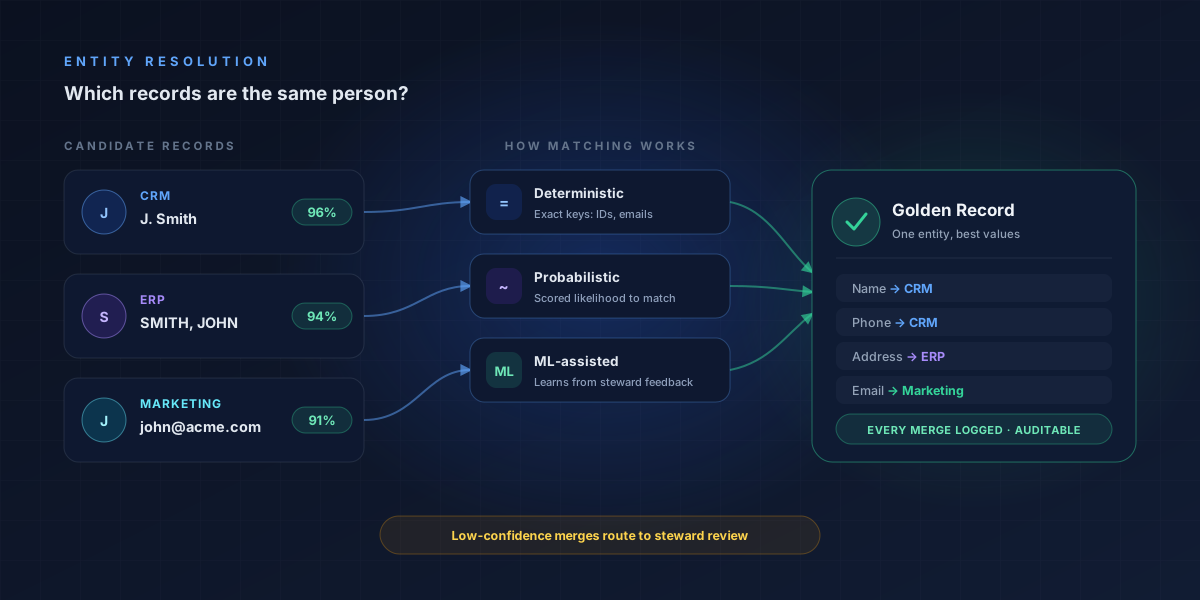
AI entity resolution is the process of using deterministic rules, probabilistic scoring, and machine learning to determine which records across systems refer to the same real-world entity — and merging them into a single golden record. It is the engine underneath customer 360, product 360, vendor deduplication, and every AI system that needs to know that "J. Smith", "John Smith", and "SMITH, JOHN" are one person.
Entity resolution has gone by many names — record linkage, deduplication, identity resolution, match and merge — but the problem is constant: your organization has the same entity stored multiple times, in different shapes, across systems that were never designed to agree. What changed recently is the method: ML models now learn similarity from your own steward decisions instead of depending on rules that are stale the week after they are written.
What Is Entity Resolution?
Entity resolution is the step in the MDM pipeline where raw records become entities. Given two or more records — say, a CRM account and an ERP customer — it decides:
- Match: Are these the same entity?
- Merge: If yes, how do we combine them into one record?
- Keep separate: If no, what evidence says they are different?
Three sub-problems make this genuinely difficult: identity (what does "same entity" even mean — same person at the same address? same company including subsidiaries?), similarity (how do you compare fields written in different formats and languages?), and scale (10 million records means 50 trillion pairs to consider if you compare naively).
Answer in one sentence
Entity resolution is how a system decides that multiple imperfect records describe one real-world thing — and produces a single trustworthy version of it.
Why Entity Resolution Is Hard
The same entity never looks the same twice
Names get transposed, truncated, and localized. Addresses use different conventions per country and per data-entry operator. Phone numbers carry or omit country codes. Product descriptions vary by marketing team. Free-text notes bury the only unique identifier three sentences deep. Deterministic rules handle exactness; they do not handle variation.
Not all fields are equally trustworthy
A matching national tax ID is near-conclusive. A matching city is almost meaningless — millions of people share one. Effective matching weights fields by how informative their agreement is, which varies by domain: in B2B data, matching domains on email are strong; in consumer data, shared households make email sharing common.
Some entities genuinely conflict
Mergers, subsidiaries, name changes, and re-registrations create cases where two records are related but not identical — or identical but with conflicting attributes. Resolution needs a policy for near-boundary cases, not just a threshold slider.
Scale makes naive comparison impossible
Comparing every pair of n records costs n(n-1)/2 comparisons. At 10 million records that is roughly 50 trillion pairs. Any real system needs blocking — strategies that narrow the candidate set (by phonetic name keys, zip code, email domain, embedding proximity) before expensive comparison runs. Poor blocking silently destroys recall: the true match never gets compared, so no algorithm downstream can find it.
For more on why this problem keeps getting harder at enterprise scale, see AI-based master data management.
Three Matching Approaches
1. Deterministic matching
Exact agreement on strong identifiers: customer ID, email, tax number, barcode. It is fast, explainable, and precise — the right first pass. Its blind spots are equally clear: one typo, one leading zero, one format change, and the match fails. Deterministic matching finds the easy duplicates and nothing else.
2. Probabilistic matching
Rooted in the Fellegi-Sunter model, probabilistic matching computes a score from the pattern of agreements and disagreements across fields, weighting each field by its discriminatory power. Agreement on a rare identifier contributes a large score; agreement on a common field contributes little. The output is a probability-like score rather than a binary answer — which matches reality: some pairs are obviously the same, some are obviously different, and a meaningful slice sits in the middle.
3. Machine-learned matching
ML models learn similarity directly from examples — accepted and rejected pairs from stewards, historical merges, or labeled samples. They shine on the fields that defeat rules:
- Names: nicknames, transliterations, initials, cultural ordering ("Wei Zhang" / "Zhang Wei")
- Addresses: unit numbers, abbreviations, informal descriptions ("the warehouse on 5th")
- Product text: descriptions that differ in wording but denote the same SKU
- Embedding-based similarity: dense vector representations catch semantic equivalence that token-level comparison misses
| Approach | Best for | Weakness |
|---|---|---|
| Deterministic | Strong keys, exact duplicates, first pass | Misses every variant and typo |
| Probabilistic | Mixed-quality fields, explainable scoring | Needs field weights tuned per domain |
| Machine-learned | Messy names, addresses, free text, semantics | Needs training signal and monitoring |
Production systems run all three: deterministic keys first for precision, probabilistic scoring for the bulk of candidates, ML for the messy fields — then a single ranked queue for review.
Anatomy of an AI Resolution Pipeline
A complete AI entity resolution pipeline has six stages. Most failed implementations skip at least two.
A complete AI entity resolution pipeline has six stages — most failed implementations skip at least two, usually blocking and verification.
- Standardization. Normalize formats — case, whitespace, punctuation, address structure, units — so comparison is fair. AI-assisted standardization learns patterns rules miss.
- Blocking / candidate generation. Produce manageable candidate pairs using keys, phonetic encodings, sorted neighborhood, or learned blocking. This stage decides your recall ceiling.
- Comparison. Compute field-level similarities for each candidate pair: exact, fuzzy, phonetic, token-based, and embedding-based comparisons.
- Scoring and classification. Combine field comparisons into a pair score (probabilistic or model-predicted) and classify as match, non-match, or review.
- Merge and survivorship. Cluster matched records, resolve attribute conflicts, and emit the golden record with provenance for every field.
- Verification and feedback. Reconcile golden records against sources on a schedule, watch duplicate rates for anomalies, and feed steward decisions back into the matcher.
Stage six is what separates a project from a capability. Without verification, resolution quality decays the moment a source system changes — see data quality monitoring for the broader pattern.
Confidence Scores and Human Review
AI entity resolution does not aim to eliminate human review — it aims to make review finite and worthwhile. Every candidate pair carries a confidence score and the evidence behind it:
- High confidence: auto-merged, with the decision logged and reversible
- Low confidence: routed to a steward queue with the matching fields highlighted, conflicting values side by side, and a suggested action
- Rejections: become training signal — the model learns that this pattern is not a match
This is the core economic shift. In a rules-only world, stewards review everything the rules flag — usually an enormous, undifferentiated pile. In a scored world, stewards work a ranked queue where each decision is high-leverage, and every decision improves the next model iteration.
The operational details — routing, SLAs, audit trails, feedback loops — are what make this work in practice. They are covered in MDM implementation patterns.
Merge and Survivorship
Finding duplicates is half the job. The other half is deciding what the merged record says. When three systems hold different phones for one customer, survivorship rules decide which phone the golden record carries:
- Source hierarchy: "CRM always wins" — simple, but wrong whenever CRM is stale
- Recency: most recently updated value wins — better, but rewards systems that update frequently with junk
- Completeness / quality scoring: the value from the field with the best observed quality and freshness wins
- Domain-specific overrides: billing address from ERP, marketing consent from the consent system, legal name from the registry
AI-based platforms rank sources per attribute using observed behavior rather than a global hierarchy — and keep re-ranking as sources change. Crucially, every surviving value keeps a pointer to its origin, so a golden record field can always be traced and defended in an audit.
Merging also needs cluster discipline: match decisions can chain (A~B, B~C) into clusters. Chaining bugs — where two clearly different entities get connected through a single wrong link — are one of the most common causes of bad merges, and a key reason automated merges need confidence thresholds and periodic cluster audits.
Measuring Accuracy
Entity resolution quality is measured with the same two axes as any classifier:
- Precision: of the pairs marked as matches, how many truly are? Low precision means bad merges — the expensive failure, because wrong merges corrupt the golden record.
- Recall: of the true duplicate pairs, how many were found? Low precision means duplicates survive — the quiet failure that keeps polluting analytics.
- Review rate: what percentage of pairs need a human? This is the operating-cost metric.
All three are measured against a labeled evaluation set — a representative sample that stewards have judged. Mature teams maintain this set as a regression suite: every rule or model change is scored against it before deployment. 4DAlert reports 98% reconciliation accuracy across enterprise deployments, with confidence scores surfaced on every match decision so precision and review rate are visible per domain rather than asserted once.
Common Use Cases
Customer deduplication
The classic case: resolve individuals and accounts across CRM, ERP, support, and marketing. Direct payoffs — no duplicate outreach, trustworthy segmentation, correct lifetime value — and a prerequisite for personalization AI that does not contact churned customers.
Vendor and supplier matching
Duplicate vendor records are a financial-control risk: duplicate payments, split approvals, audit findings. Entity resolution here is measurable in dollars recovered and is often the first MDM win a CFO notices.
Product catalog consolidation
Merge product records across catalog, inventory, pricing, and e-commerce — variants, bundles, regional SKUs — so search, recommendation, and margin analysis operate on one product entity.
Reference and regulatory data
Matching internal parties to regulatory lists (sanctions, beneficial ownership, LEI codes) where false negatives carry compliance consequences and false positives carry investigation cost.
Feeding AI and RAG systems
Retrieval-augmented generation and analytics agents need stable entity keys to cite and reason over. Duplicate entities produce duplicate, contradictory context — which is how AI answers drift. More on this in enterprise RAG architecture.
Entity Resolution in 4DAlert
4DAlert is Performalytic's AI-powered data management platform, and entity resolution is a core module rather than a bolt-on. It implements the full pipeline described above, with three design choices that matter:
- Match with confidence, review by exception. Deterministic, probabilistic, and ML-assisted matching run together across customer, product, vendor, and location domains. Every decision carries a score and its evidence; only low-confidence pairs enter the steward queue, routed with SLA tracking and a full audit trail.
- Verify after merge. Continuous cross-system reconciliation checks golden records against their sources on a schedule, and duplicate anomaly detection learns normal duplicate rates per domain — so a broken feed or a source starting to emit duplicates surfaces as an exception instead of a wrong number downstream.
- Stay in your environment. 4DAlert connects to 100+ platforms — Snowflake, BigQuery, Redshift, Databricks, Oracle, PostgreSQL, SQL Server, SAP, Salesforce — and deployable inside your VPC on AWS, GCP, or Azure. SOC2 compliant; master data does not leave your perimeter.
Why post-merge verification is part of resolution
A golden record created once is a snapshot; a golden record reconciled continuously is a capability. Survivorship errors, stale feeds, and new upstream duplicates all degrade resolution quality after go-live — and without reconciliation and anomaly alerts, none of them announce themselves. This is why 4DAlert treats verification as part of the entity resolution module, not a separate project.
Teams typically profile their source systems in week one and run production resolution on a first domain within a few weeks. The 4DAlert product page walks through the module in detail.
Implementation Checklist
If you are standing up entity resolution — with 4DAlert or any other approach — these are the decisions to lock before you write match logic:
- Define the entity and its identity criteria. What makes two records "the same customer"? Households? Parent-child accounts? Write it down before tuning thresholds.
- Profile duplicates and conflicts first. A baseline duplicate rate per domain gives you the business case and the metric you will be judged on.
- Design blocking before matching. Validate candidate-pair recall against your labeled set — if blocking drops true pairs, no matcher recovers them.
- Set precision over recall for auto-merge. Leave duplicates in the queue for review; only merge what you can defend. Recall improves with iterations, bad merges destroy trust on day one.
- Decide survivorship per attribute. Document who owns phone, address, legal name, and consent — with override rules and provenance.
- Instrument the review queue. Routing, SLAs, audit trail, and feedback into the model. An unmanaged queue becomes a spreadsheet within a month.
- Plan verification for day one. Reconciliation schedules, duplicate-rate anomaly alerts, and a named owner for the exception process.
- Start with one domain. Customer or vendor — whichever has the clearest measurable pain — then expand with a repeatable playbook.
Related reading: the complete registry vs consolidation vs coexistence comparison and our AI-based MDM guide for the wider program context.
Frequently Asked Questions
What is entity resolution?
Entity resolution is the process of determining which records across different systems refer to the same real-world entity — a person, company, product, or location — and consolidating them into a single golden record. Also called record linkage, deduplication, or identity resolution, it combines match rules, probabilistic scoring, and increasingly machine learning to handle messy, inconsistent data at scale.
What is the difference between deterministic and probabilistic matching?
Deterministic matching links records on exact agreement of strong identifiers such as customer ID or email — precise but blind to variants. Probabilistic matching scores agreements and disagreements across many fields based on how informative each field is, producing a confidence score that works where no single key is reliable. Production systems combine both, typically running deterministic rules first and probabilistic scoring on the remaining candidates.
What is survivorship in match and merge?
Survivorship is the rule set that decides which value survives when matched records are merged into a golden record — for example keeping the CRM's phone number but the ERP's legal address. Modern platforms rank sources per attribute using observed freshness and completeness rather than trusting a fixed hierarchy, and retain provenance so every surviving value can be traced back to its source.
How accurate is AI-based entity resolution?
Accuracy is measured with precision (of the matches made, how many are correct) and recall (of the true duplicates, how many were found), evaluated against a labeled sample maintained as a regression set. AI-based approaches typically improve both by learning from steward decisions. 4DAlert reports 98% reconciliation accuracy across enterprise deployments, with confidence scores on every match so low-confidence cases go to human review.
How does 4DAlert approach entity resolution?
4DAlert combines deterministic rules, probabilistic scoring, and ML-assisted matching across customer, product, vendor, and location domains. Every match carries a confidence score and supporting evidence, low-confidence pairs route into stewardship workflows with SLA tracking, survivorship is configured per attribute with provenance, and continuous reconciliation verifies golden records against source systems after merge.
At Performalytic, we help enterprises turn scattered records into trusted entities — using 4DAlert to resolve duplicates, build golden records, and verify them continuously. Schedule a consultation and we will profile one of your domains to show what your current match logic is missing.