TL;DR - Key Takeaways
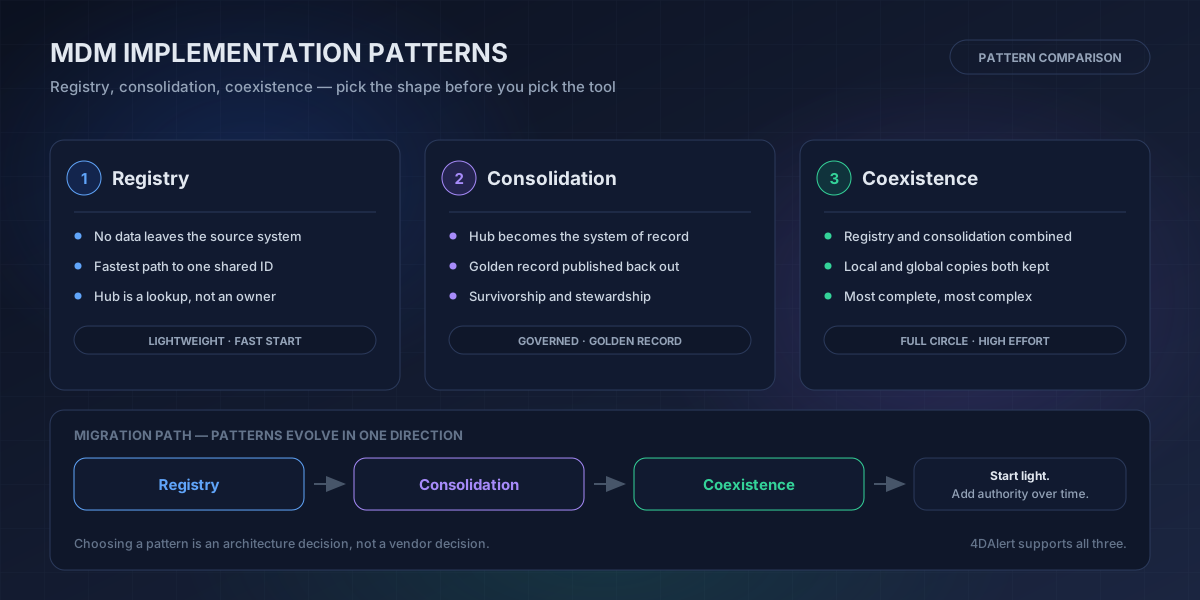
- Three canonical patterns exist — Registry (virtual pointers), Consolidation (physical golden records), and Coexistence (bi-directional sync) — each with distinct tradeoffs for governance, performance, and organizational fit
- Most enterprises should start with Consolidation — it provides physical golden records for analytics and AI without requiring source system changes
- Migration paths are well-defined — Registry to Consolidation to Coexistence is the natural progression as MDM maturity grows
- Pattern choice depends on four factors — data volume, latency requirements, source system autonomy, and stewardship maturity
- 4DAlert accelerates every pattern — automated reconciliation, quality monitoring, and exception management reduce MDM implementation timelines by 40-60%
Most MDM failures aren't caused by bad technology. They're caused by picking the wrong architecture pattern for the organization's maturity, data landscape, and governance readiness. A registry pattern forced onto an organization that needs real-time coexistence creates bottlenecks. A coexistence pattern imposed on a team that can barely agree on customer definitions creates chaos.
The three canonical MDM implementation patterns — Registry, Consolidation, and Coexistence — aren't just technical choices. They're organizational commitments that affect how data flows, who owns golden records, and how quickly your AI systems can trust the entities they consume. For a broader view of how MDM fits into the AI era, see our guide on MDM in the AI Era.
Why Your MDM Pattern Matters More Than Your Tool
Organizations often spend months evaluating MDM platforms — Informatica MDM, Reltio, Profisee, Semarchy — without first answering the foundational question: which architecture pattern fits our reality?
The pattern determines:
- Where golden records live — in the MDM hub, in source systems, or both
- How data flows — one-way ingestion, batch synchronization, or real-time bi-directional sync
- Who owns the golden record — a central data team, domain teams, or a hybrid model
- What governance looks like — centralized stewardship, distributed ownership, or federated control
- How quickly AI systems can consume clean data — batch availability vs real-time access
Get the pattern right, and even a modest tool delivers value. Get it wrong, and even the most expensive platform becomes shelfware.
Registry Pattern: The Lightweight Start
Simple Registry Pattern
A registry MDM maintains only pointers to source system records and a match index — no physical golden record is created. When a query comes in, the registry retrieves the best record from the source systems on the fly.
How It Works
The registry acts as a lookup service. It doesn't store master data — it stores references. When you need a customer's complete profile, the registry identifies which source systems hold that customer's records and assembles the view at query time. Think of it as a phone book that tells you where to find someone, rather than moving them into a new house.
The core components:
- Match index: A cross-reference table mapping entity IDs across source systems (CRM ID 12345 = ERP ID 67890 = Marketing ID ABC)
- Survivorship rules: Logic that determines which source system "wins" for each attribute when assembling the view (e.g., CRM has the best phone number, ERP has the best address)
- Query orchestration: Real-time calls to source systems to assemble the golden view on demand
When to Use Registry
- Quick wins with limited budget: Registry implementations can be operational in 4-8 weeks with minimal infrastructure
- Source systems that cannot be changed: When legacy systems are authoritative and cannot accept data writes back
- Simple reference data: Product categories, location hierarchies, currency codes — entities with low complexity and high stability
- Proof of concept: When you need to demonstrate MDM value before securing budget for a full consolidation hub
Limitations
- No physical golden record: Analytics and AI systems cannot consume a pre-built entity view — they must call the registry at query time
- Latency dependency: Query performance depends on source system availability and response times
- Limited governance: Without a physical golden record, stewardship is confined to managing the match index rather than the entity itself
- Scaling challenges: As source systems grow, real-time assembly becomes increasingly expensive
Consolidation Pattern: The Gold Standard
Moderate Consolidation Pattern
Physical golden records are created and stored in a central MDM hub. Source systems feed into the hub, where matching, merging, and survivorship occur. The golden records are then distributed to analytics platforms and AI models.
How It Works
This is the most widely adopted MDM pattern. Source systems periodically (or near-real-time) push entity data into the MDM hub. The hub applies matching algorithms, merges records into golden records, applies survivorship rules, and stores the result. Downstream consumers — data warehouses, AI pipelines, reporting tools — query the MDM hub directly for clean, deduplicated entities.
The consolidation process follows five steps:
- Ingest: Source systems feed records into the MDM hub via batch ETL, CDC, or APIs
- Standardize: Normalize formats, units, and conventions (e.g., "St." becomes "Street", phone numbers??? E.164)
- Match: Identify records across sources that refer to the same entity using deterministic rules, probabilistic models, or hybrid approaches
- Merge: Combine matched records into a single golden record, selecting the best attribute values based on survivorship rules
- Publish: Make golden records available to downstream consumers via APIs, data feeds, or direct database access
When to Use Consolidation
- Analytics and AI workloads: When your primary use case is feeding clean entities to data warehouses, ML pipelines, and BI tools
- Regulatory compliance: When auditors require a single, authoritative source of truth for customer, product, or supplier data
- Single source of truth mandate: When the organization has decided that one system will own master data definitions
- Mature data governance: When you have data stewards, quality rules, and escalation processes in place
Limitations
- One-way flow: Golden records stay in the hub — source systems continue operating with their own versions
- Batch dependency: If synchronization is batch-based, source systems may operate on stale data between sync cycles
- Source system disconnect: Operational teams using source systems may not trust or use the golden records
Coexistence Pattern: The Full-Circle Approach
Complex Coexistence Pattern
Golden records are created in the MDM hub and then propagated back to source systems, enriching them with cleansed and deduplicated data. Source systems and the MDM hub coexist with bi-directional synchronization.
How It Works
Coexistence is the most mature MDM pattern. It follows the same consolidation process — ingest, standardize, match, merge — but adds a critical fifth step: distribute. After golden records are created, they flow back to source systems, enriching operational data with cleansed, deduplicated, and enriched attributes.
This creates a virtuous cycle: source systems send dirty data to the hub, the hub creates clean golden records, and the clean data flows back to source systems, improving the quality of data at the source. Over time, the overall data quality of the ecosystem improves continuously.
Coexistence requires:
- Bi-directional synchronization: Real-time or near-real-time data flow in both directions between hub and source systems
- Write-back capabilities: Source systems must accept data writes from the MDM hub (not all can)
- Conflict resolution: When a source system and the hub disagree on a value, clear rules determine which wins
- Stewardship workflows: Human review of merge decisions, exception handling, and quality feedback loops
When to Use Coexistence
- Operational MDM: When operational systems need clean master data directly — not just analytics and AI
- Real-time access: When AI models, personalization engines, or fraud detection need golden records with sub-second latency
- Source system improvement: When the goal is to improve data quality at the source, not just in the analytics layer
- Multi-domain MDM: When multiple entity domains (customer, product, supplier, location) need cross-domain golden records
Limitations
- Highest complexity: Bi-directional sync, conflict resolution, and write-back create significant engineering overhead
- Source system changes: Not all source systems can accept data writes — legacy systems, SaaS platforms, and third-party APIs often cannot
- Organizational maturity: Requires strong governance, clear ownership, and cross-team collaboration
- Longest implementation: Typically 6-12 months for the initial domain, with ongoing optimization
Pattern Comparison at a Glance
| Factor | Registry | Consolidation | Coexistence |
|---|---|---|---|
| Golden record storage | None (pointers only) | Central MDM hub | Hub + source systems |
| Data flow direction | Virtual assembly | Source → Hub | Source ↔ Hub (bi-directional) |
| Implementation time | 4-8 weeks | 3-6 months | 6-12 months |
| Source system changes required | None | Read-only feeds | Read + write-back |
| Analytics/AI readiness | Low (real-time assembly) | High (pre-built golden records) | Highest (real-time + batch) |
| Governance maturity needed | Low | Moderate | High |
| Operational system impact | None | Minimal (batch feeds) | Significant (write-back) |
| Best for | Quick wins, simple reference data | Analytics, AI, compliance | Operational MDM, real-time AI |
How to Choose the Right Pattern
The right pattern depends on four factors. Score your organization on each dimension to find your natural fit.
The three canonical MDM patterns trade implementation speed against golden-record readiness — pick on operating model and governance maturity, not on vendor preference.
1. Data Volume and Complexity
Registry works for low-to-medium volume with simple entities (reference data, lookups). Consolidation handles medium-to-high volume with moderate complexity (customer, product). Coexistence is designed for high volume with complex, multi-domain entities requiring real-time access.
2. Latency Requirements
If your primary consumers are batch analytics (data warehouse, ML training), consolidation provides sufficient freshness with daily or hourly syncs. If real-time systems (personalization, fraud detection, customer-facing apps) need golden records, coexistence is the only pattern that delivers sub-second access.
3. Source System Autonomy
Can your source systems accept data writes? If they're modern APIs with write-back support, coexistence is viable. If they're legacy mainframes or SaaS platforms you don't control, consolidation (one-way ingestion) is more practical. If source systems cannot be modified at all, registry is the safest starting point.
4. Stewardship Maturity
Registry requires minimal governance — you're managing a match index, not golden records. Consolidation needs data stewards who can review merge decisions, define survivorship rules, and handle exceptions. Coexistence requires mature governance with clear ownership, cross-team collaboration, and feedback loops.
Which Pattern Fits Your Organization?
🚀 Start with Registry if...
You need a quick win to demonstrate MDM value, have limited budget, or source systems cannot be modified. Great for proof of concept and simple reference data domains.
⚡ Choose Consolidation if...
Your primary need is clean golden records for analytics and AI. You have moderate governance maturity and source systems can provide batch or CDC feeds. This is where most enterprises land.
🔧 Plan for Coexistence if...
Operational systems need clean master data in real-time. You have mature governance, source systems support write-back, and the goal is continuous quality improvement at the source.
Migration Paths Between Patterns
The natural progression is Registry → Consolidation → Coexistence. Each migration builds on the previous pattern's foundation.
Registry to Consolidation
Add physical storage for golden records. The match index you built for the registry becomes the foundation for consolidation's matching engine. You're essentially adding a persistent layer on top of the virtual assembly. Key steps:
- Add a golden record store (MDM hub database) alongside the existing match index
- Migrate from real-time assembly to batch or CDC-based ingestion
- Implement survivorship rules that determine which source wins for each attribute
- Point downstream consumers to the hub instead of the registry
Consolidation to Coexistence
Add write-back capabilities. The golden records you're already creating flow back to source systems. Key steps:
- Enable bi-directional sync for source systems that support write-back
- Implement conflict resolution rules for when source and hub disagree
- Configure data stewardship workflows for reviewing and approving golden record changes
- Add real-time sync for source systems that need immediate access to golden records
The critical principle: never skip a step. Trying to jump from no MDM directly to coexistence almost always fails because the organization hasn't built the matching logic, survivorship rules, or governance processes that coexistence requires.
How 4DAlert Accelerates MDM Implementation
Regardless of which pattern you choose, 4DAlert provides the data quality and reconciliation infrastructure that makes MDM implementations succeed. Building MDM on top of unreliable data is like building a house on sand — 4DAlert ensures your foundation is solid. For a feature-level comparison with legacy MDM suites, see 4DAlert vs Legacy MDM Platforms.
Data profiling before you start
Before choosing a pattern, you need to understand your data landscape. 4DAlert's automated profiling scans your source systems and reveals:
- Duplicate rates: How many duplicate customer, product, or supplier records exist across systems — the business case for MDM in a single report
- Data quality scores: Completeness, consistency, and accuracy metrics for each entity domain across each source system
- Cross-system inconsistencies: Records that refer to the same entity but have conflicting attribute values (different addresses, different phone numbers, different segment classifications)
- Schema drift: How source system schemas have changed over time, which affects what data you can reliably ingest into the MDM hub
Reconciliation to verify golden record accuracy
Once your MDM hub is creating golden records, you need to verify they're correct. 4DAlert's cross-system reconciliation compares golden records against source systems to detect:
- Survivorship errors: Cases where the wrong source system "won" for a particular attribute (e.g., an outdated address from the ERP overriding a current address from the CRM)
- Match failures: Records that should have been merged but weren't (false negatives) and records that were incorrectly merged (false positives)
- Freshness gaps: Golden records that haven't been updated because the source feed is delayed or broken
Continuous quality monitoring
MDM isn't a one-time project — it's an ongoing discipline. 4DAlert monitors the health of your master data continuously:
- Duplicate detection: New duplicates entering the system after initial matching — critical for catching source system issues before they contaminate golden records
- Entity drift: Changes in entity attributes over time that may indicate data quality degradation or source system issues
- Quality score tracking: Trend analysis showing whether master data quality is improving, stable, or declining
- Alert routing: Quality issues are routed to the right data stewards via Slack, email, or PagerDuty based on severity and domain ownership
4DAlert in practice
An enterprise customer used 4DAlert to profile their customer data across CRM, ERP, and marketing systems before starting their MDM implementation. The profiling revealed a 34% duplicate rate across systems — a finding that secured executive sponsorship and budget for a full consolidation MDM hub. After implementation, 4DAlert's reconciliation monitors golden record accuracy daily, catching survivorship errors that would have taken weeks to discover through manual audits.
Exception management for data stewards
MDM generates exceptions — records that can't be automatically matched, merge decisions that need human review, conflicts between source systems. 4DAlert provides structured workflows for managing these exceptions:
- Assignment routing: Exceptions are automatically assigned to the right steward based on entity domain, geography, or data source
- SLA tracking: Monitor resolution times and escalate overdue exceptions
- Audit trail: Every decision is logged with rationale, creating compliance-ready documentation
- Feedback loops: Steward decisions feed back into matching algorithms, improving accuracy over time
For teams also managing data quality across pipelines, 4DAlert's data quality framework pairs naturally with MDM governance.
Common Pitfalls to Avoid
1. Choosing the most complex pattern first
The mistake: Jumping straight to coexistence because it's the "most complete" pattern. Without the matching logic, survivorship rules, and governance processes built through consolidation, coexistence becomes a bi-directional pipeline for dirty data.
The fix: Start with consolidation for your highest-impact entity domain. Prove the value, build the governance muscle, then expand to coexistence for domains that need real-time access.
2. Underestimating the matching challenge
The mistake: Assuming deterministic rules (exact email match, exact phone match) will handle entity resolution. Real-world data is messy — "John Smith" at "123 Main St" and "J. Smith" at "123 Main Street" are the same person, but deterministic rules won't catch it.
The fix: Invest in probabilistic matching from day one. Modern MDM platforms with ML-based entity resolution handle the fuzzy matching that deterministic rules miss. For deeper insight, see our guide on AI-powered entity resolution.
3. Ignoring source system quality
The mistake: Building an MDM hub on top of source systems with 40%+ duplicate rates, inconsistent formats, and missing attributes. The hub amplifies whatever quality exists in the source.
The fix: Profile source systems before starting MDM implementation. Use 4DAlert to identify quality issues, fix the worst offenders at the source, and establish data contracts that prevent quality degradation.
4. No stewardship model
The mistake: Building the technical infrastructure without defining who owns golden records, who resolves exceptions, and who approves merge decisions. MDM without stewardship is just a more expensive data quality problem.
The fix: Establish data stewards for each entity domain before the first golden record is created. Define escalation paths, SLA expectations, and feedback mechanisms.
5. Treating MDM as a one-time project
The mistake: Launching MDM, declaring victory, and moving on. Master data is a living system — new sources appear, business definitions change, and data quality evolves. Without continuous monitoring, golden records degrade within months.
The fix: Implement continuous monitoring from day one. 4DAlert's automated quality checks catch drift and degradation before they impact downstream consumers.
Getting Started
Here's a practical path to choosing and implementing the right MDM pattern:
- Profile your data first: Use 4DAlert to scan your source systems for duplicates, inconsistencies, and quality gaps. The profiling report is your business case for MDM.
- Score your organization: Rate yourself on the four dimensions — data volume, latency needs, source system autonomy, and stewardship maturity. The pattern that fits your scores is your starting point.
- Start with one domain: Pick the entity with the highest business impact — usually Customer. Get it right for one domain before expanding to Product, Supplier, and Location.
- Implement quality guardrails: Deploy 4DAlert for continuous monitoring alongside your MDM hub. Catch quality issues early, before they contaminate golden records.
- Plan your migration path: Design with coexistence in mind, but implement consolidation first. Build the matching logic, survivorship rules, and governance processes that will support the eventual evolution to coexistence.
For a complete guide to MDM fundamentals, see our What Is Master Data Management? article. To explore how MDM fits into broader data architecture, see our data modeling crisis analysis. For entity resolution and survivorship in depth, see AI entity resolution, or browse the Master Data Management knowledge hub.
Frequently Asked Questions
What are the three MDM implementation patterns?
The three canonical patterns are: Registry (maintains pointers to source records with no physical golden record, suitable for simple reference data and quick wins), Consolidation (creates and stores physical golden records in a central hub fed by source systems, ideal for analytics and AI), and Coexistence (bi-directional sync where golden records flow back to source systems for real-time stewardship and operational MDM).
Which MDM pattern should I start with?
Most enterprises start with the Consolidation pattern. It provides physical golden records for analytics and AI without requiring source system changes. If you need a quick proof of concept or have very limited budget, Registry is a viable starting point. Plan for Coexistence as your long-term target if operational systems need real-time access to clean master data.
Can you migrate from one MDM pattern to another?
Yes. The typical progression is Registry to Consolidation to Coexistence. Migration from Registry to Consolidation involves adding physical storage for golden records and transitioning from virtual assembly to batch/CDC ingestion. Migration from Consolidation to Coexistence involves enabling bi-directional sync and write-back capabilities for source systems that support it.
How does 4DAlert support MDM implementations?
4DAlert provides automated data profiling to assess source system quality before MDM implementation, cross-system reconciliation to verify golden record accuracy against source systems, continuous quality monitoring to detect duplicate drift and entity degradation, and structured exception management workflows for data stewards. Teams using 4DAlert report 40-60% faster MDM implementation timelines.
How long does it take to implement an MDM pattern?
A focused Registry implementation can be operational in 4-8 weeks. Consolidation typically takes 3-6 months for a single entity domain (e.g., Customer). Coexistence requires 6-12 months depending on the number of source systems and the complexity of bi-directional synchronization. Each pattern builds on the previous one, so starting with consolidation positions you for faster coexistence adoption later.
At Performalytic, we help enterprises design and implement MDM systems that match their organizational reality — not the other way around. Our team combines deep expertise in data architecture, entity resolution, and quality monitoring to build master data foundations that your AI systems can trust. Schedule a consultation to assess your readiness and design an MDM strategy that fits your enterprise.