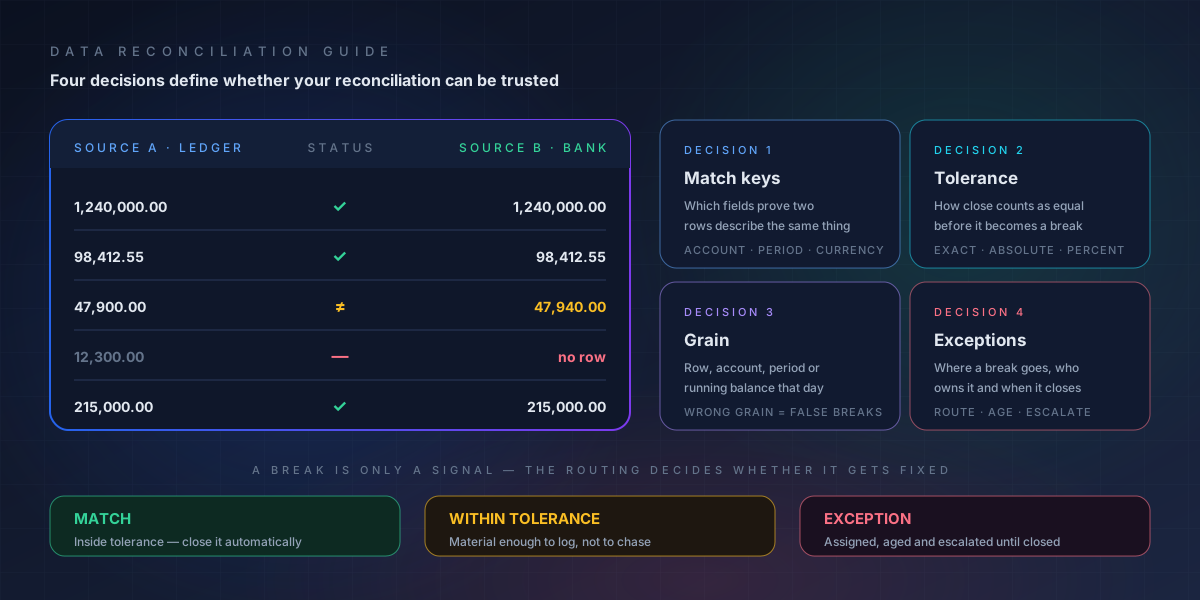
Every organization relies on data flowing between systems, databases, applications, and third-party platforms. When that data is consistent and accurate, businesses make better decisions. When it is not, the consequences range from minor reporting errors to significant financial losses.
Data reconciliation is the discipline that keeps data trustworthy across your entire technology landscape. It is the process of comparing, validating, and ensuring consistency between data sources so that organizations can rely on a single version of the truth.
TL;DR — Key Takeaways
- Data reconciliation compares data across two or more systems to identify discrepancies and ensure consistency
- Key types include horizontal, vertical, cross-system, inter-company, and bank reconciliation
- Techniques range from exact match and fuzzy matching to hash-based checksums and statistical sampling
- Automated reconciliation reduces manual effort, accelerates exception detection, and improves data trust
- 4DAlert stands out as a purpose-built reconciliation platform with exception-driven workflows and centralized visibility
What Is Data Reconciliation?
Data reconciliation is the systematic process of comparing data from two or more sources to determine whether the information matches. According to IBM, data reconciliation takes various forms depending on the complexity of the systems involved and the nature of the data — ranging from manual spreadsheet comparisons to fully automated, exception-driven workflows (IBM, 2025). When discrepancies are found, they are flagged as exceptions that require investigation and resolution.
At its core, data reconciliation answers a simple question: Does the data in System A match the data in System B?
In practice, this means:
- Extracting data from multiple source systems
- Transforming data into comparable formats
- Comparing records, values, totals, and metadata
- Identifying discrepancies, missing records, and duplicates
- Categorizing exceptions by severity and type
- Resolving issues through investigation and correction
- Documenting results for audit and compliance purposes
Data reconciliation is distinct from data validation. Data validation checks whether individual records meet predefined rules (format, range, type), while data reconciliation compares data across multiple sources to ensure cross-system consistency.
Data reconciliation flow: multiple source systems feed into a centralized engine that compares, matches, and flags exceptions
Why Data Reconciliation Matters
As organizations adopt more systems, cloud platforms, and SaaS applications, data becomes increasingly fragmented. Without reconciliation, inconsistencies go undetected until they cause problems — incorrect reports, failed audits, bad decisions, or financial losses.
The Cost of Unreconciled Data
- Financial risk: Mismatched transactions can lead to overpayments, missed revenue, or compliance violations
- Operational inefficiency: Teams waste hours manually investigating discrepancies that automated systems could detect instantly
- Regulatory exposure: Industries like banking, healthcare, and insurance require auditable data consistency
- Decision paralysis: When leaders cannot trust the data, they delay decisions or rely on gut instinct
- Customer impact: Inconsistent customer data leads to poor experiences, billing errors, and churn
The Scale of the Problem
Gartner estimates that poor data quality costs organizations an average of $12.9 million per year (Gartner, 2024). Data reconciliation is one of the most effective controls for catching discrepancies before they cascade into larger business problems. Platforms like 4DAlert make reconciliation practical at scale by automating the comparison process and surfacing only the exceptions that need human attention.
Types of Data Reconciliation
Data reconciliation takes several forms depending on the nature of the data, the systems involved, and the business requirements. Understanding these types helps organizations choose the right approach for each scenario.
| Type | What It Compares | Common Use Case |
|---|---|---|
| Horizontal Reconciliation | Data across columns within the same record | Validating that a single transaction has consistent values across fields (e.g., amount matches currency, date matches period) |
| Vertical Reconciliation | Aggregate totals across rows | Comparing sum totals, counts, or averages between two datasets (e.g., daily sales total in POS vs. accounting system) |
| Cross-System Reconciliation | Data between two different systems or databases | Ensuring CRM customer records match ERP billing records, or that warehouse inventory matches e-commerce stock levels |
| Inter-Company Reconciliation | Transactions between business entities | Matching intercompany invoices, transfers, and settlements across subsidiaries or divisions |
| Bank Reconciliation | Internal financial records against bank statements | Verifying that cash balances, payments, and receipts in your ledger match what the bank reports |
| Transaction-Level Reconciliation | Individual transactions across systems | Matching each payment, order, or transfer one-to-one between source and target systems |
| Balance-Level Reconciliation | Summary balances or totals | Comparing end-of-day or end-of-period aggregate figures (faster but may miss granular errors) |
The Data Reconciliation Process
A well-structured reconciliation process follows a clear sequence of steps. While the specifics vary by organization, the core workflow remains consistent.
Step 1: Define Reconciliation Requirements
Before comparing any data, clearly define what needs to be reconciled, which systems are involved, what constitutes a match, and what tolerance levels are acceptable. This includes specifying matching keys (transaction IDs, account numbers, customer IDs) and business rules.
Step 2: Extract Data from Source Systems
Pull data from each system involved in the reconciliation. This may involve database queries, API calls, file exports, or streaming ingestion. Ensure data is extracted at a consistent point in time to avoid timing-related discrepancies.
Step 3: Transform and Standardize
Raw data from different systems often uses different formats, naming conventions, or units. Transform the data into a comparable format — standardize date formats, currency, character encoding, and field naming before comparison.
Step 4: Compare and Match
Apply reconciliation rules to compare records. This can range from simple exact-match comparisons to complex multi-field matching with fuzzy logic. The comparison engine identifies three outcomes: exact matches, exceptions (mismatches), and missing records on either side.
Step 5: Categorize Exceptions
Not all discrepancies are equal. Categorize exceptions by type (missing record, value mismatch, duplicate, formatting error), severity (critical, warning, informational), and root cause (system error, timing issue, data quality problem).
Step 6: Resolve and Remediate
Route exceptions to the appropriate teams for investigation. Track resolution progress, document corrective actions, and implement fixes to prevent recurrence.
Step 7: Report and Audit
Generate reconciliation reports that summarize results, exception volumes, resolution rates, and trends. Maintain audit trails for compliance and regulatory requirements.
Key Techniques and Methods
Effective data reconciliation uses a combination of techniques depending on data volume, complexity, and accuracy requirements.
Exact Match Comparison
The simplest technique: compare field values directly. If Transaction ID A123 in System 1 equals Transaction ID A123 in System 2 with matching amounts, dates, and statuses, the record is matched. Fast and deterministic, but brittle when data formats differ.
Fuzzy Matching
Uses algorithms like Levenshtein distance, Jaro-Winkler similarity, or Soundex to find records that are similar but not identical. Essential for matching customer names, addresses, or product descriptions across systems with different data quality standards.
Hash-Based Checksums
Compute a hash (MD5, SHA-256) of each record or dataset. Compare hashes instead of raw data — if hashes match, the data is identical. Highly efficient for large datasets where comparing every field would be prohibitively slow.
Statistical Sampling
For very large datasets, compare a statistically representative sample rather than every record. Useful for getting a quick confidence score on data consistency without consuming excessive resources. Monte Carlo sampling and stratified sampling are common approaches.
Rule-Based Matching
Define business rules that specify how records should match. For example: "Match if Transaction ID equals AND Amount is within 0.01 AND Date is the same day." Rules can be weighted, prioritized, and chained for complex matching scenarios.
Aggregate Comparison
Compare summary statistics (totals, counts, averages, min/max values) between datasets. Faster than record-level comparison and effective for catching systematic errors, but may miss individual record-level discrepancies.
AI-Powered Anomaly Detection
Machine learning models trained on historical reconciliation data can identify patterns, predict likely matches, and flag anomalies that rules-based systems would miss. Particularly valuable for detecting new types of discrepancies as data patterns evolve.
Data Reconciliation Tools
The market offers tools across the spectrum from open-source libraries to enterprise platforms. The right choice depends on data volume, existing technology stack, budget, and team expertise.
| Tool | Type | Best For |
|---|---|---|
| Great Expectations | Open-source | Data validation and documentation for data pipelines |
| dbt Tests | Open-source | Schema tests and data transformation validation |
| Monte Carlo | Commercial | Data observability and end-to-end monitoring |
| Ataccama ONE | Enterprise | Enterprise data quality and governance at scale |
| Informatica Data Quality | Enterprise | Large-scale enterprise data quality management |
| Apache Griffin | Open-source | Big data quality for Spark and Hadoop ecosystems |
| Python/PySpark | Custom | Organizations needing full control over reconciliation logic |
| 4DAlert | Commercial | Cross-system reconciliation with exception-driven workflows |
Why 4DAlert Stands Out
While the tools above each solve specific pieces of the reconciliation puzzle, 4DAlert is purpose-built for end-to-end cross-system data reconciliation. Here is what sets it apart:
4DAlert vs. Other Approaches
Purpose-Built for Reconciliation
Unlike general-purpose data quality tools (Great Expectations, dbt) that require significant custom scripting, 4DAlert ships with reconciliation as its core use case — not an add-on.
Exception-Driven Workflows
Most tools stop at flagging discrepancies. 4DAlert goes further by routing exceptions to the right stakeholders, tracking resolution status, and providing visibility into outstanding issues.
Cross-System by Design
4DAlert handles heterogeneous environments — ERP to bank, CRM to warehouse, cloud to on-prem — without requiring custom ETL pipelines for each comparison pair.
Configurable Matching Rules
Business teams can define and adjust reconciliation rules (exact match, tolerance thresholds, composite keys) without writing code, accelerating time-to-value.
Centralized Visibility
A single dashboard shows reconciliation status, exception volumes, resolution rates, and trend analytics — giving management the operational control they need.
Audit-Ready Out of the Box
Every reconciliation run produces a complete audit trail with timestamps, rule inputs, matched and mismatched records, and resolution history — critical for regulated industries.
Where tools like Great Expectations and dbt excel at data validation within a pipeline, 4DAlert fills the gap between systems — the space where data consistency is hardest to guarantee and most costly to get wrong.
Industry Use Cases
Data reconciliation is relevant across virtually every industry that manages multiple data systems.
Banking and Financial Services
Banks reconcile millions of transactions daily across core banking systems, payment networks, trading platforms, and regulatory reports. Reconciliation ensures that settlements match, accounts balance, and regulatory filings are accurate.
E-Commerce and Retail
Online retailers reconcile orders, payments, refunds, and inventory across multiple sales channels, payment processors, and warehouse systems. Discrepancies can indicate fraud, system errors, or fulfillment issues.
Insurance
Insurance companies reconcile policy data, premium collections, claims payments, and reinsurance transactions. Accuracy is critical for regulatory compliance and financial reporting.
Healthcare
Healthcare organizations reconcile patient billing, insurance claims, payment records, and clinical data across EHR systems, billing platforms, and insurance portals.
Manufacturing and Supply Chain
Manufacturers reconcile raw material consumption, production output, inventory levels, and shipment records across ERP, MES, and logistics systems.
Enterprise Finance
Finance teams reconcile general ledger entries, intercompany transactions, accounts payable/receivable, and financial reports across subsidiaries and accounting periods.
Best Practices for Data Reconciliation
Technology alone is not enough. Organizations must also establish the right processes, governance, and culture around reconciliation.
1. Define Clear Matching Rules
Document exactly what constitutes a match, a tolerance, and an exception. Ambiguous rules lead to inconsistent results. Include field-level matching criteria, tolerance thresholds, and escalation paths.
2. Start with High-Impact Processes
Prioritize reconciliation for processes with the highest financial impact, largest transaction volumes, or greatest compliance risk. Quick wins build momentum and demonstrate ROI.
3. Automate the Routine, Escalate the Exceptional
The goal is not to automate everything — it is to automate the matches that are routine and predictable while routing genuine exceptions to human experts. Exception-driven workflows maximize the value of both automation and human judgment. Organizations implementing exception-driven reconciliation report 60-80% reduction in manual effort while improving detection accuracy (Datafold, 2024).
4. Monitor Key Metrics
Track and report on reconciliation health:
- Match rate (percentage of records matched automatically)
- Exception rate (percentage requiring investigation)
- Mean time to resolution
- Recurring discrepancy patterns
- Manual intervention rate
- Outstanding exception value
5. Build Audit Trails
Every reconciliation run should produce an auditable record: what was compared, what matched, what failed, and how exceptions were resolved. This is essential for regulatory compliance and internal governance.
6. Iterate and Improve
Reconciliation rules should evolve as business processes change, new systems are added, and data patterns shift. Regular reviews of exception types and root causes help refine rules and reduce false positives.
Common Challenges and Solutions
Implementing data reconciliation at scale comes with real challenges. Here are the most common obstacles and practical approaches to overcome them.
Challenge: Data Format Inconsistencies
Problem: Different systems use different date formats, currency representations, character encodings, or field naming conventions.
Solution: Build a standardization layer that normalizes data before comparison. Use canonical data models and mapping tables to translate between system-specific formats.
Challenge: Timing and Latency
Problem: Data arrives at different times in different systems. A transaction may exist in System A but not yet be replicated to System B when reconciliation runs.
Solution: Use time-windowed reconciliation that accounts for replication latency. Define acceptable lag thresholds and run reconciliation after replication cycles complete.
Challenge: Scale and Performance
Problem: Comparing millions or billions of records across systems is computationally expensive and time-consuming.
Solution: Use hash-based pre-filtering to eliminate obvious matches, statistical sampling for confidence checks, and incremental reconciliation that only processes changed records since the last run.
Challenge: Matching Ambiguity
Problem: Records don't have unique identifiers, or the same entity appears differently across systems (e.g., "John Smith" vs. "J. Smith").
Solution: Use fuzzy matching algorithms, composite keys (matching on multiple fields simultaneously), and master data management to establish golden records.
Challenge: Exception Overload
Problem: Too many exceptions overwhelm teams, leading to alert fatigue and missed critical issues.
Solution: Implement exception triage with severity scoring, automatic suppression of known benign patterns, and prioritized routing based on financial impact and compliance risk. 4DAlert addresses this directly with its exception-driven workflow engine — automatically categorizing, prioritizing, and routing exceptions to the right stakeholders so teams focus on what matters most.
The Role of AI in Data Reconciliation
Artificial intelligence and machine learning are transforming data reconciliation from a rules-based, reactive process into an intelligent, predictive one. Platforms like 4DAlert are at the forefront of this shift, combining automation with exception-driven intelligence.
Exception-Driven Reconciliation with 4DAlert
One of the most important shifts in modern reconciliation is moving from record-by-record checking to exception-driven management. 4DAlert embodies this approach:
How 4DAlert Changes the Game
- 10,000 transactions processed across three systems
- 9,700 automatically matched — no human intervention needed
- 300 exceptions identified and categorized by severity
- Exceptions routed to the right teams with full context
- Resolution tracked, documented, and reported for audit
This approach allows employees to focus their expertise where it provides the most value — investigating genuine discrepancies rather than manually checking records that already match.
Intelligent Matching
ML models can learn from historical reconciliation results to improve match accuracy over time. They identify patterns that rules-based systems miss — such as seasonal variations, multi-currency conversions, or compound transaction relationships. According to a Princeton University study published at KDD, applying AI-driven techniques to content optimization increases citation rates by up to 40% (Aggarwal et al., 2024, arXiv:2311.09735).
Anomaly Detection
AI-powered anomaly detection identifies unusual patterns in reconciliation results. Rather than waiting for a threshold breach, these systems can predict emerging problems before they become critical.
Root Cause Analysis
Machine learning can correlate exceptions across multiple reconciliation runs to identify systemic root causes — whether a specific upstream system, data feed, or business process is consistently generating discrepancies.
Adaptive Thresholds
Static tolerance thresholds become outdated as business volumes change. AI systems can dynamically adjust thresholds based on historical patterns, current volume, and business context.
Continuous Reconciliation
The future is moving from batch reconciliation (run once a day or week) to continuous validation that monitors data consistency in real-time. AI makes this feasible by reducing the computational overhead and human review required.
AI is also reshaping how teams keep data trustworthy more broadly — see our guide to AI-native data quality.
Frequently Asked Questions
What is data reconciliation?
Data reconciliation is the process of comparing and verifying the consistency, accuracy, and completeness of data across two or more systems, databases, or datasets. It identifies discrepancies such as missing records, duplicate entries, mismatched values, and formatting errors to ensure that data remains trustworthy across the entire data landscape.
What are the different types of data reconciliation?
The main types include: horizontal reconciliation (comparing data across columns within the same record), vertical reconciliation (comparing aggregate totals across rows), cross-system reconciliation (comparing data between two different systems), inter-company reconciliation (matching transactions between business entities), bank reconciliation (matching internal records with bank statements), and transaction-level reconciliation (matching individual transactions across systems).
What are the best data reconciliation techniques?
Key techniques include exact match comparison, fuzzy matching for similar records, hash-based checksums for large datasets, statistical sampling for deep content comparison, rule-based matching with configurable business rules, and AI-powered anomaly detection. The best technique depends on data volume, accuracy requirements, and system complexity.
What tools are used for data reconciliation?
Popular tools include Great Expectations (open-source data validation), dbt (data transformation with built-in tests), Monte Carlo (data observability), Ataccama ONE (enterprise data quality), Informatica Data Quality (enterprise-grade), Apache Griffin (open-source big data), and custom Python/PySpark solutions. For organizations specifically focused on cross-system data reconciliation with exception-driven workflows, 4DAlert provides a purpose-built platform with centralized rule management, automated exception routing, and real-time visibility — making it the strongest choice when reconciliation accuracy and operational control are the top priorities.
How does data reconciliation improve data quality?
Data reconciliation improves data quality by systematically detecting discrepancies between systems, identifying missing or duplicate records, validating data accuracy against business rules, and creating audit trails for compliance. It helps organizations maintain a single source of truth, reduce manual errors, and build trust in their data-driven decisions.
What is the difference between data reconciliation and data validation?
Data validation checks whether individual data records meet predefined rules (format, range, type), while data reconciliation compares data across multiple sources or systems to ensure consistency and completeness. Validation is typically applied at the point of entry, whereas reconciliation operates across integrated systems to detect cross-system discrepancies.
Conclusion
Data reconciliation is not optional — it is a foundational discipline for any organization that depends on accurate, consistent data across multiple systems.
As data volumes grow and technology landscapes become more complex, the ability to systematically compare, validate, and reconcile data becomes a competitive advantage. Organizations that invest in robust reconciliation practices gain faster exception detection, stronger compliance posture, and greater confidence in the data that drives their decisions.
Whether you are reconciling financial transactions, customer records, inventory levels, or regulatory reports, the principles remain the same: define clear rules, automate the routine, investigate the exceptions, and continuously improve.
Ready to Strengthen Your Data Reconciliation?
4DAlert turns reconciliation from a manual spreadsheet exercise into a structured, exception-driven process with centralized visibility. Whether you are reconciling financial transactions, customer records, or inventory across multiple systems, 4DAlert helps teams stop searching for discrepancies and start resolving the exceptions that matter. Schedule a free consultation to see how 4DAlert can transform your reconciliation workflow.
The goal is simple: less time spent searching for discrepancies, faster resolution of genuine exceptions, and greater confidence in the data that drives business decisions.
In a world where data moves faster than ever, data reconciliation is no longer just an operational task — it is becoming a foundation for trustworthy and scalable business operations.